Turck Dominique, Bresson Jean-Louis, Burlingame Barbara, Dean Tara, Fairweather-Tait Susan, Heinonen Marina, Hirsch-Ernst Karen Ildico, Mangelsdorf Inge, McArdle Harry J, Naska Androniki, Nowicka Grażyna, Pentieva Kristina, Sanz Yolanda, Siani Alfonso, Sjödin Anders, Stern Martin, Tomé Daniel, Loveren Henk Van, Vinceti Marco, Willatts Peter, Fewtrell Mary, Lamberg-Allardt Christel, Przyrembel Hildegard, Arcella Davide, Dumas Céline, Fabiani Lucia, Martino Laura, Tomcikova Daniela, Neuhäuser-Berthold Monika
EFSA J. 2018 Aug 7;16(8):e05365. doi: 10.2903/j.efsa.2018.5365. eCollection 2018 Aug.
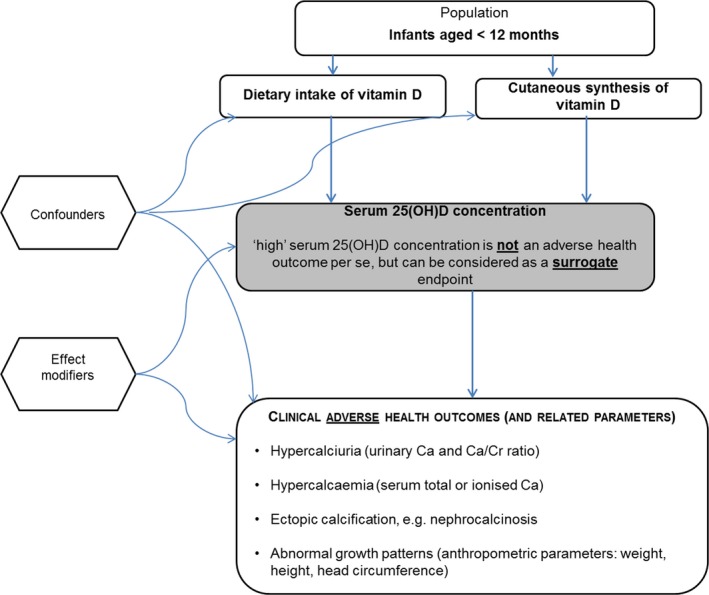
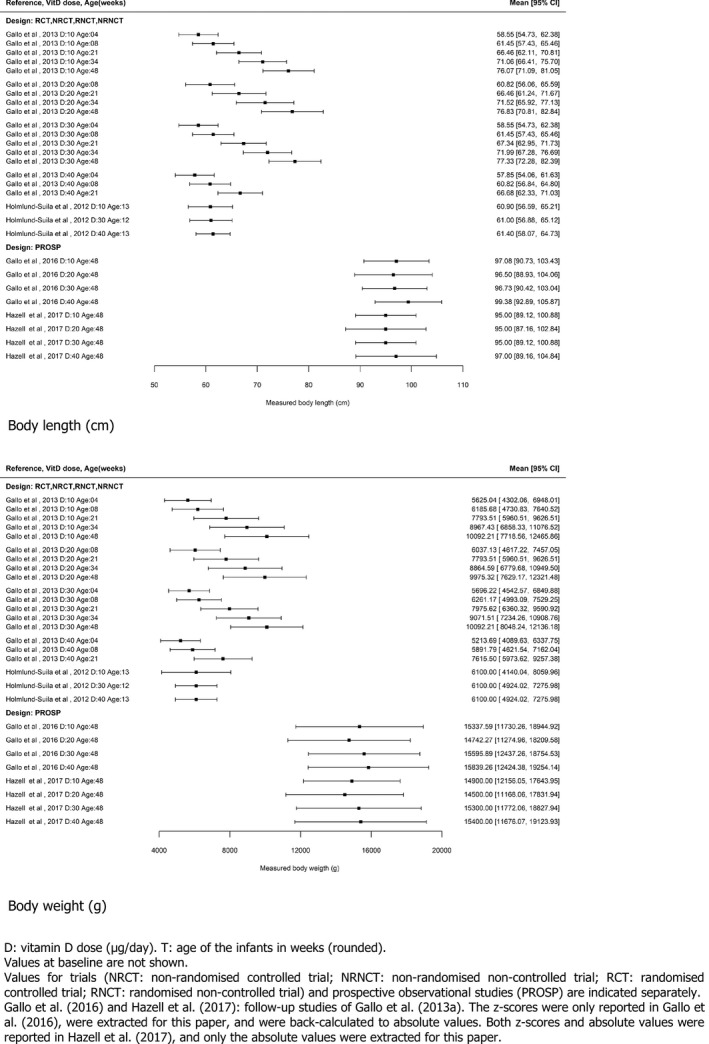
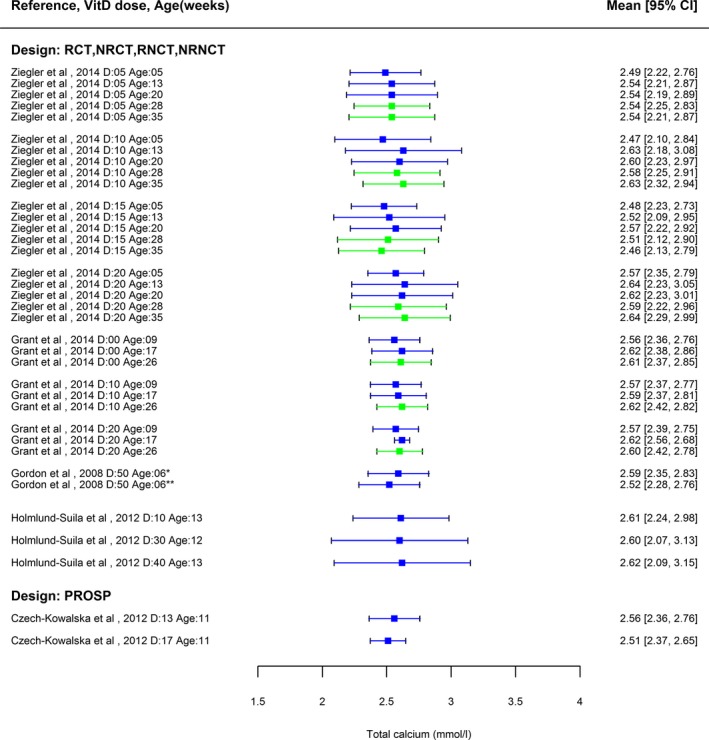
Following a request from the European Commission, the Panel on Dietetic Products, Nutrition and Allergies (NDA) was asked to revise the tolerable upper intake level (UL) for vitamin D for infants (≤ 1 year) set in 2012. From its literature review, the Panel concluded that the available evidence on daily vitamin D intake and the risk of adverse health outcomes (hypercalciuria, hypercalcaemia, nephrocalcinosis and abnormal growth patterns) cannot be used alone for deriving the UL for infants. The Panel conducted a meta-regression analysis of collected data, to derive a dose-response relationship between daily supplemental intake of vitamin D and mean achieved serum 25(OH)D concentrations. Considering that a serum 25(OH)D concentration of 200 nmol/L or below is unlikely to pose a risk of adverse health outcomes in infants, the Panel estimated the percentage of infants reaching a concentration above this value at different intakes of vitamin D. Based on the overall evidence, the Panel kept the UL of 25 μg/day for infants aged up to 6 months and set a UL of 35 μg/day for infants 6-12 months. The Panel was also asked to advise on the safety of the consumption of infant formulae with an increased maximum vitamin D content of 3 μg/100 kcal (Commission Delegated Regulation (EU) 2016/127 repealing Directive 2006/141/EC in 2020). For infants aged up to 4 months, the intake assessment showed that the use of infant formulae containing vitamin D at 3 μg/100 kcal may lead some infants to receive an intake above the UL of 25 μg/day from formulae alone without considering vitamin D supplemental intake. For infants aged 4-12 months, the 95th percentile of vitamin D intake (high consumers) estimated from formulae and foods fortified or not with vitamin D does not exceed the ULs, without considering vitamin D supplemental intake.
应欧盟委员会的要求,营养产品、营养与过敏症专家小组(NDA)被要求修订2012年设定的婴儿(≤1岁)维生素D可耐受最高摄入量(UL)。通过文献综述,专家小组得出结论,关于每日维生素D摄入量与不良健康后果(高钙尿症、高钙血症、肾钙质沉着症和异常生长模式)风险的现有证据不能单独用于推导婴儿的UL。专家小组对收集的数据进行了元回归分析,以得出每日补充维生素D摄入量与平均血清25(OH)D浓度之间的剂量反应关系。考虑到血清25(OH)D浓度在200 nmol/L或以下不太可能给婴儿带来不良健康后果风险,专家小组估计了在不同维生素D摄入量下血清浓度超过该值的婴儿比例。基于总体证据,专家小组维持6个月及以下婴儿25μg/天的UL,并为6-12个月婴儿设定了35μg/天的UL。专家小组还被要求就最大维生素D含量增加至3μg/100kcal的婴儿配方奶粉的食用安全性提供建议(欧盟委员会授权法规(EU)2016/127于2020年废止指令2006/141/EC)。对于4个月及以下婴儿,摄入量评估表明,使用含3μg/100kcal维生素D的婴儿配方奶粉可能会导致一些婴儿仅从配方奶粉中获得的摄入量就超过25μg/天的UL,而未考虑维生素D补充摄入量。对于4-12个月的婴儿,在不考虑维生素D补充摄入量的情况下,根据添加或未添加维生素D的配方奶粉和食物估算的维生素D摄入量第95百分位数(高摄入量者)不超过UL。