Hadjicharalambous Chrystalleni, Grispoldi Luca, Goga Beniamino Cenci
EFSA J. 2019 Sep 17;17(Suppl 2):e170906. doi: 10.2903/j.efsa.2019.e170906. eCollection 2019 Sep.
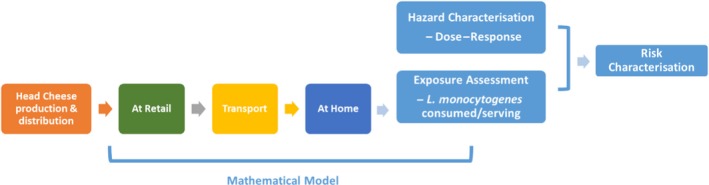
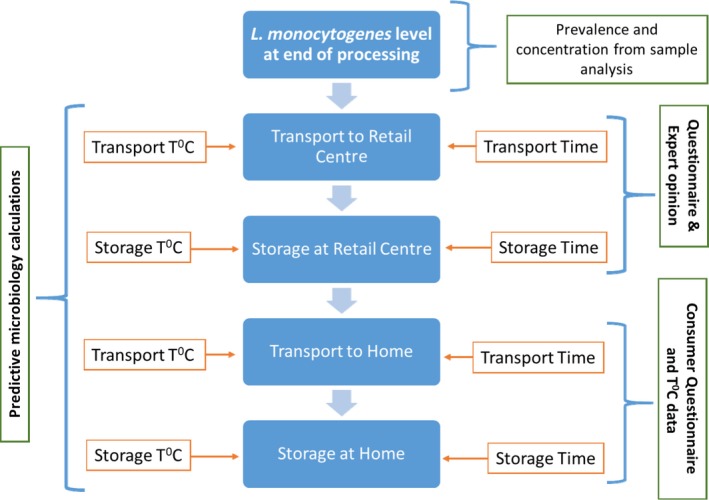
Ready to Eat (RTE) cooked meat products are among the most consumed RTE food subcategories in the EU. They are also associated with the highest number of listeriosis cases per year. Contamination with may arise from post-processing and its growth is often supported by the pH and water activity of the product. may grow during refrigeration and reach unacceptable levels at the time of consumption, posing a public health risk. The aim of this study was to conduct a Quantitative Microbiological Risk Assessment (QMRA) of in a traditional Italian RTE cooked meat product. Data for the risk assessment included prevalence and concentration of the microorganism, temperature-time conditions during transport and storage, information on the growth of the microorganism and its potential for disease (dose-response). These data were obtained from laboratory analysis of product samples (n = 50), a consumer survey (n = 160), recordings of temperatures of domestic refrigerators (n = 60) and were complemented with information from the literature. The data were described with appropriate probability distributions and introduced into a previously described growth model of . Based on the above components, a probabilistic model was created to evaluate the growth of at each stage of the product pathway (retail storage, transportation and domestic storage) using Monte Carlo simulations. The model design for this pathogen/food product combination, alongside with the findings of the study are included in a separate publication (manuscript under preparation). The results may help risk managers to apply appropriate control measures to minimise the public health risk. The project contributed to further education of the fellow, especially in the use of QMRA risk analysis tools and laid the foundations for future collaborations between the fellow's home institution, the University of Crete, Greece and the University of Perugia, Italy.
即食(RTE)熟肉制品是欧盟消费最多的即食食品子类别之一。它们每年还与最高数量的李斯特菌病病例相关。污染可能源于后处理过程,其生长通常受到产品pH值和水分活度的支持。该菌可能在冷藏期间生长,并在食用时达到不可接受的水平,从而构成公共卫生风险。本研究的目的是对一种传统意大利即食熟肉制品中的该菌进行定量微生物风险评估(QMRA)。风险评估数据包括微生物的流行率和浓度、运输和储存期间的温度-时间条件、微生物生长及其致病潜力(剂量反应)的信息。这些数据来自产品样本(n = 50)的实验室分析、消费者调查(n = 160)、家用冰箱温度记录(n = 60),并辅以文献信息。数据用适当的概率分布进行描述,并引入到先前描述的该菌生长模型中。基于上述组成部分,创建了一个概率模型,使用蒙特卡罗模拟评估产品供应链各阶段(零售储存、运输和家庭储存)中该菌的生长情况。这种病原体/食品产品组合的模型设计以及研究结果包含在另一篇单独的出版物中(正在准备的手稿)。结果可能有助于风险管理者应用适当的控制措施,以将公共卫生风险降至最低。该项目有助于对研究人员进行进一步培训,特别是在使用QMRA风险分析工具方面,并为研究人员的母校希腊克里特大学和意大利佩鲁贾大学未来的合作奠定了基础。