Department of Physical Therapy for Cardiovascular/Respiratory Disorders and Geriatrics, Faculty of Physical Therapy, Cairo University, Giza, Egypt.
Department of Health and Rehabilitation Sciences, College of Applied Medical Sciences, Prince Sattam bin Abdulaziz University, Alkharj, Saudi Arabia.
Biomed Res Int. 2020 Jun 12;2020:5036585. doi: 10.1155/2020/5036585. eCollection 2020.
This work is aimed at assessing the effects of inspiratory muscle training on lung functions, inspiratory muscle strength, and aerobic capacity in diabetic peripheral neuropathy (DPN) patients with obstructive sleep apnea (OSA).
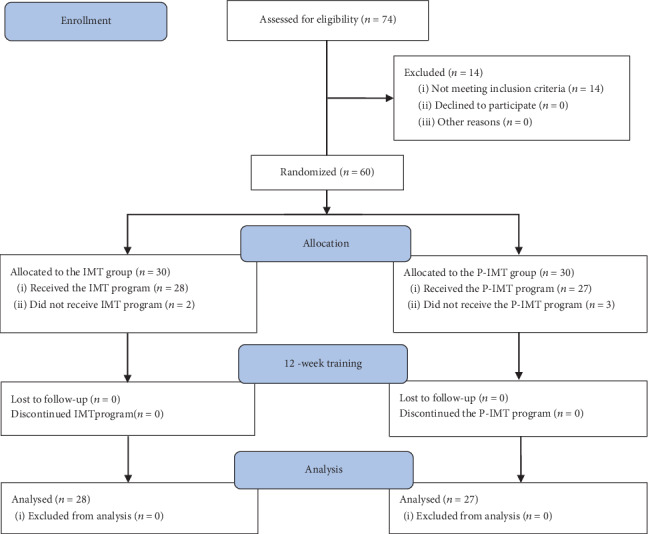
A randomized control study was performed on 55 patients diagnosed with DPN and OSA. They were assigned to the training group (IMT, = 28) and placebo training group (P-IMT, = 27). Inspiratory muscle strength, lung functions, and aerobic capacity were evaluated before and after 12 weeks postintervention. An electronic inspiratory muscle trainer was conducted, 30 min a session, three times a week for 12 consecutive weeks.
From seventy-four patients, 55 have completed the study program. A significant improvement was observed in inspiratory muscle strength ( < 0.05) in the IMT group while no changes were observed in the P-IMT group ( > 0.05). No changes were observed in the lung function in the two groups ( > 0.05). Also, VOmax and VCOmax changed significantly after training in the IMT group ( < 0.05) while no changes were observed in the P-IMT group ( > 0.05). Other cardiopulmonary exercise tests did not show any significant change in both groups ( > 0.05).
Based on the outcomes of the study, it was found that inspiratory muscle training improves inspiratory muscle strength and aerobic capacity without a notable effect on lung functions for diabetic patients suffering from DPN and OSA.
本研究旨在评估吸气肌训练对糖尿病周围神经病变合并阻塞性睡眠呼吸暂停(OSA)患者肺功能、吸气肌力量和有氧能力的影响。
对 55 例诊断为 DPN 和 OSA 的患者进行随机对照研究。将患者分为训练组(IMT,n = 28)和安慰剂训练组(P-IMT,n = 27)。干预后 12 周分别评估吸气肌力量、肺功能和有氧能力。采用电子吸气肌训练器,每次 30 分钟,每周 3 次,连续 12 周。
74 例患者中,55 例完成了研究计划。IMT 组吸气肌力量明显改善( < 0.05),而 P-IMT 组无变化( > 0.05)。两组肺功能均无变化( > 0.05)。此外,IMT 组训练后 VOmax 和 VCOmax 明显变化( < 0.05),而 P-IMT 组无变化( > 0.05)。两组其他心肺运动试验均无明显变化( > 0.05)。
根据研究结果,吸气肌训练可改善糖尿病合并 DPN 和 OSA 患者的吸气肌力量和有氧能力,但对肺功能无明显影响。