Sequí-Domínguez Irene, Cavero-Redondo Iván, Álvarez-Bueno Celia, Pozuelo-Carrascosa Diana P, Nuñez de Arenas-Arroyo Sergio, Martínez-Vizcaíno Vicente
Universidad de Castilla-La Mancha, Health and Social Research Center, 16071 Cuenca, Spain.
Universidad Politécnica y Artística del Paraguay, Asunción 001518, Paraguay.
J Clin Med. 2020 Jul 2;9(7):2080. doi: 10.3390/jcm9072080.
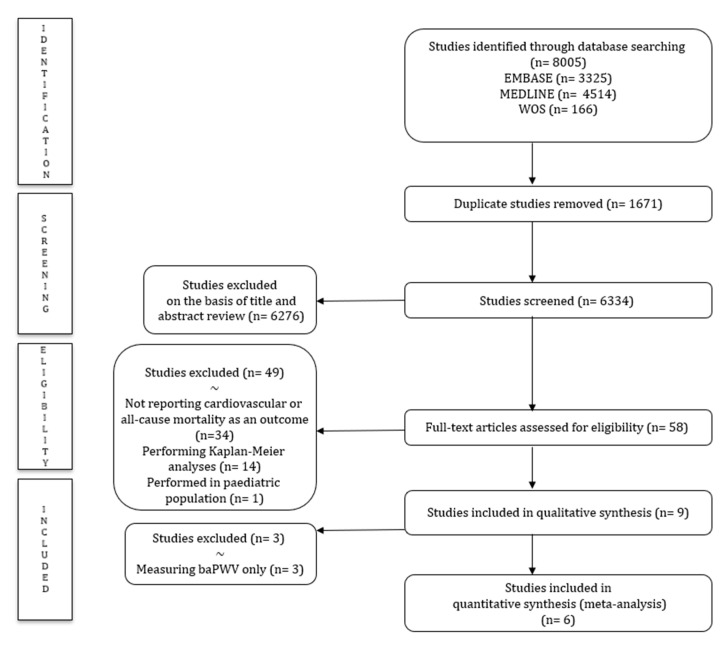
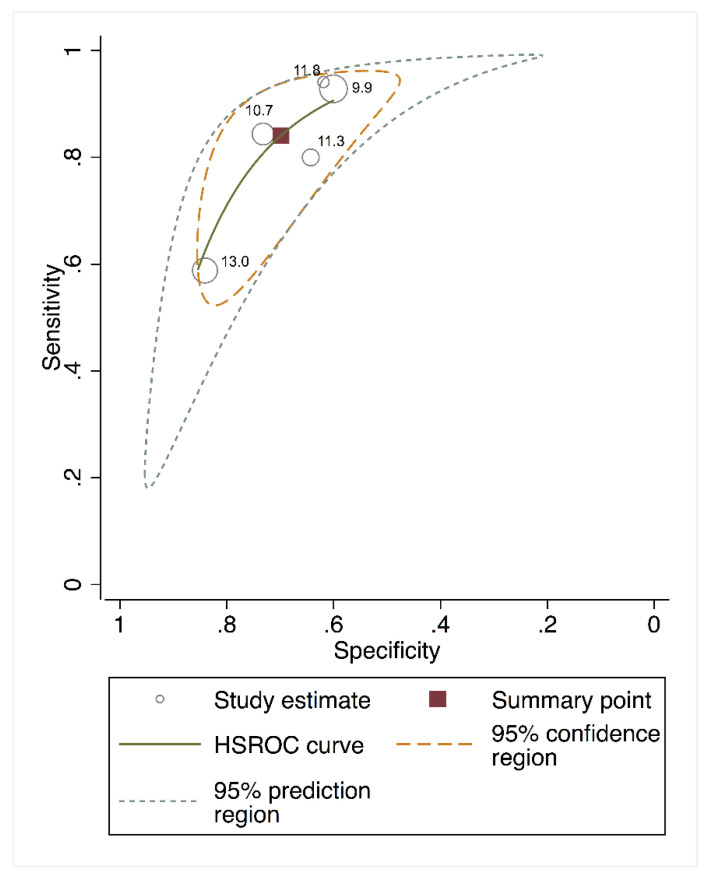
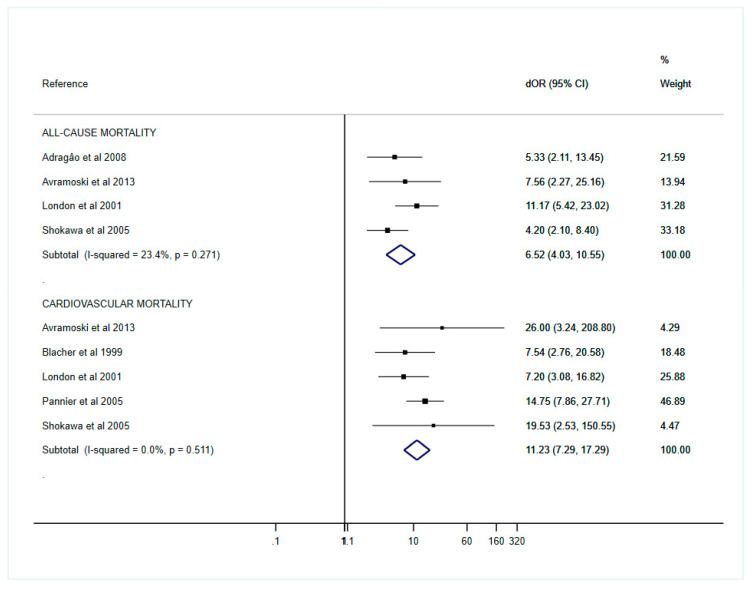
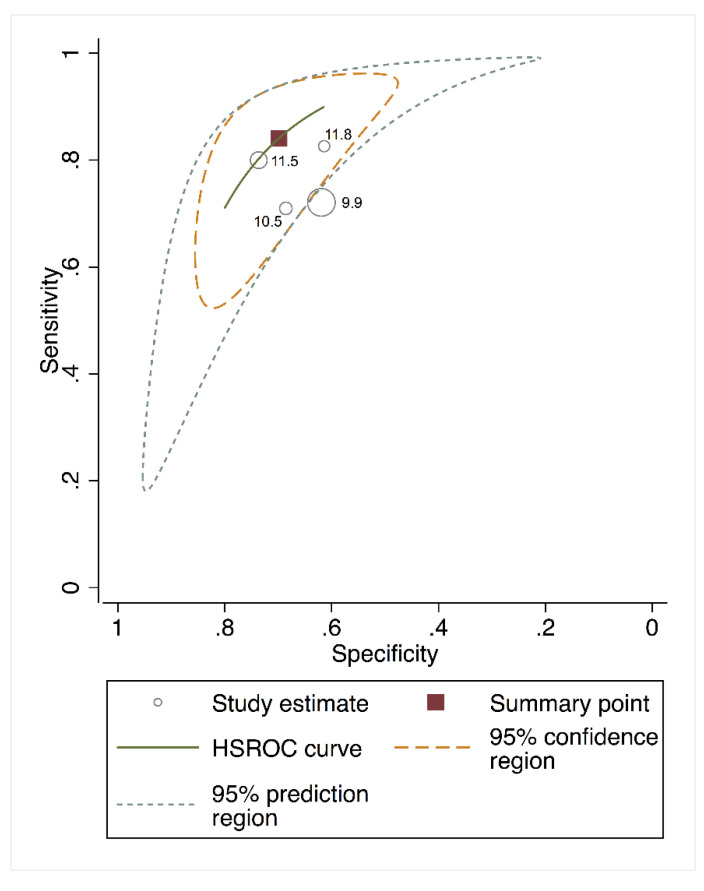
Increased arterial stiffness has been associated with an increased risk of developing cardiovascular diseases and all-cause mortality. Pulse wave velocity (PWV) is an innovative and affordable measurement of arterial stiffness which may be an accessible tool to estimate mortality risk; however, no meta-analysis has estimated its predictive performance for cardiovascular and all-cause mortality. Moreover, reference values for PWV have only been established by consensus for healthy populations. The aim of this review was to estimate PWV and especially carotid femoral PWV performance predicting cardiovascular and all-cause mortality as well as comparing the resulting cfPWV thresholds with already established values in order to increase its validity. Original studies measuring PWV thresholds and its association with cardiovascular and all-cause mortality were systematically searched. The DerSimonian and Laird method was used to compute pooled estimates of diagnostic odds ratio (dOR), and overall test performances were summarized in hierarchical summary receiver operating characteristic curves (HSROC). Six studies were included in the meta-analysis. The pooled dOR values for the predictive performance of cfPWV were 11.23 (95 % CI, 7.29-1.29) for cardiovascular mortality and 6.52 (95% CI, 4.03-10.55) for all-cause mortality. The area under the HSROC curve for cfPWV was 0.75 (95% CI, 0.69-0.81) for cardiovascular mortality and 0.78 (95% CI, 0.74-0.83) for all-cause mortality, where the closest cut-off point to the summary point was 10.7 and 11.5, respectively. This systematic review and meta-analysis demonstrates that cfPWV is a useful and accurate cardiovascular mortality predictor and that its previously estimated reference values for estimating risk may be used in high-risk populations.
动脉僵硬度增加与心血管疾病发生风险及全因死亡率升高相关。脉搏波速度(PWV)是一种创新且经济的动脉僵硬度测量方法,可能是评估死亡风险的一种便捷工具;然而,尚无荟萃分析评估其对心血管疾病和全因死亡率的预测性能。此外,PWV的参考值仅通过健康人群的共识确定。本综述的目的是评估PWV,尤其是颈股PWV预测心血管疾病和全因死亡率的性能,并将所得的颈股PWV阈值与已确定的值进行比较,以提高其有效性。系统检索了测量PWV阈值及其与心血管疾病和全因死亡率关联的原始研究。采用DerSimonian和Laird方法计算诊断比值比(dOR)的合并估计值,并在分层汇总接受者操作特征曲线(HSROC)中总结总体测试性能。荟萃分析纳入了六项研究。颈股PWV预测性能的合并dOR值,心血管死亡率为11.23(95%CI,7.29 - 1.29),全因死亡率为6.52(95%CI,4.03 - 10.55)。颈股PWV的HSROC曲线下面积,心血管死亡率为0.75(95%CI,0.69 - 0.81),全因死亡率为0.78(95%CI,0.74 - 0.83),其中最接近汇总点的截断点分别为10.7和11.5。这项系统综述和荟萃分析表明,颈股PWV是一种有用且准确的心血管死亡率预测指标,其先前估计的风险评估参考值可用于高危人群。