van de Loo Aurora J A E, Mackus Marlou, Kwon Oran, Krishnakumar Illathu Madhavamenon, Garssen Johan, Kraneveld Aletta D, Scholey Andrew, Verster Joris C
Division of Pharmacology, Utrecht Institute for Pharmaceutical Sciences (UIPS), Utrecht University, 3584CG Utrecht, The Netherlands.
Institute for Risk Assessment Sciences (IRAS), Utrecht University, 3584CM Utrecht, The Netherlands.
J Clin Med. 2020 Jul 2;9(7):2081. doi: 10.3390/jcm9072081.
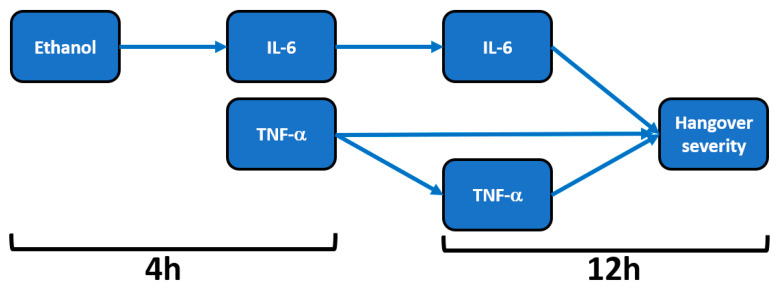
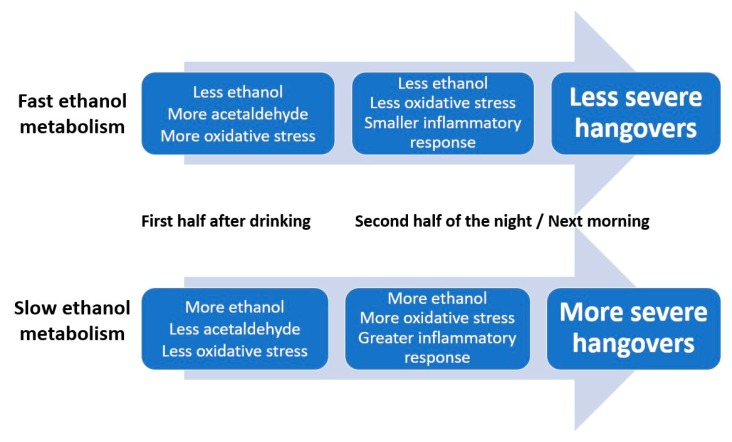
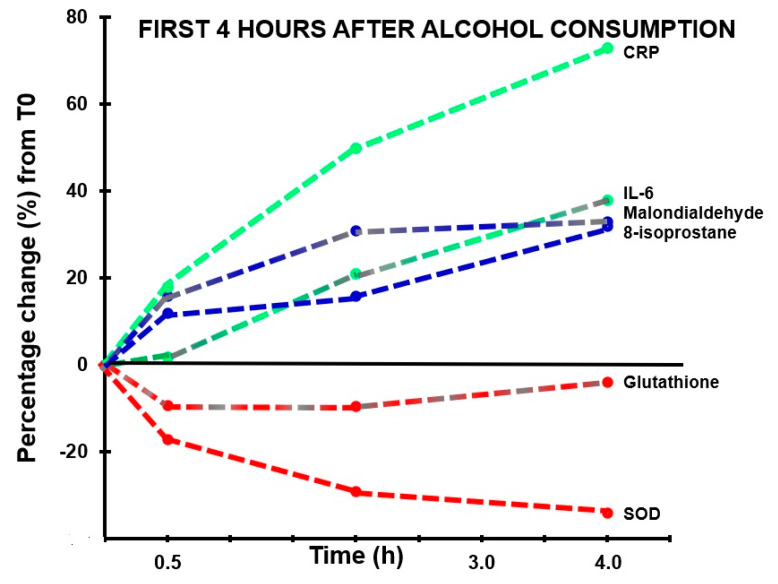
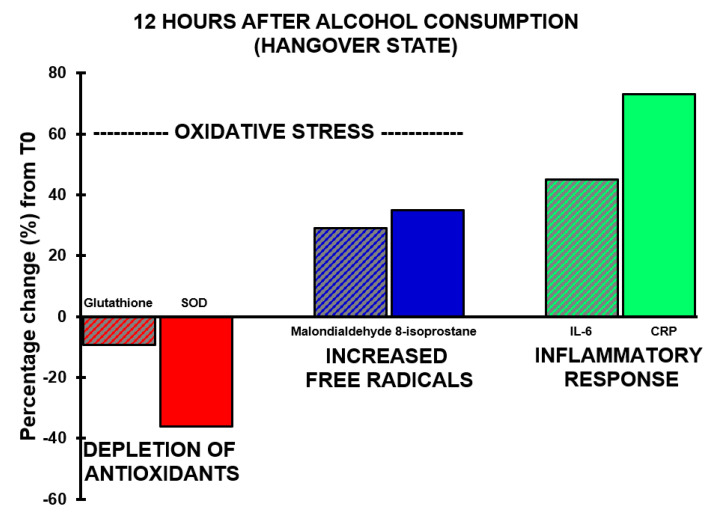
An increasing number of studies are focusing on the inflammatory response to alcohol as a potentially important determinant of hangover severity. In this article, data from two studies were re-evaluated to investigate the relationship between hangover severity and relevant biomarkers of alcohol metabolism, oxidative stress and the inflammatory response to alcohol. Hangover severity was significantly and positively correlated with blood concentrations of biomarkers of the inflammatory response to alcohol, in particular, Interleukin-6 (IL-6), tumor necrosis factor-alpha (TNF-α) and C-reactive protein (CRP). At 4 h after alcohol consumption, blood ethanol concentration (but not acetaldehyde) was significantly and positively associated with elevated levels of IL-6, suggesting a direct inflammatory effect of ethanol. In addition, biomarkers of oxidative stress, i.e., malondialdehyde and 8-isoprostrane, were significantly correlated with hangover severity, suggesting that oxidative stress also contributes to the inflammatory response. The timing of the assessments suggests initial slow elimination of ethanol in the first hours after alcohol consumption. As a consequence, more ethanol is present in the second half of the night and the next morning, which will elicit more oxidative stress and a more profound inflammatory response. Together, these processes result in more severe hangovers.
越来越多的研究聚焦于对酒精的炎症反应,将其视为宿醉严重程度的一个潜在重要决定因素。在本文中,对两项研究的数据进行了重新评估,以调查宿醉严重程度与酒精代谢、氧化应激及对酒精的炎症反应的相关生物标志物之间的关系。宿醉严重程度与对酒精的炎症反应生物标志物的血浓度显著正相关,尤其是白细胞介素-6(IL-6)、肿瘤坏死因子-α(TNF-α)和C反应蛋白(CRP)。饮酒后4小时,血液乙醇浓度(而非乙醛)与IL-6水平升高显著正相关,提示乙醇有直接的炎症作用。此外,氧化应激生物标志物,即丙二醛和8-异前列腺素,与宿醉严重程度显著相关,表明氧化应激也促成了炎症反应。评估时间表明饮酒后的最初几个小时乙醇清除缓慢。因此,下半夜和第二天早晨会有更多乙醇存在,这将引发更多氧化应激和更强烈的炎症反应。这些过程共同导致更严重的宿醉。