Verster Joris C, van de Loo Aurora J A E, Benson Sarah, Scholey Andrew, Stock Ann-Kathrin
Division of Pharmacology, Utrecht Institute for Pharmaceutical Sciences (UIPS), Utrecht University, 3584CG Utrecht, The Netherlands.
Institute for Risk Assessment Sciences (IRAS), Utrecht University, 3584CM Utrecht, The Netherlands.
J Clin Med. 2020 Mar 13;9(3):786. doi: 10.3390/jcm9030786.
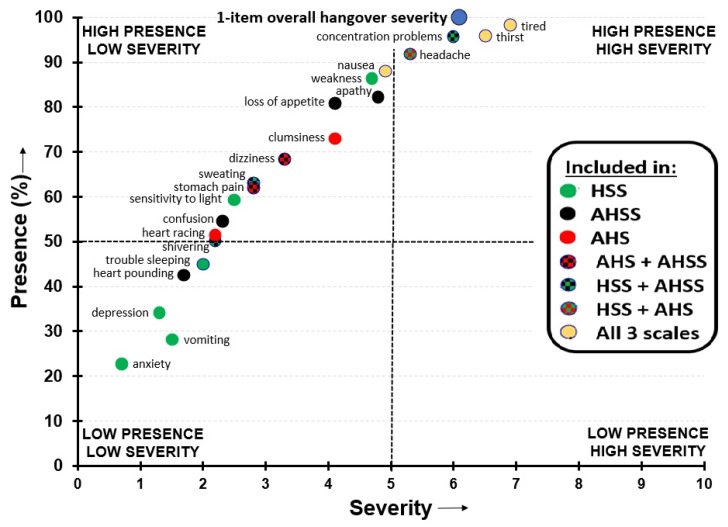
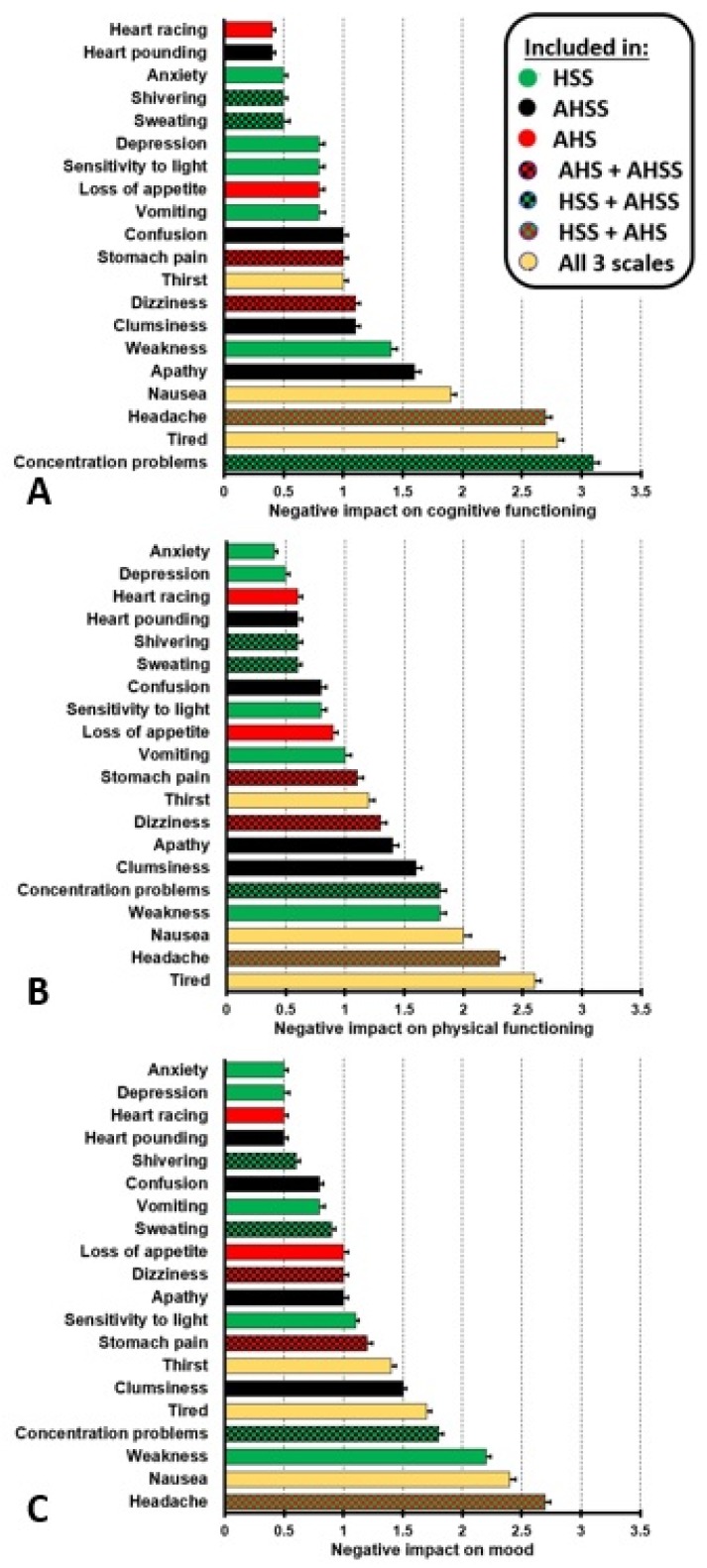
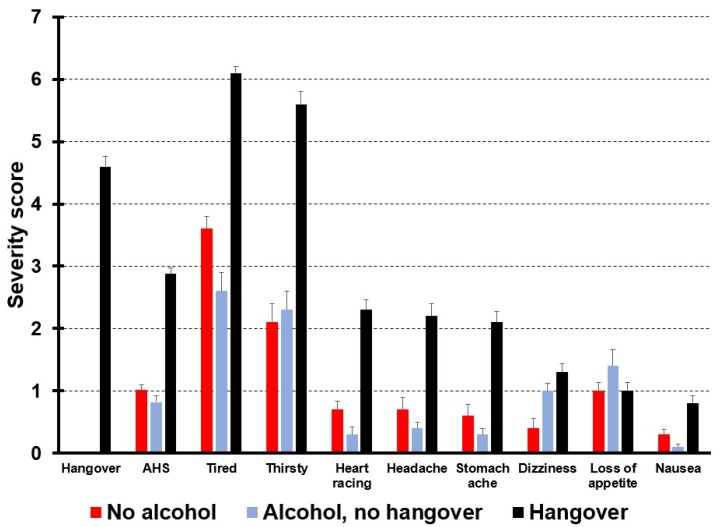
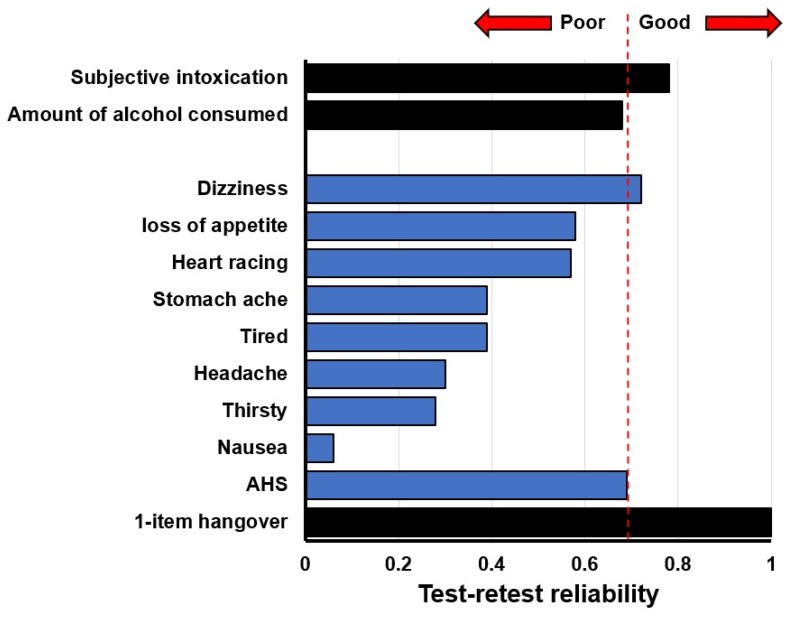
The aim of this study was to critically evaluate and compare the different methods to assess overall hangover severity. Currently, there are three multi-item hangover scales that are commonly used for this purpose. All of them comprise a number of hangover symptoms for which an average score is calculated. These scales were compared to a single, 1-item scale assessing overall hangover severity. The results showed that the hangover symptom scales significantly underestimate (subjective) hangover severity, as assessed with a 1-item overall hangover severity scale. A possible reason for this could be that overall hangover severity varies, depending on the frequency of occurrence of individual symptoms included in the respective scale. In contrast, it can be assumed that, when completing a 1-item overall hangover scale, the rating includes all possible hangover symptoms and their impact on cognitive and physical functioning and mood, thus better reflecting the actually experienced hangover severity. On the other hand, solely relying on hangover symptom scales may yield false positives in subjects who report not having a hangover. When the average symptom score is greater than zero, this may lead to non-hungover subjects being categorized as having a hangover, as many of the somatic and psychological hangover symptoms may also be experienced without consuming alcohol (e.g., having a headache). Taken together, the current analyses suggest that a 1-item overall hangover score is superior to hangover symptom scales in accurately assessing overall hangover severity. We therefore recommend using a 1-item overall hangover rating as primary endpoint in future hangover studies that aim to assess overall hangover severity.
本研究的目的是严格评估和比较评估整体宿醉严重程度的不同方法。目前,有三种多项目宿醉量表常用于此目的。它们都包含一些宿醉症状,并计算平均得分。将这些量表与一个评估整体宿醉严重程度的单项目量表进行比较。结果表明,与单项目整体宿醉严重程度量表评估的结果相比,宿醉症状量表显著低估了(主观)宿醉严重程度。其一个可能的原因是,整体宿醉严重程度会有所不同,这取决于各量表中所包含的个体症状的出现频率。相比之下,可以假设,在完成单项目整体宿醉量表时,评分包含了所有可能的宿醉症状及其对认知、身体功能和情绪的影响,从而能更好地反映实际经历的宿醉严重程度。另一方面,仅依靠宿醉症状量表可能会在报告没有宿醉的受试者中产生假阳性结果。当平均症状得分大于零时,这可能会导致未宿醉的受试者被归类为有宿醉,因为许多躯体和心理宿醉症状在不饮酒的情况下也可能出现(例如,头痛)。综上所述,当前的分析表明,在准确评估整体宿醉严重程度方面,单项目整体宿醉得分优于宿醉症状量表。因此,我们建议在未来旨在评估整体宿醉严重程度的宿醉研究中,使用单项目整体宿醉评分作为主要终点。