Department of Respiration and Critical Care Diseases, Ruijin Hospital, School of Medicine, Shanghai Jiao Tong University, Shanghai, China.
Institute of Respiratory Diseases, School of Medicine, Shanghai Jiaotong University, Shanghai, China.
Epidemiol Infect. 2020 Jul 7;148:e146. doi: 10.1017/S0950268820001533.
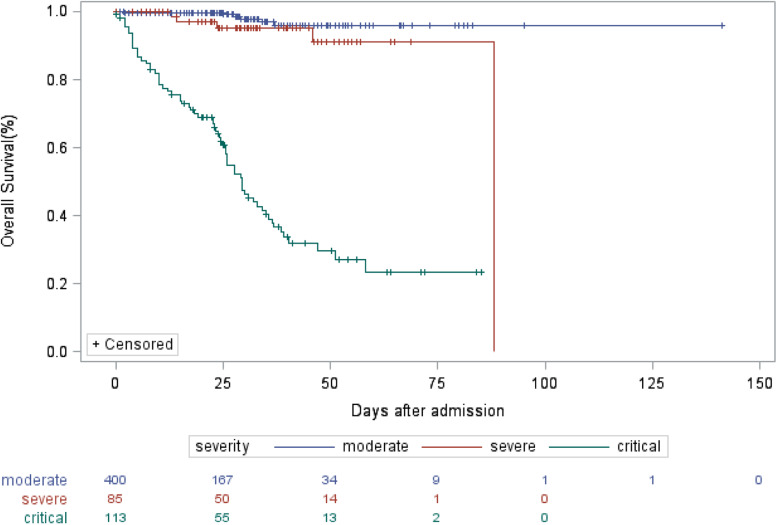
Corona Virus Disease 2019 (COVID-19) has presented an unprecedented challenge to the health-care system across the world. The current study aims to identify the determinants of illness severity of COVID-19 based on ordinal responses. A retrospective cohort of COVID-19 patients from four hospitals in three provinces in China was established, and 598 patients were included from 1 January to 8 March 2020, and divided into moderate, severe and critical illness group. Relative variables were retrieved from electronic medical records. The univariate and multivariate ordinal logistic regression models were fitted to identify the independent predictors of illness severity. The cohort included 400 (66.89%) moderate cases, 85 (14.21%) severe and 113 (18.90%) critical cases, of whom 79 died during hospitalisation as of 28 April. Patients in the age group of 70+ years (OR = 3.419, 95% CI: 1.596-7.323), age of 40-69 years (OR = 1.586, 95% CI: 0.824-3.053), hypertension (OR = 3.372, 95% CI: 2.185-5.202), ALT >50 μ/l (OR = 3.304, 95% CI: 2.107-5.180), cTnI >0.04 ng/ml (OR = 7.464, 95% CI: 4.292-12.980), myohaemoglobin>48.8 ng/ml (OR = 2.214, 95% CI: 1.42-3.453) had greater risk of developing worse severity of illness. The interval between illness onset and diagnosis (OR = 1.056, 95% CI: 1.012-1.101) and interval between illness onset and admission (OR = 1.048, 95% CI: 1.009-1.087) were independent significant predictors of illness severity. Patients of critical illness suffered from inferior survival, as compared with patients in the severe group (HR = 14.309, 95% CI: 5.585-36.659) and in the moderate group (HR = 41.021, 95% CI: 17.588-95.678). Our findings highlight that the identified determinants may help to predict the risk of developing more severe illness among COVID-19 patients and contribute to optimising arrangement of health resources.
新型冠状病毒病 2019(COVID-19)对全球医疗体系提出了前所未有的挑战。本研究旨在基于有序反应识别 COVID-19 疾病严重程度的决定因素。建立了来自中国三个省的四家医院的 COVID-19 患者回顾性队列,纳入了 2020 年 1 月 1 日至 3 月 8 日的 598 例患者,并分为中度、重度和危重症组。从电子病历中检索相对变量。拟合单变量和多变量有序逻辑回归模型,以确定疾病严重程度的独立预测因素。该队列包括 400 例(66.89%)中度病例、85 例(14.21%)重度病例和 113 例(18.90%)危重症病例,截至 4 月 28 日,其中 79 人在住院期间死亡。70 岁以上年龄组患者(OR=3.419,95%CI:1.596-7.323)、40-69 岁年龄组患者(OR=1.586,95%CI:0.824-3.053)、高血压患者(OR=3.372,95%CI:2.185-5.202)、ALT>50μ/l(OR=3.304,95%CI:2.107-5.180)、cTnI>0.04ng/ml(OR=7.464,95%CI:4.292-12.980)、肌红蛋白>48.8ng/ml(OR=2.214,95%CI:1.42-3.453)患者发生更严重疾病的风险更高。发病与诊断之间的间隔(OR=1.056,95%CI:1.012-1.101)和发病与入院之间的间隔(OR=1.048,95%CI:1.009-1.087)是疾病严重程度的独立显著预测因素。危重症患者的生存预后差于重症组(HR=14.309,95%CI:5.585-36.659)和中度组(HR=41.021,95%CI:17.588-95.678)。我们的研究结果表明,确定的决定因素可能有助于预测 COVID-19 患者发生更严重疾病的风险,并有助于优化卫生资源的配置。