Ji Chengang, Liu Dong, Zhang Cheng, Jay Guo L
Department of Electrical Engineering and Computer Science, University of Michigan, 1301 Beal Avenue, Ann Arbor, MI, 48109, USA.
MIIT Key Laboratory of Thermal Control of Electronic Equipment, School of Energy and Power Engineering, Nanjing University of Science and Technology, 200 Xiaolingwei Street, 210094, Nanjing, China.
Nat Commun. 2020 Jul 6;11(1):3367. doi: 10.1038/s41467-020-17107-6.
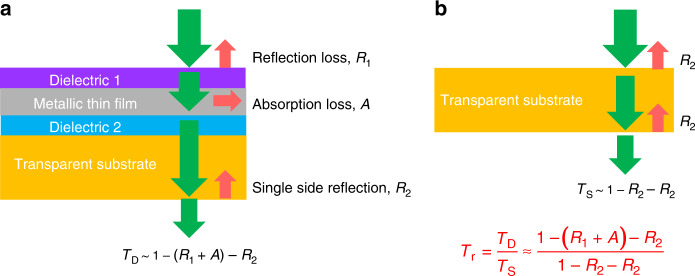
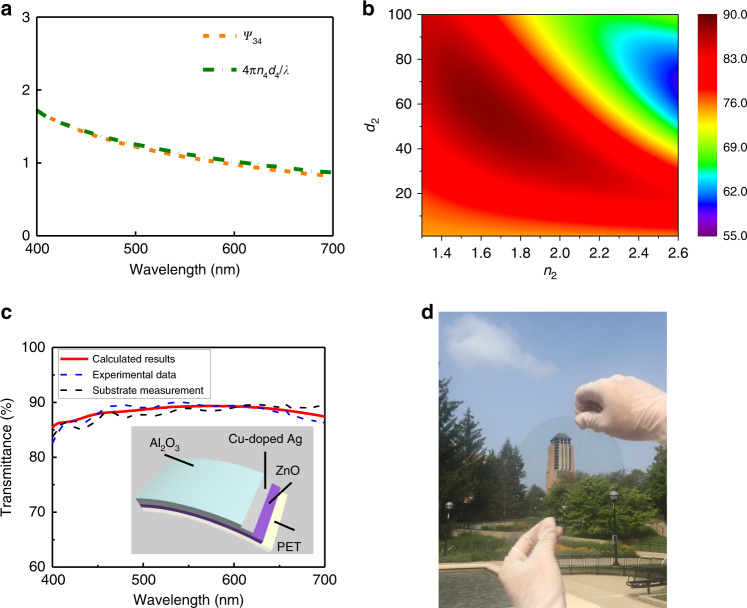
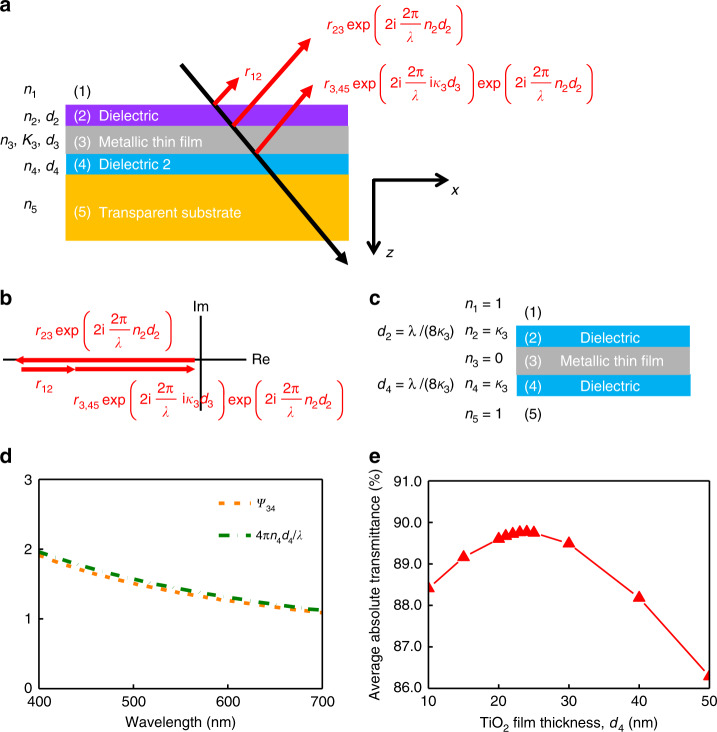
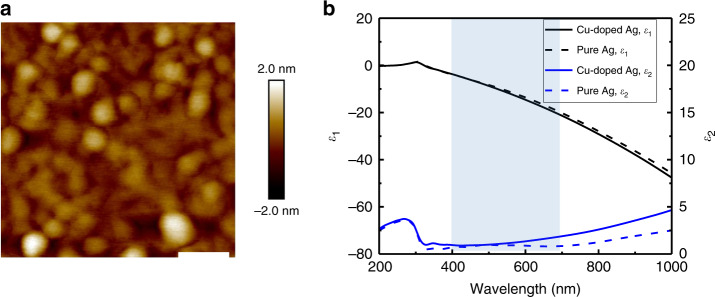
Flexible transparent electrodes are in significant demand in applications including solar cells, light-emitting diodes, and touch panels. The combination of high optical transparency and high electrical conductivity, however, sets a stringent requirement on electrodes based on metallic materials. To obtain practical sheet resistances, the visible transmittance of the electrodes in previous studies is typically lower than the transparent substrates the electrode structures are built on, namely, the transmittance relative to the substrate is <100%. Here, we demonstrate a flexible dielectric-metal-dielectric-based electrode with ~88.4% absolute transmittance, even higher than the ~88.1% transmittance of the polymer substrate, which results in a relative transmittance of ~100.3%. This non-trivial performance is achieved by leveraging an optimized dielectric-metal-dielectric structure guided by analytical and quantitative principles described in this work, and is attributed to an ultra-thin and ultra-smooth copper-doped silver film with low optical loss and low sheet resistance.
柔性透明电极在包括太阳能电池、发光二极管和触摸面板等应用中有着巨大的需求。然而,高光学透明度和高电导率的结合对基于金属材料的电极提出了严格的要求。为了获得实际的薄层电阻,先前研究中电极的可见光透射率通常低于构建电极结构的透明基板,即相对于基板的透射率<100%。在此,我们展示了一种基于柔性介电-金属-介电的电极,其绝对透射率约为88.4%,甚至高于聚合物基板约88.1%的透射率,这导致相对透射率约为100.3%。这种非凡的性能是通过利用由本文所述的分析和定量原理指导的优化介电-金属-介电结构实现的,并且归因于具有低光学损耗和低薄层电阻的超薄且超光滑的铜掺杂银膜。