State Key Laboratory for Oncogenes and Related Genes, Division of Gastroenterology and Hepatology, Key Laboratory of Gastroenterology and Hepatology, Ministry of Health, Shanghai Institute of Digestive Disease, Renji Hospital, School of Medicine, Shanghai Jiao Tong University, Shanghai, China.
Cancer Med. 2019 Feb;8(2):480-491. doi: 10.1002/cam4.1850. Epub 2019 Jan 12.
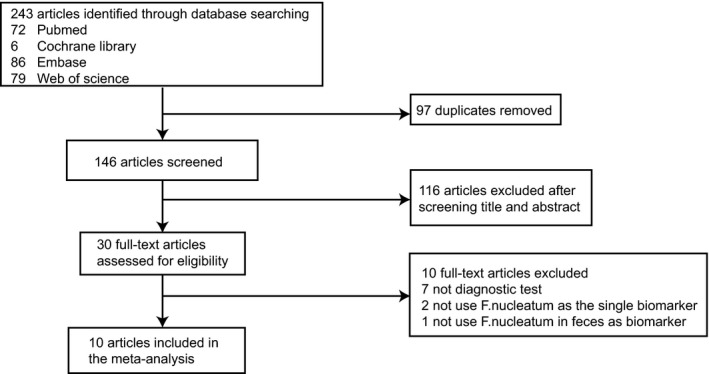
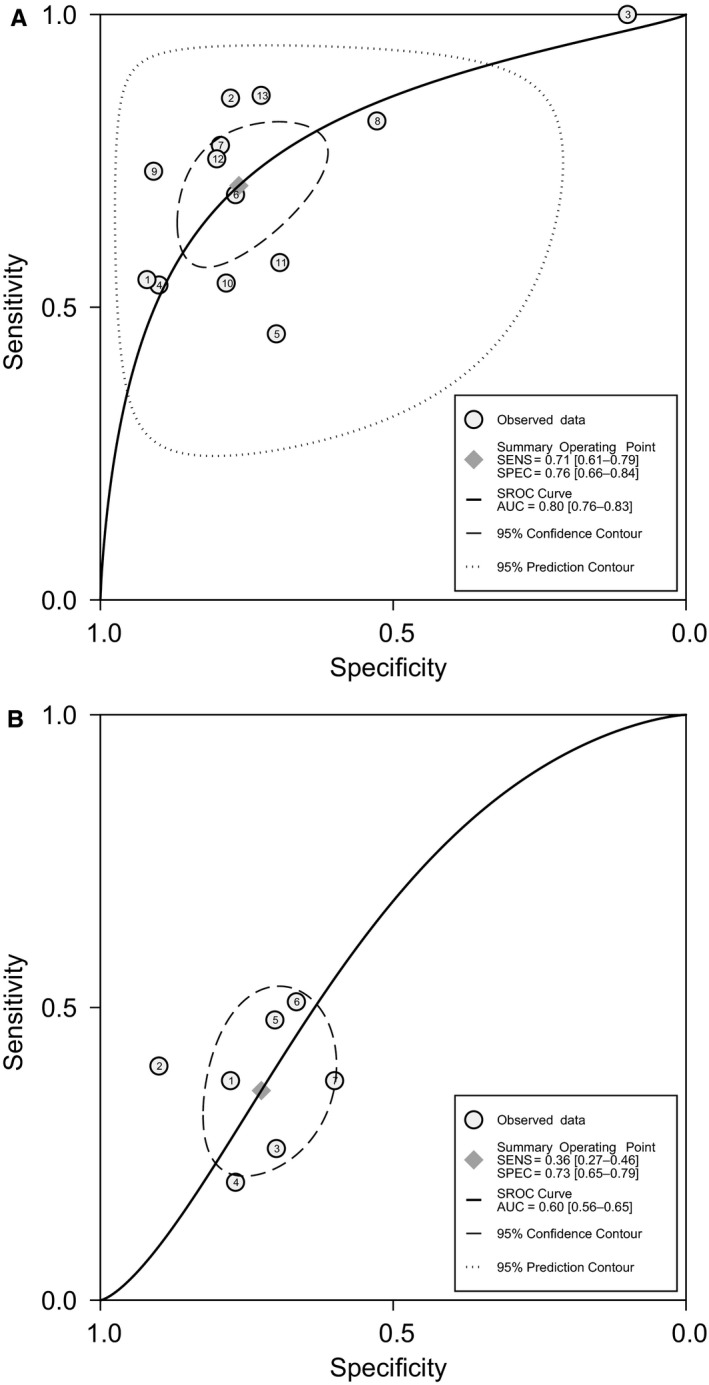
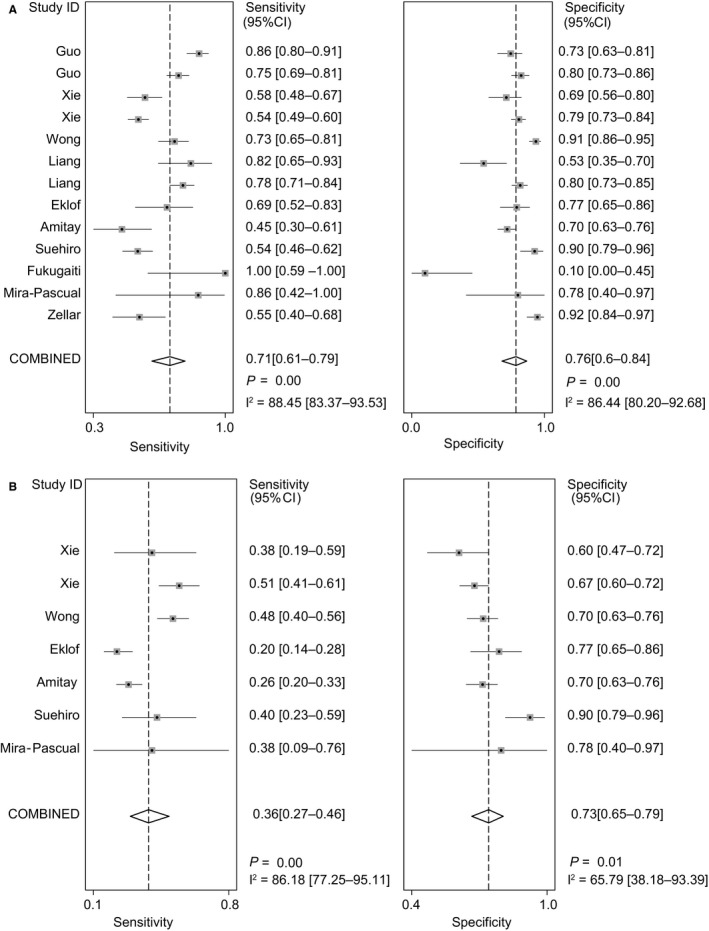
The fecal Fusobacterium nucleatum has been reported as a potential noninvasive biomarker for colorectal tumor in several studies, but its exact diagnostic accuracy was ambiguous due to the wide range of sensitivity and specificity. To assess the diagnostic accuracy of fecal F. nucleatum for colorectal tumor, we searched electronic databases including PubMed, Cochrane Library, Embase, and Web of Science, without any date and language restrictions. Two reviewers independently extracted data and appraised study quality with Quality Assessment of Diagnostic Accuracy Studies. We included ten studies comprising 13 cohorts for colorectal cancer (CRC) and seven cohorts for colorectal adenoma (CRA). A total of 1450 patients and 1421 controls for CRC and 656 patients and 827 controls for CRA were included. The pooled sensitivity and specificity of fecal F. nucleatum for CRC were 71% (95% CI, 61%-79%) and 76% (95% CI, 66%-84%), with the area under the receiver-operating characteristics (AUC) curve of 0.80 (95% CI, 0.76-0.83). The pooled sensitivity and specificity of fecal F. nucleatum for CRA were 36% (95% CI, 27%-46%) and 73% (95% CI, 65%-79%), with an AUC of 0.60 (95% CI, 0.56-0.65). Substantial heterogeneity among studies existed, which was partly caused by DNA extraction kits, regions of study, sample size, and demographic characteristics of participants. Fecal F. nucleatum was valuable for the diagnosis of CRC although it performed below expectation. For CRA, the specificity of fecal F. nucleatum indicated the possibility of noninvasive screening. Subgroup analyses for adenoma were incomplete due to lack of data. Heterogeneity limited the credibility of the study.
已有研究报道粪便具核梭杆菌可作为结直肠肿瘤的一种潜在非侵入性生物标志物,但由于其灵敏度和特异性差异较大,确切的诊断准确性尚不清楚。为评估粪便具核梭杆菌诊断结直肠肿瘤的准确性,我们检索了包括 PubMed、Cochrane 图书馆、Embase 和 Web of Science 在内的电子数据库,未对检索时间和语言进行任何限制。两位审查员独立提取数据,并使用诊断准确性研究的质量评估标准评估研究质量。我们纳入了 10 项研究,共包含 13 个结直肠癌 (CRC) 队列和 7 个结直肠腺瘤 (CRA) 队列。CRC 共纳入 1450 例患者和 1421 例对照,CRA 共纳入 656 例患者和 827 例对照。粪便具核梭杆菌诊断 CRC 的汇总灵敏度和特异度分别为 71%(95%CI,61%-79%)和 76%(95%CI,66%-84%),受试者工作特征曲线下面积(AUC)为 0.80(95%CI,0.76-0.83)。粪便具核梭杆菌诊断 CRA 的汇总灵敏度和特异度分别为 36%(95%CI,27%-46%)和 73%(95%CI,65%-79%),AUC 为 0.60(95%CI,0.56-0.65)。研究间存在较大的异质性,部分原因是 DNA 提取试剂盒、研究区域、样本量以及参与者的人口统计学特征不同。粪便具核梭杆菌对 CRC 的诊断具有一定价值,但诊断效能低于预期。对于 CRA,具核梭杆菌的特异性提示了非侵入性筛查的可能性。由于数据缺乏,腺瘤的亚组分析不完整。异质性限制了研究的可信度。