Lou Ruvo Center for Brain Health, Cleveland Clinic, Cleveland, Ohio, 44195.
Neurological Institute, Cleveland Clinic, Cleveland, Ohio, 44195.
Ann Clin Transl Neurol. 2020 Jul;7(7):1225-1239. doi: 10.1002/acn3.51109. Epub 2020 Jul 7.
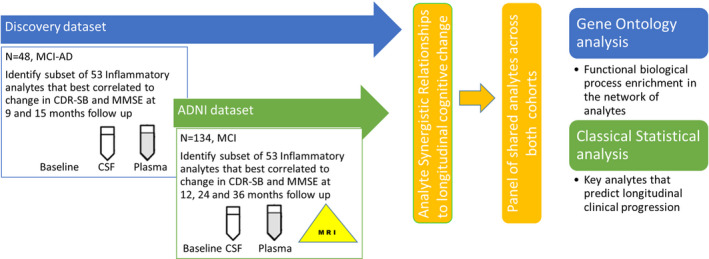
To determine the inflammatory analytes that predict clinical progression and evaluate their performance against biomarkers of neurodegeneration.
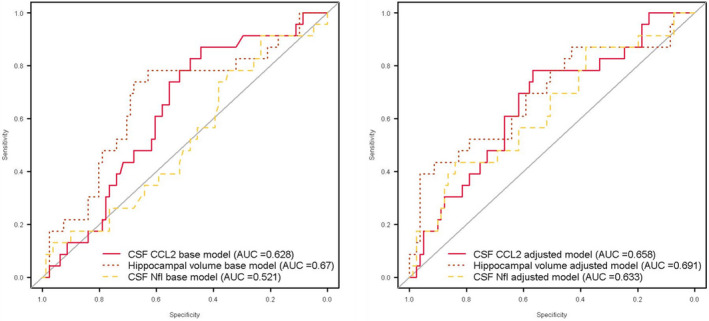
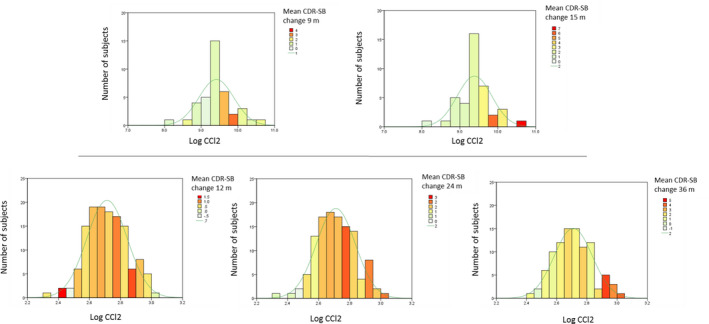
A longitudinal study of MCI-AD patients in a Discovery cohort over 15 months, with replication in the Alzheimer's Disease Neuroimaging Initiative (ADNI) MCI cohort over 36 months. Fifty-three inflammatory analytes were measured in the CSF and plasma with a RBM multiplex analyte platform. Inflammatory analytes that predict clinical progression on Clinical Dementia Rating Scale-Sum of Boxes (CDR-SB) and Mini Mental State Exam scores were assessed in multivariate regression models. To provide context, key analyte results in ADNI were compared against biomarkers of neurodegeneration, hippocampal volume, and CSF neurofilament light (NfL), in receiver operating characteristic (ROC) analyses evaluating highest quartile of CDR-SB change over two years (≥3 points).
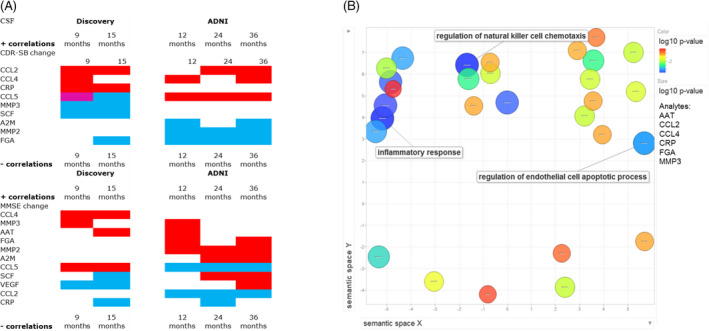
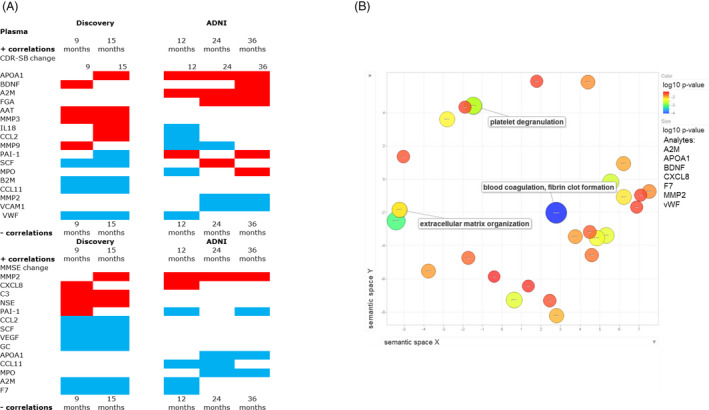
Cerebrospinal fluid inflammatory analytes in relation to cognitive decline were best described by gene ontology terms, natural killer cell chemotaxis, and endothelial cell apoptotic process and in plasma, extracellular matrix organization, blood coagulation, and fibrin clot formation described the analytes. CSF CCL2 was most robust in predicting rate of cognitive change and analytes that correlated to CCL2 suggest IL-10 pathway dysregulation. The ROC curves for ≥3 points change in CDR-SB over 2 years when comparing baseline hippocampal volume, CSF NfL, and CCL2 were not significantly different.
Baseline levels of immune cell chemotactic cytokine CCL2 in the CSF and IL-10 pathway dysregulation impact longitudinal cognitive and functional decline in MCI-AD. CCL2's utility appears comparable to biomarkers of neurodegeneration in predicting rapid decline.
确定预测临床进展的炎症分析物,并评估其对神经退行性变生物标志物的性能。
在 15 个月的时间内对 MCI-AD 患者进行了一项纵向研究,在 Alzheimer's Disease Neuroimaging Initiative (ADNI) MCI 队列中进行了 36 个月的复制。使用 RBM 多重分析物平台在 CSF 和血浆中测量了 53 种炎症分析物。在多元回归模型中评估了预测临床痴呆评定量表-总盒评分(CDR-SB)和简易精神状态检查评分临床进展的炎症分析物。为了提供背景,在 ADNI 中对关键分析物结果进行了比较,以评估与神经退行性变、海马体积和 CSF 神经丝轻链(NfL)相关的生物标志物,通过评估两年内 CDR-SB 变化最高四分位数(≥3 分)的接收器工作特征(ROC)分析。
与认知下降相关的脑脊液炎症分析物最好由基因本体术语描述,包括自然杀伤细胞趋化作用和内皮细胞凋亡过程,而在血浆中,细胞外基质组织、血液凝固和纤维蛋白凝块形成描述了分析物。CSF CCL2 最能准确预测认知变化率,与 CCL2 相关的分析物表明 IL-10 途径失调。当比较基线海马体积、CSF NfL 和 CCL2 时,在 2 年内 CDR-SB 变化≥3 分的 ROC 曲线没有显著差异。
CSF 中免疫细胞趋化细胞因子 CCL2 的基线水平和 IL-10 途径失调会影响 MCI-AD 患者的纵向认知和功能下降。CCL2 的效用似乎与神经退行性变的生物标志物在预测快速下降方面相当。