Department of Early Childhood Education, Center for Child and Family Science, The Education University of Hong Kong, Hong Kong, China.
Department of Applied Psychology, Guangdong University of Foreign Studies, Guangzhou 510006, China.
Int J Environ Res Public Health. 2020 Jul 4;17(13):4820. doi: 10.3390/ijerph17134820.
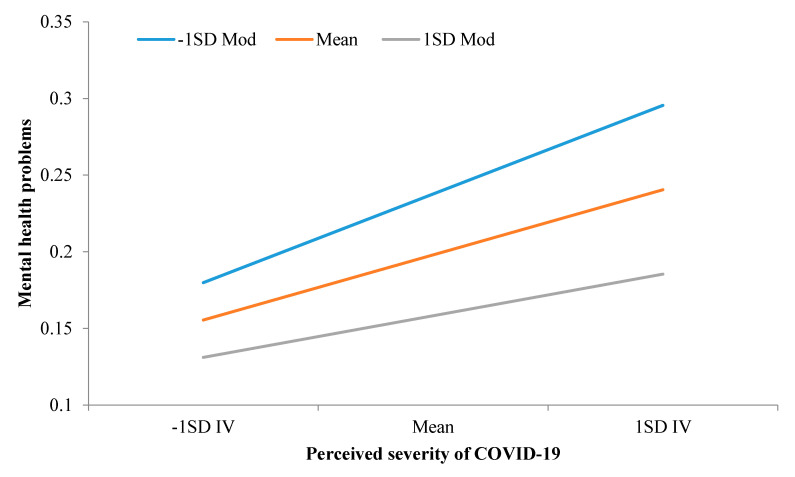
Coronavirus disease 2019 (COVID-19) has caused thousands of deaths in China. Prior research suggests that individuals' perceived severity of COVID-19 is related to a range of negative emotional and behavioral reactions among the Chinese public. However, scant research has examined the underlying mechanisms. Drawing upon the risk-resilience model, this study proposes that self-control, as a resilient factor, would potentially moderate the association between perceived severity of COVID-19 and mental health problems. Data from a national survey was used to examine this idea. Participants were 4607 citizens from 31 regions in China (M = 23.71 years, 72.5% female) who completed a national survey at the beginning of February 2020. Results of hierarchical regression showed that after controlling for a number of demographic variables, perceived severity of COVID-19 and self-control were positively and negatively related to mental health problems, respectively. More importantly, self-control moderated the "perceived severity of COVID-19-mental health problems" association, with this link attenuating as the levels of self-control increased. These findings suggest that compared to those with high self-control, individuals with low self-control are more vulnerable and are more in need of psychological aids to maintain mental health in the encounter of the COVID-19 outbreak. Practically, enhancing individuals' self-control ability might be a promising way to improve individuals' mental health during the early period of the COVID-19 outbreak.
新型冠状病毒肺炎(COVID-19)在中国已造成数千人死亡。先前的研究表明,个体对 COVID-19 的感知严重程度与中国公众的一系列负面情绪和行为反应有关。然而,很少有研究探讨其潜在的机制。本研究以风险-韧性模型为基础,提出自我控制作为一种韧性因素,可能会调节个体对 COVID-19 严重程度的感知与心理健康问题之间的关系。本研究使用来自全国性调查的数据来检验这一观点。参与者是来自中国 31 个地区的 4607 名公民(M=23.71 岁,72.5%为女性),他们于 2020 年 2 月初完成了一项全国性调查。分层回归的结果表明,在控制了一些人口统计学变量后,对 COVID-19 的感知严重程度和自我控制分别与心理健康问题呈正相关和负相关。更重要的是,自我控制调节了“对 COVID-19 的感知严重程度-心理健康问题”之间的关系,随着自我控制水平的提高,这种联系减弱。这些发现表明,与自我控制能力高的个体相比,自我控制能力低的个体更容易受到影响,在 COVID-19 爆发期间更需要心理援助来维持心理健康。实际上,提高个体的自我控制能力可能是在 COVID-19 爆发初期改善个体心理健康的一种有前途的方法。