Jeon Jueun, You Dong Gil, Um Wooram, Lee Jeongjin, Kim Chan Ho, Shin Sol, Kwon Seunglee, Park Jae Hyung
School of Chemical Engineering, College of Engineering, Sungkyunkwan University, 2066 Seobu-ro, Jangan-gu, Suwon 16419, Republic of Korea.
Department of Health Sciences and Technology, SAIHST, Sungkyunkwan University, 81 Irwon-ro, Gangnam-gu, Seoul 06351, Republic of Korea.
Sci Adv. 2020 May 20;6(21):eaaz8400. doi: 10.1126/sciadv.aaz8400. eCollection 2020 May.
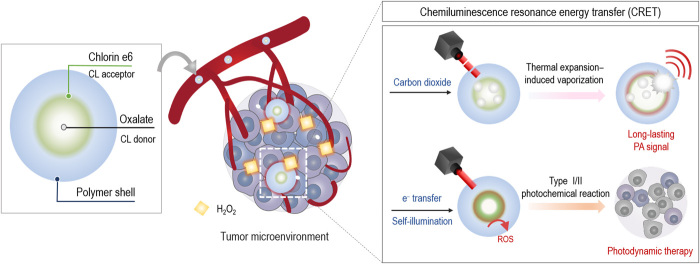
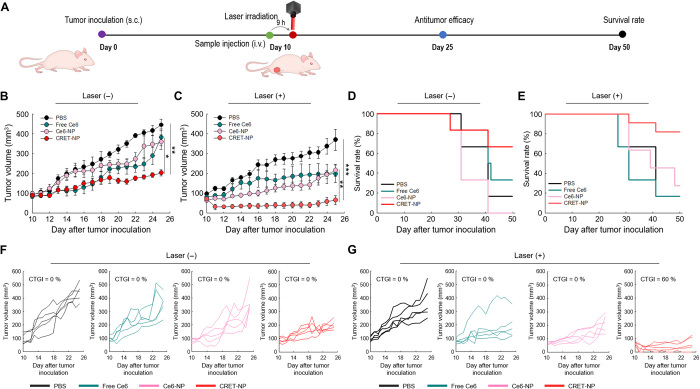
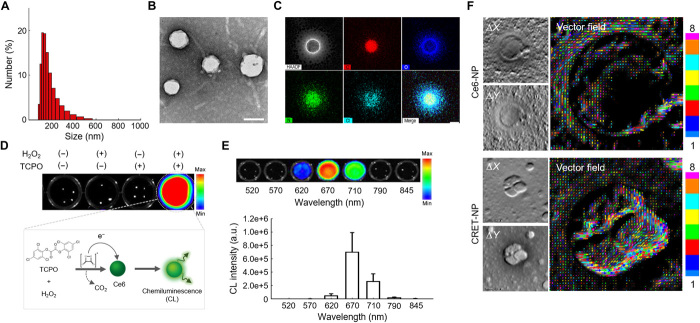
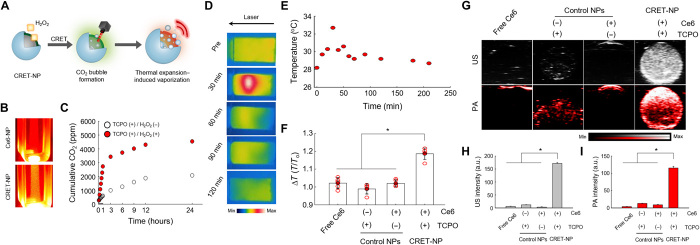
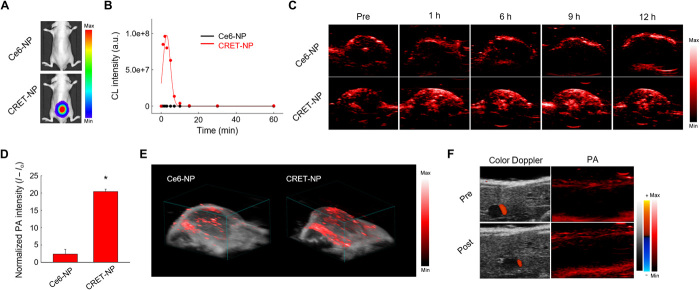
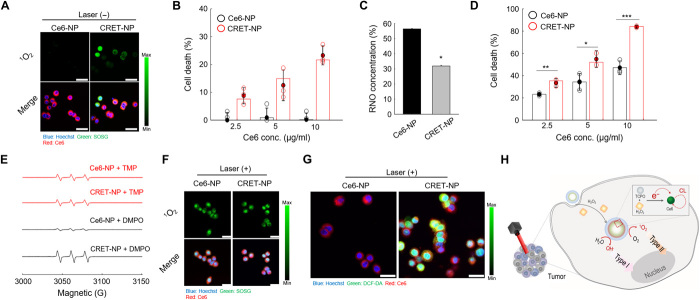
Chemiluminescence (CL) has recently gained attention for CL resonance energy transfer (CRET)-mediated photodynamic therapy of cancer. However, the short duration of the CL signal and low quantum yield of the photosensitizer have limited its translational applications. Here, we report CRET-based nanoparticles (CRET-NPs) to achieve quantum yield-enhanced cancer phototheranostics by reinterpreting the hidden nature of CRET. Owing to reactive oxygen species (ROS)-responsive CO generation, CRET-NPs were capable of generating a strong and long-lasting photoacoustic signal in the tumor tissue via thermal expansion-induced vaporization. In addition, the CRET phenomenon of the NPs enhanced ROS quantum yield of photosensitizer through both electron transfer for an oxygen-independent type I photochemical reaction and self-illumination for an oxygen-dependent type II photochemical reaction. Consequently, owing to their high ROS quantum yield, CRET-NPs effectively inhibited tumor growth with complete tumor growth inhibition in 60% of cases, even with a single treatment.
化学发光(CL)最近因基于化学发光共振能量转移(CRET)的癌症光动力疗法而受到关注。然而,CL信号的持续时间短和光敏剂的量子产率低限制了其转化应用。在此,我们报告了基于CRET的纳米颗粒(CRET-NPs),通过重新诠释CRET的隐藏本质来实现量子产率增强的癌症光诊疗。由于活性氧(ROS)响应性CO的产生,CRET-NPs能够通过热膨胀诱导的汽化在肿瘤组织中产生强烈且持久的光声信号。此外,NPs的CRET现象通过电子转移促进不依赖氧的I型光化学反应以及自身发光促进依赖氧的II型光化学反应,提高了光敏剂的ROS量子产率。因此,由于其高ROS量子产率,CRET-NPs有效地抑制了肿瘤生长,在60%的病例中实现了完全的肿瘤生长抑制,即使是单次治疗。