van Lent Liza Gg, Sungur Hande, Kunneman Florian A, van de Velde Bob, Das Enny
Centre for Language Studies, Radboud University, Nijmegen, Netherlands.
Communication Sciences, University of Amsterdam, Amsterdam, Netherlands.
J Med Internet Res. 2017 Jun 13;19(6):e193. doi: 10.2196/jmir.7219.
In 2014, the world was startled by a sudden outbreak of Ebola. Although Ebola infections and deaths occurred almost exclusively in Guinea, Sierra Leone, and Liberia, few potential Western cases, in particular, caused a great stir among the public in Western countries.
This study builds on the construal level theory to examine the relationship between psychological distance to an epidemic and public attention and sentiment expressed on Twitter. Whereas previous research has shown the potential of social media to assess real-time public opinion and sentiment, generalizable insights that further the theory development lack.
Epidemiological data (number of Ebola infections and fatalities) and media data (tweet volume and key events reported in the media) were collected for the 2014 Ebola outbreak, and Twitter content from the Netherlands was coded for (1) expressions of fear for self or fear for others and (2) psychological distance of the outbreak to the tweet source. Longitudinal relations were compared using vector error correction model (VECM) methodology.
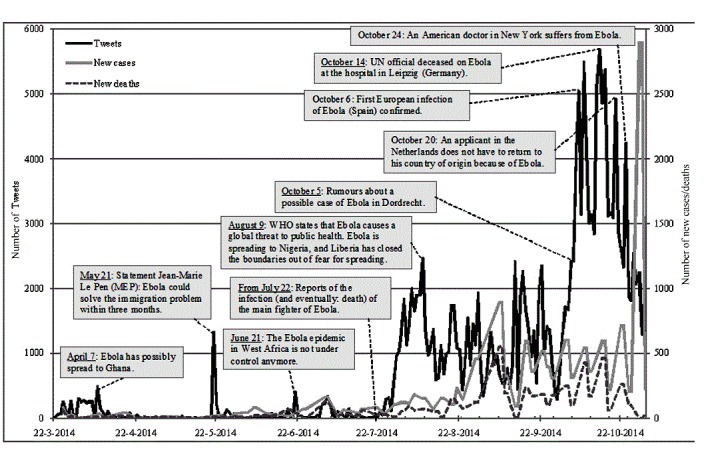
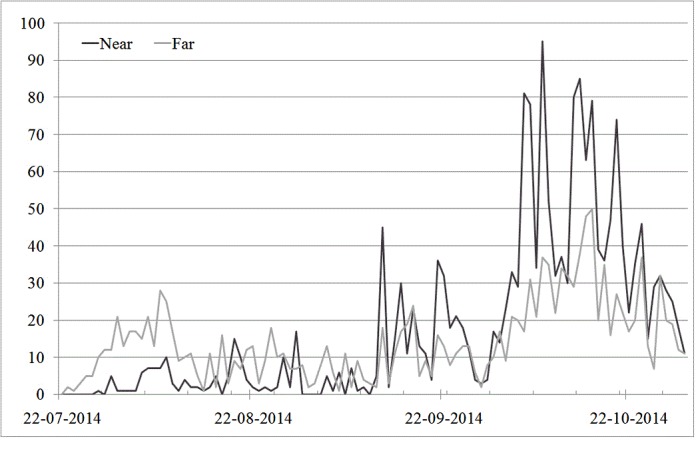
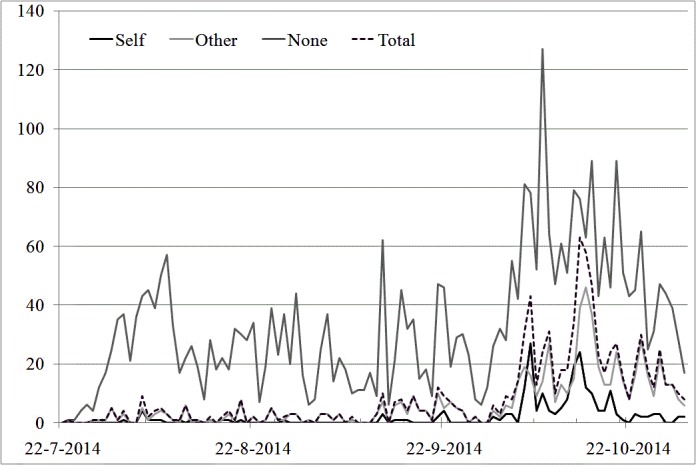
Analyses based on 4500 tweets revealed that increases in public attention to Ebola co-occurred with severe world events related to the epidemic, but not all severe events evoked fear. As hypothesized, Web-based public attention and expressions of fear responded mainly to the psychological distance of the epidemic. A chi-square test showed a significant positive relation between proximity and fear: χ=103.2 (P<.001). Public attention and fear for self in the Netherlands showed peaks when Ebola became spatially closer by crossing the Mediterranean Sea and Atlantic Ocean. Fear for others was mostly predicted by the social distance to the affected parties.
Spatial and social distance are important predictors of public attention to worldwide crisis such as epidemics. These factors need to be taken into account when communicating about human tragedies.
2014年,埃博拉疫情的突然爆发震惊了世界。尽管埃博拉感染和死亡几乎都发生在几内亚、塞拉利昂和利比里亚,但少数潜在的西方病例,尤其是在西方国家引起了公众的极大轰动。
本研究基于解释水平理论,探讨与流行病的心理距离与推特上表达的公众关注和情绪之间的关系。尽管先前的研究表明社交媒体有评估实时公众舆论和情绪的潜力,但缺乏推进理论发展的可推广见解。
收集了2014年埃博拉疫情爆发的流行病学数据(埃博拉感染和死亡人数)和媒体数据(推特发布量和媒体报道的关键事件),并对来自荷兰的推特内容进行编码,分析(1)对自己或他人的恐惧表达,以及(2)疫情与推特来源的心理距离。使用向量误差修正模型(VECM)方法比较纵向关系。
基于4500条推文的分析表明,公众对埃博拉的关注度增加与与该疫情相关的严重世界事件同时发生,但并非所有严重事件都会引发恐惧。如假设的那样,基于网络的公众关注和恐惧表达主要对疫情的心理距离做出反应。卡方检验显示接近程度与恐惧之间存在显著正相关:χ=103.2(P<.001)。当埃博拉疫情跨越地中海和大西洋在空间上变得更近时,荷兰的公众关注和对自身的恐惧出现了峰值。对他人的恐惧大多由与受影响方的社会距离预测。
空间和社会距离是公众对诸如流行病等全球危机关注的重要预测因素。在传播人类悲剧时需要考虑这些因素。