• 文献检索
  • 文档翻译
  • 深度研究
  • 学术资讯
  • Suppr Zotero 插件Zotero 插件
  • 邀请有礼
  • 套餐&价格
  • 历史记录
应用&插件
Suppr Zotero 插件Zotero 插件浏览器插件Mac 客户端Windows 客户端微信小程序
定价
高级版会员购买积分包购买API积分包
服务
文献检索文档翻译深度研究API 文档MCP 服务
关于我们
关于 Suppr公司介绍联系我们用户协议隐私条款
关注我们

Suppr 超能文献

核心技术专利:CN118964589B侵权必究
粤ICP备2023148730 号-1Suppr @ 2026

文献检索

告别复杂PubMed语法,用中文像聊天一样搜索,搜遍4000万医学文献。AI智能推荐,让科研检索更轻松。

立即免费搜索

文件翻译

保留排版,准确专业,支持PDF/Word/PPT等文件格式,支持 12+语言互译。

免费翻译文档

深度研究

AI帮你快速写综述,25分钟生成高质量综述,智能提取关键信息,辅助科研写作。

立即免费体验

媒体报道和政府政策对与 COVID-19 皮肤症状相关的谷歌查询的影响:信息流行病学研究。

The Influence of Media Coverage and Governmental Policies on Google Queries Related to COVID-19 Cutaneous Symptoms: Infodemiology Study.

机构信息

Assistance Publique des Hôpitaux de Paris (AP-HP), Département de dermatologie, Hôpital Henri Mondor, Créteil, France.

Laboratoire Génie Industriel, CentraleSupélec, Université Paris-Saclay, Gif-sur-Yvette, France.

出版信息

JMIR Public Health Surveill. 2021 Feb 25;7(2):e25651. doi: 10.2196/25651.

DOI:10.2196/25651
PMID:33513563
原文链接:https://pmc.ncbi.nlm.nih.gov/articles/PMC7909455/
Abstract

BACKGROUND

During COVID-19, studies have reported the appearance of internet searches for disease symptoms before their validation by the World Health Organization. This suggested that monitoring of these searches with tools including Google Trends may help monitor the pandemic itself. In Europe and North America, dermatologists reported an unexpected outbreak of cutaneous acral lesions (eg, chilblain-like lesions) in April 2020. However, external factors such as public communications may also hinder the use of Google Trends as an infodemiology tool.

OBJECTIVE

The study aimed to assess the impact of media announcements and lockdown enforcement on internet searches related to cutaneous acral lesions during the COVID-19 outbreak in 2020.

METHODS

Two searches on Google Trends, including daily relative search volumes for (1) "toe" or "chilblains" and (2) "coronavirus," were performed from January 1 to May 16, 2020, with the United States, the United Kingdom, France, Italy, Spain, and Germany as the countries of choice. The ratio of interest over time in "chilblains" and "coronavirus" was plotted. To assess the impact of lockdown enforcement and media coverage on these internet searches, we performed an interrupted time-series analysis for each country.

RESULTS

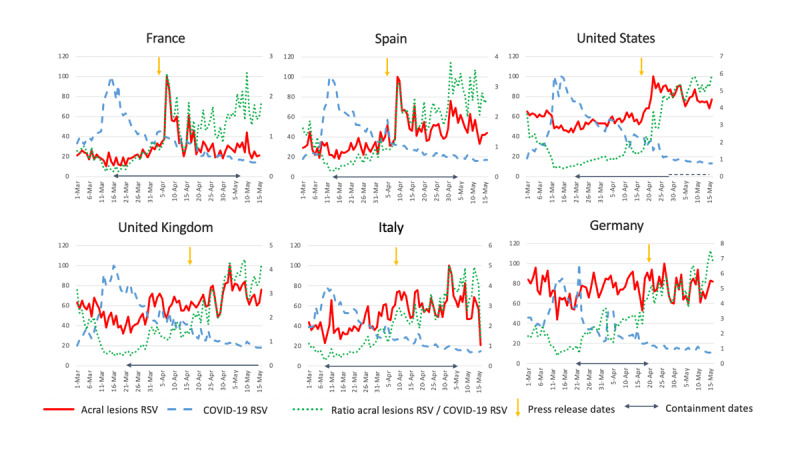
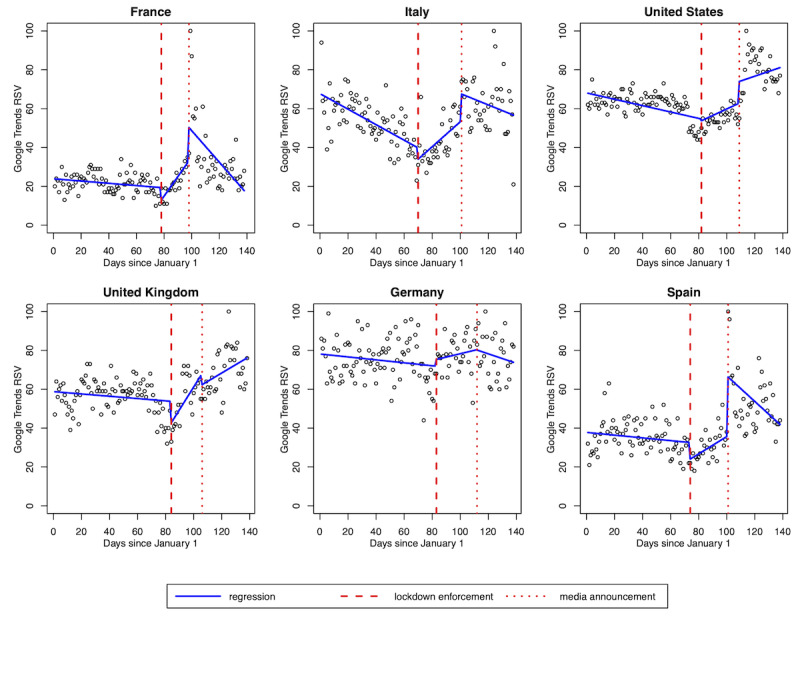
The ratio of interest over time in "chilblains" to "coronavirus" showed a constant upward trend. In France, Italy, and the United Kingdom, lockdown enforcement was associated with a significant slope change for "chilblain" searches with a variation coefficient of 1.06 (SE 0.42) (P=0.01), 1.04 (SE 0.28) (P<.01), and 1.21 (SE 0.44) (P=0.01), respectively. After media announcements, these ratios significantly increased in France, Spain, Italy, and the United States with variation coefficients of 18.95 (SE 5.77) (P=.001), 31.31 (SE 6.31) (P<.001), 14.57 (SE 6.33) (P=.02), and 11.24 (SE 4.93) (P=.02), respectively, followed by a significant downward trend in France (-1.82 [SE 0.45]), Spain (-1.10 [SE 0.38]), and Italy (-0.93 [SE 0.33]) (P<.001, P=0.004, and P<.001, respectively). The adjusted R values were 0.311, 0.351, 0.325, and 0.305 for France, Spain, Italy, and the United States, respectively, suggesting an average correlation between time and the search volume; however, this correlation was weak for Germany and the United Kingdom.

CONCLUSIONS

To date, the association between chilblain-like lesions and COVID-19 remains controversial; however, our results indicate that Google queries of "chilblain" were highly influenced by media coverage and government policies, indicating that caution should be exercised when using Google Trends as a monitoring tool for emerging diseases.
https://cdn.ncbi.nlm.nih.gov/pmc/blobs/8ad2/7909455/3739c4533d45/publichealth_v7i2e25651_fig2.jpg
https://cdn.ncbi.nlm.nih.gov/pmc/blobs/8ad2/7909455/3660ba3f6315/publichealth_v7i2e25651_fig1.jpg
https://cdn.ncbi.nlm.nih.gov/pmc/blobs/8ad2/7909455/3739c4533d45/publichealth_v7i2e25651_fig2.jpg
https://cdn.ncbi.nlm.nih.gov/pmc/blobs/8ad2/7909455/3660ba3f6315/publichealth_v7i2e25651_fig1.jpg
https://cdn.ncbi.nlm.nih.gov/pmc/blobs/8ad2/7909455/3739c4533d45/publichealth_v7i2e25651_fig2.jpg
摘要

背景

在 COVID-19 期间,有研究报告称,在世界卫生组织(WHO)确认疾病症状之前,人们已经在互联网上搜索过这些症状。这表明,使用包括 Google Trends 在内的工具监测这些搜索,可能有助于监测大流行本身。在欧洲和北美,皮肤科医生报告称,2020 年 4 月,出现了大量的肢端皮肤病变(如冻疮样病变)。然而,公众宣传等外部因素也可能会阻碍 Google Trends 作为传染病监测工具的使用。

目的

本研究旨在评估媒体公告和封锁执行对 2020 年 COVID-19 爆发期间与肢端皮肤病变相关的互联网搜索的影响。

方法

从 2020 年 1 月 1 日至 5 月 16 日,我们在 Google Trends 上进行了两次搜索,包括对(1)“脚趾”或“冻疮”和(2)“冠状病毒”的每日相对搜索量进行搜索,选择了美国、英国、法国、意大利、西班牙和德国作为研究国家。绘制“冻疮”和“冠状病毒”随时间的兴趣比。为了评估封锁执行和媒体报道对这些互联网搜索的影响,我们对每个国家进行了中断时间序列分析。

结果

“冻疮”与“冠状病毒”的兴趣比随时间呈持续上升趋势。在法国、意大利和英国,封锁执行与“冻疮”搜索的斜率变化显著相关,变化系数分别为 1.06(SE 0.42)(P=0.01)、1.04(SE 0.28)(P<.01)和 1.21(SE 0.44)(P=0.01)。在媒体发布公告后,法国、西班牙、意大利和美国的这些比率显著增加,变化系数分别为 18.95(SE 5.77)(P=.001)、31.31(SE 6.31)(P<.001)、14.57(SE 6.33)(P=.02)和 11.24(SE 4.93)(P=.02),随后法国(-1.82 [SE 0.45])、西班牙(-1.10 [SE 0.38])和意大利(-0.93 [SE 0.33])的比率显著下降(P<.001、P=0.004 和 P<.001)。法国、西班牙、意大利和美国的调整 R 值分别为 0.311、0.351、0.325 和 0.305,这表明时间与搜索量之间存在平均相关性;然而,德国和英国的相关性较弱。

结论

迄今为止,冻疮样病变与 COVID-19 之间的关联仍存在争议;然而,我们的结果表明,“冻疮”的谷歌查询受到媒体报道和政府政策的高度影响,这表明在将 Google Trends 用作新兴疾病监测工具时应谨慎行事。

相似文献

1
The Influence of Media Coverage and Governmental Policies on Google Queries Related to COVID-19 Cutaneous Symptoms: Infodemiology Study.媒体报道和政府政策对与 COVID-19 皮肤症状相关的谷歌查询的影响:信息流行病学研究。
JMIR Public Health Surveill. 2021 Feb 25;7(2):e25651. doi: 10.2196/25651.
2
Correlations of Online Search Engine Trends With Coronavirus Disease (COVID-19) Incidence: Infodemiology Study.在线搜索引擎趋势与冠状病毒病(COVID-19)发病的相关性:信息流行病学研究。
JMIR Public Health Surveill. 2020 May 21;6(2):e19702. doi: 10.2196/19702.
3
The Popularity of the Biologically-Based Therapies During Coronavirus Pandemic Among the Google Users in the USA, UK, Germany, Italy and France.在冠状病毒大流行期间,美国、英国、德国、意大利和法国的谷歌用户中生物疗法的受欢迎程度。
Complement Ther Med. 2021 May;58:102682. doi: 10.1016/j.ctim.2021.102682. Epub 2021 Feb 15.
4
United States Influenza Search Patterns Since the Emergence of COVID-19: Infodemiology Study.美国自新冠肺炎疫情出现以来的流感搜索模式:信息流行病学研究。
JMIR Public Health Surveill. 2022 Mar 3;8(3):e32364. doi: 10.2196/32364.
5
Association of Search Query Interest in Gastrointestinal Symptoms With COVID-19 Diagnosis in the United States: Infodemiology Study.美国胃肠道症状搜索查询兴趣与 COVID-19 诊断的关联:信息流行病学研究。
JMIR Public Health Surveill. 2020 Jul 17;6(3):e19354. doi: 10.2196/19354.
6
Public Interest in Immunity and the Justification for Intervention in the Early Stages of the COVID-19 Pandemic: Analysis of Google Trends Data.公众对免疫的关注和在 COVID-19 大流行早期阶段进行干预的正当性:谷歌趋势数据分析。
J Med Internet Res. 2021 Jun 18;23(6):e26368. doi: 10.2196/26368.
7
Understanding Health Communication Through Google Trends and News Coverage for COVID-19: Multinational Study in Eight Countries.通过谷歌趋势和新冠疫情新闻报道理解健康传播:八国跨国研究。
JMIR Public Health Surveill. 2021 Dec 21;7(12):e26644. doi: 10.2196/26644.
8
Tracking COVID-19 in Europe: Infodemiology Approach.追踪欧洲的 COVID-19:信息流行病学方法。
JMIR Public Health Surveill. 2020 Apr 20;6(2):e18941. doi: 10.2196/18941.
9
Ocular-symptoms-related Google Search Trends during the COVID-19 Pandemic in Europe.新冠疫情期间欧洲与眼部症状相关的谷歌搜索趋势。
Int Ophthalmol. 2021 Jun;41(6):2213-2223. doi: 10.1007/s10792-021-01782-5. Epub 2021 Mar 16.
10
Information-Seeking Patterns During the COVID-19 Pandemic Across the United States: Longitudinal Analysis of Google Trends Data.美国新冠疫情期间的信息寻求模式:谷歌趋势数据的纵向分析
J Med Internet Res. 2021 May 3;23(5):e22933. doi: 10.2196/22933.

引用本文的文献

1
Spatiotemporal evolution of online interest in assisted reproductive technology: a two-decade global analysis through google trends.辅助生殖技术在线关注度的时空演变:通过谷歌趋势进行的二十年全球分析
BMC Public Health. 2025 Aug 18;25(1):2822. doi: 10.1186/s12889-025-23990-9.
2
Evaluating the effectiveness and limitations of online health information tools in assessing the quality of medication-related content.评估在线健康信息工具在评估药物相关内容质量方面的有效性和局限性。
Front Public Health. 2025 Feb 24;13:1460202. doi: 10.3389/fpubh.2025.1460202. eCollection 2025.
3
Infodemiology of RSV in Italy (2017-2022): An Alternative Option for the Surveillance of Incident Cases in Pediatric Age?

本文引用的文献

1
COVID-19 pandemic and the skin: what should dermatologists know?COVID-19 大流行与皮肤:皮肤科医生应该了解哪些知识?
Clin Dermatol. 2020 Nov-Dec;38(6):785-787. doi: 10.1016/j.clindermatol.2020.03.012. Epub 2020 Mar 24.
2
Clinical, Laboratory, and Interferon-Alpha Response Characteristics of Patients With Chilblain-like Lesions During the COVID-19 Pandemic.COVID-19 大流行期间冻疮样皮损患者的临床、实验室和干扰素-α反应特征。
JAMA Dermatol. 2021 Feb 1;157(2):202-206. doi: 10.1001/jamadermatol.2020.4324.
3
Why are chilblains underreported in Nordic countries during the COVID-19 pandemic? An analysis of Google Trends.
意大利呼吸道合胞病毒的信息流行病学(2017 - 2022年):儿童期新发病例监测的另一种选择?
Children (Basel). 2022 Dec 16;9(12):1984. doi: 10.3390/children9121984.
4
Forecasting and Surveillance of COVID-19 Spread Using Google Trends: Literature Review.利用谷歌趋势预测和监测 COVID-19 传播:文献综述。
Int J Environ Res Public Health. 2022 Sep 29;19(19):12394. doi: 10.3390/ijerph191912394.
5
Online Information of COVID-19: Visibility and Characterization of Highest Positioned Websites by Google between March and April 2020-A Cross-Country Analysis.2020 年 3 月至 4 月期间谷歌对 COVID-19 最高排名网站的在线信息:可见性和特征分析——一项跨国研究
Int J Environ Res Public Health. 2022 Jan 28;19(3):1491. doi: 10.3390/ijerph19031491.
6
The national burden of scabies in Germany: a population-based approach using Internet search engine data.德国疥疮的国家负担:基于人群的方法,使用互联网搜索引擎数据。
Infection. 2022 Aug;50(4):915-923. doi: 10.1007/s15010-022-01763-5. Epub 2022 Feb 8.
7
Associations between COVID-19 mobility restrictions and economic, mental health, and suicide-related concerns in the US using cellular phone GPS and Google search volume data.利用手机 GPS 和谷歌搜索量数据,研究美国新冠疫情出行限制措施与经济、心理健康和自杀相关问题的关联。
PLoS One. 2021 Dec 22;16(12):e0260931. doi: 10.1371/journal.pone.0260931. eCollection 2021.
8
Influence of Mass Media on Italian Web Users During the COVID-19 Pandemic: Infodemiological Analysis.新冠疫情期间大众媒体对意大利网络用户的影响:信息流行病学分析
JMIRx Med. 2021 Oct 18;2(4):e32233. doi: 10.2196/32233. eCollection 2021 Oct-Dec.
9
Online Search Behavior Related to COVID-19 Vaccines: Infodemiology Study.与新冠疫苗相关的在线搜索行为:信息流行病学研究
JMIR Infodemiology. 2021 Nov 12;1(1):e32127. doi: 10.2196/32127. eCollection 2021 Jan-Dec.
10
Understanding Health Communication Through Google Trends and News Coverage for COVID-19: Multinational Study in Eight Countries.通过谷歌趋势和新冠疫情新闻报道理解健康传播:八国跨国研究。
JMIR Public Health Surveill. 2021 Dec 21;7(12):e26644. doi: 10.2196/26644.
为什么在新冠疫情期间北欧国家冻疮的报告率较低?基于谷歌趋势的分析
J Eur Acad Dermatol Venereol. 2021 Feb;35(2):e100-e101. doi: 10.1111/jdv.16974. Epub 2020 Oct 22.
4
Google searches in patient self-care increase during the COVID-19 lockdown.在新冠疫情封锁期间,患者自我护理方面的谷歌搜索量有所增加。
J Am Acad Dermatol. 2020 Nov;83(5):e349. doi: 10.1016/j.jaad.2020.06.1028. Epub 2020 Jul 21.
5
Regional Infoveillance of COVID-19 Case Rates: Analysis of Search-Engine Query Patterns.新型冠状病毒肺炎病例发生率的区域信息监测:搜索引擎查询模式分析
J Med Internet Res. 2020 Jul 30;22(7):e19483. doi: 10.2196/19483.
6
The "Big Five" Lung Diseases in CoViD-19 Pandemic - a Google Trends analysis.新冠疫情中的“五大”肺部疾病——谷歌趋势分析
Pulmonology. 2021 Jan-Feb;27(1):71-72. doi: 10.1016/j.pulmoe.2020.06.008. Epub 2020 Jun 23.
7
Evaluation of Chilblains as a Manifestation of the COVID-19 Pandemic.冻疮作为 COVID-19 大流行表现的评估。
JAMA Dermatol. 2020 Sep 1;156(9):998-1003. doi: 10.1001/jamadermatol.2020.2368.
8
Negative SARS-CoV-2 PCR in patients with chilblain-like lesions.冻疮样皮损患者的新冠病毒核酸检测呈阴性。
Lancet Infect Dis. 2021 Mar;21(3):315-316. doi: 10.1016/S1473-3099(20)30518-1. Epub 2020 Jun 18.
9
Three months of informational trends in COVID-19 across New York City.纽约市 COVID-19 信息趋势三个月分析。
J Public Health (Oxf). 2020 Aug 18;42(3):448-450. doi: 10.1093/pubmed/fdaa082.
10
Are online searches for the novel coronavirus (COVID-19) related to media or epidemiology? A cross-sectional study.针对新型冠状病毒(COVID-19)的在线搜索是否与媒体或流行病学有关?一项横断面研究。
Int J Infect Dis. 2020 Aug;97:386-390. doi: 10.1016/j.ijid.2020.06.028. Epub 2020 Jun 12.