Tošović Jelena, Bren Urban
Faculty of Chemistry and Chemical Engineering, University of Maribor, Smetanova Street 17, SI-2000 Maribor, Slovenia.
Department of Chemistry, Faculty of Science, University of Kragujevac, 12 Radoja Domanovića, 34000 Kragujevac, Serbia.
Antioxidants (Basel). 2020 Jul 6;9(7):587. doi: 10.3390/antiox9070587.
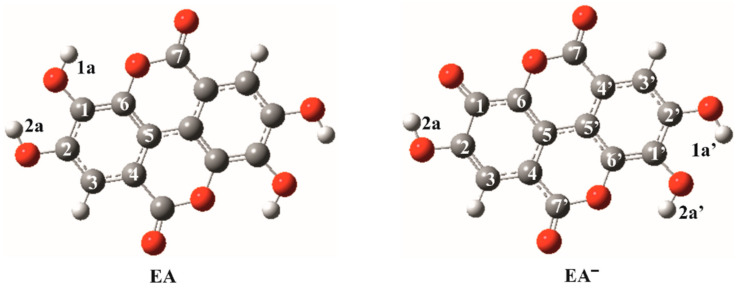
Although one can find numerous studies devoted to the investigation of antioxidative activity of ellagic acid (EA) in the scientific literature, the mechanisms of its action have not yet been fully clarified. Therefore, further kinetic studies are needed to understand its antioxidative capacity completely. This work aims to reveal the underlying molecular mechanisms responsible for the antioxidative action of EA. For this purpose, its reactions with HO and CClOO radicals were simulated at physiological conditions using the quantum mechanics-based test for overall free-radical scavenging activity. The density functional theory in combination with the conductor-like polarizable continuum solvation model was utilized. With HO radical EA conforms to the hydrogen atom transfer and radical adduct formation mechanisms, whereas sequential proton loss electron transfer mechanism is responsible for scavenging of CClOO radical. In addition, compared to trolox, EA was found more reactive toward HO, but less reactive toward CClOO. The calculated rate constants for the reactions of EA with both free radicals are in a very good agreement with the corresponding experimental values.
尽管在科学文献中可以找到大量致力于研究鞣花酸(EA)抗氧化活性的研究,但其作用机制尚未完全阐明。因此,需要进一步的动力学研究来全面了解其抗氧化能力。这项工作旨在揭示EA抗氧化作用背后的分子机制。为此,在生理条件下,使用基于量子力学的整体自由基清除活性测试,模拟了EA与HO和CClOO自由基的反应。采用了密度泛函理论与类导体极化连续介质溶剂化模型相结合的方法。对于HO自由基,EA符合氢原子转移和自由基加合物形成机制,而顺序质子损失电子转移机制则负责清除CClOO自由基。此外,与生育三烯酚相比,发现EA对HO的反应性更高,但对CClOO的反应性更低。计算得到的EA与两种自由基反应的速率常数与相应的实验值非常吻合。