Department of Viroscience, Erasmus University Medical Center, Rotterdam, The Netherlands.
Erasmus Laboratory Animal Science Center, Erasmus University Medical Center, Rotterdam, The Netherlands.
Nat Commun. 2020 Jul 8;11(1):3496. doi: 10.1038/s41467-020-17367-2.
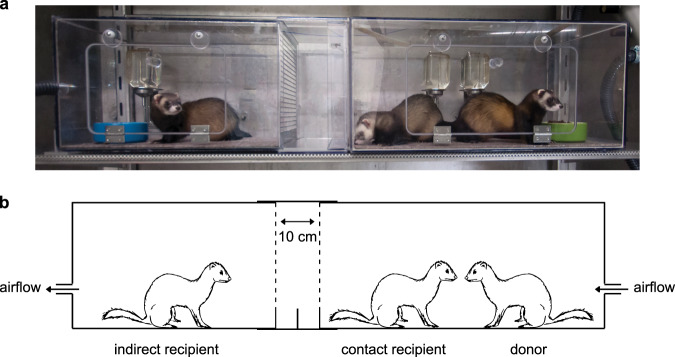
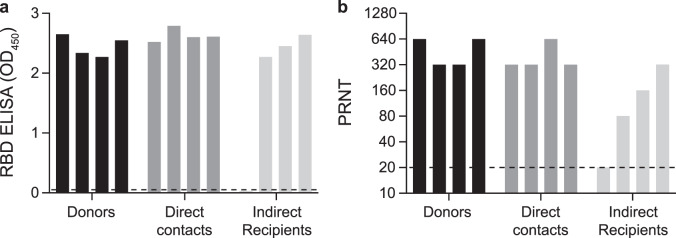
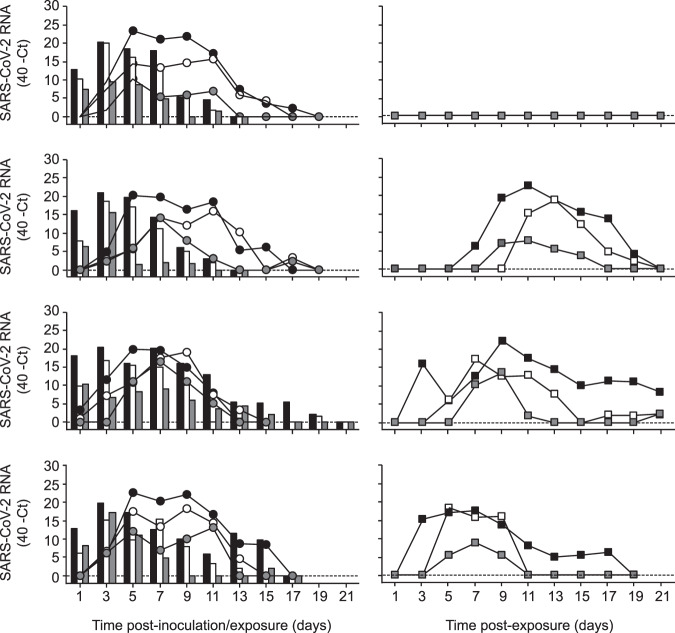
SARS-CoV-2, a coronavirus that emerged in late 2019, has spread rapidly worldwide, and information about the modes of transmission of SARS-CoV-2 among humans is critical to apply appropriate infection control measures and to slow its spread. Here we show that SARS-CoV-2 is transmitted efficiently via direct contact and via the air (via respiratory droplets and/or aerosols) between ferrets, 1 to 3 days and 3 to 7 days after exposure respectively. The pattern of virus shedding in the direct contact and indirect recipient ferrets is similar to that of the inoculated ferrets and infectious virus is isolated from all positive animals, showing that ferrets are productively infected via either route. This study provides experimental evidence of robust transmission of SARS-CoV-2 via the air, supporting the implementation of community-level social distancing measures currently applied in many countries in the world and informing decisions on infection control measures in healthcare settings.
SARS-CoV-2 是一种在 2019 年末出现的冠状病毒,已在全球范围内迅速传播。了解 SARS-CoV-2 在人与人之间的传播模式对于采取适当的感染控制措施和减缓其传播至关重要。在这里,我们证明 SARS-CoV-2 在暴露后分别为 1 至 3 天和 3 至 7 天之间,在雪貂之间通过直接接触和空气(通过呼吸道飞沫和/或气溶胶)有效传播。在直接接触和间接接受的雪貂中,病毒脱落的模式与接种的雪貂相似,并且从所有阳性动物中分离出传染性病毒,表明雪貂通过任一途径都可有效感染。这项研究提供了 SARS-CoV-2 通过空气进行强有力传播的实验证据,支持了目前在世界许多国家实施的社区层面的社交距离措施,并为医疗保健环境中的感染控制措施决策提供了信息。