Shi Yanmei, Ji Yan, Long Jun, Liang Yu, Liu Yang, Yu Yifu, Xiao Jianping, Zhang Bin
Institute of Molecular Plus, Department of Chemistry, School of Science, Tianjin University, Tianjin, 300072, China.
Tianjin Key Laboratory of Molecular Optoelectronic Science, Collaborative Innovation Center of Chemical Science and Engineering, Tianjin, 300072, China.
Nat Commun. 2020 Jul 8;11(1):3415. doi: 10.1038/s41467-020-17120-9.
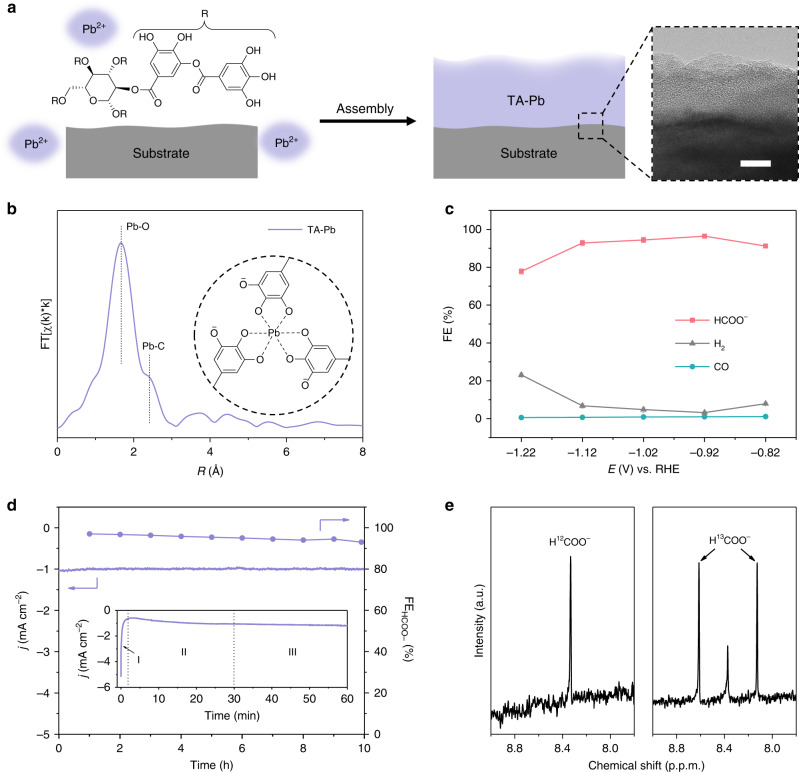
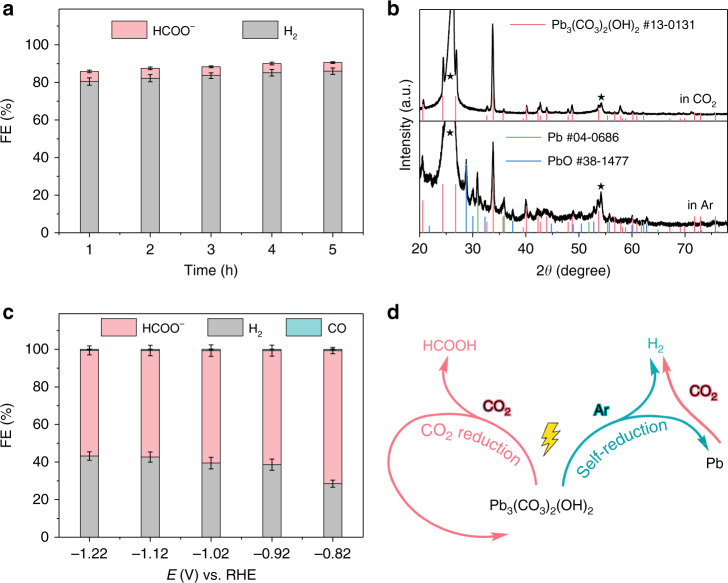
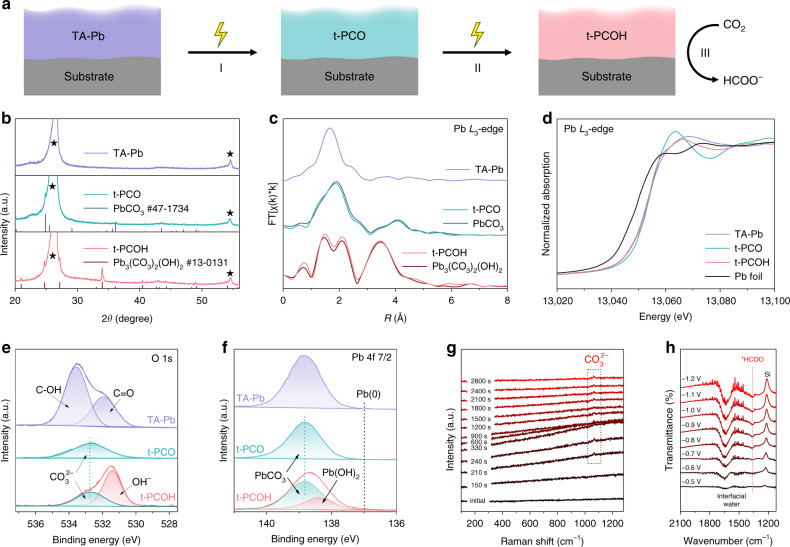
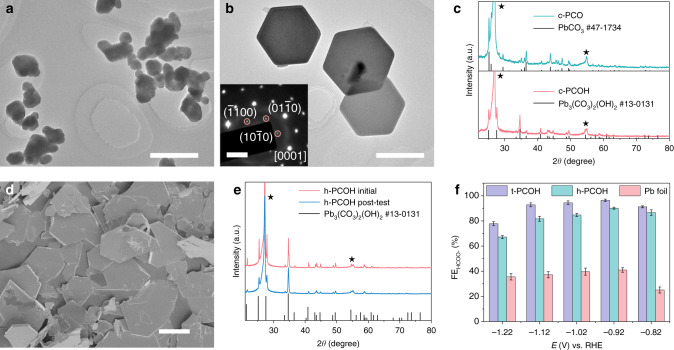
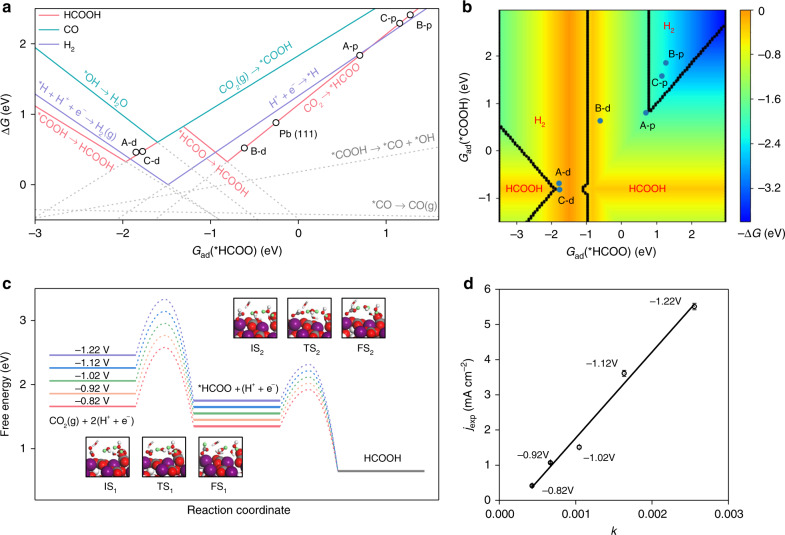
For most metal-containing CO reduction reaction (CORR) electrocatalysts, the unavoidable self-reduction to zero-valence metal will promote hydrogen evolution, hence lowering the CORR selectivity. Thus it is challenging to design a stable phase with resistance to electrochemical self-reduction as well as high CORR activity. Herein, we report a scenario to develop hydrocerussite as a stable and active electrocatalyst via in situ conversion of a complex precursor, tannin-lead(II) (TA-Pb) complex. A comprehensive characterization reveals the in situ transformation of TA-Pb to cerussite (PbCO), and sequentially to hydrocerussite (Pb(CO)(OH)), which finally serves as a stable and active phase under CORR condition. Both experiments and theoretical calculations confirm the high activity and selectivity over hydrocerussite. This work not only offers a new approach of enhancing the selectivity in CORR by suppressing the self-reduction of electrode materials, but also provides a strategy for studying the reaction mechanism and active phases of electrocatalysts.
对于大多数含金属的一氧化碳还原反应(CORR)电催化剂而言,不可避免的自还原为零价金属会促进析氢,从而降低CORR选择性。因此,设计一种既具有抗电化学自还原能力又具有高CORR活性的稳定相具有挑战性。在此,我们报道了一种通过复杂前驱体单宁-铅(II)(TA-Pb)配合物的原位转化来开发白铅矿作为稳定且活性电催化剂的方案。全面表征揭示了TA-Pb原位转变为碳酸铅(PbCO),并依次转变为羟碳酸铅(Pb(CO)(OH)),最终在CORR条件下作为稳定且活性的相。实验和理论计算均证实了羟碳酸铅具有高活性和选择性。这项工作不仅提供了一种通过抑制电极材料自还原来提高CORR选择性的新方法,还为研究电催化剂的反应机理和活性相提供了一种策略。