Department of Behavioral Sciences, New York Institute of Technology, Old Westbury, New York, USA.
Department of Psychology, Stony Brook University, New York, USA.
Sci Rep. 2020 Jul 8;10(1):11222. doi: 10.1038/s41598-020-66732-0.
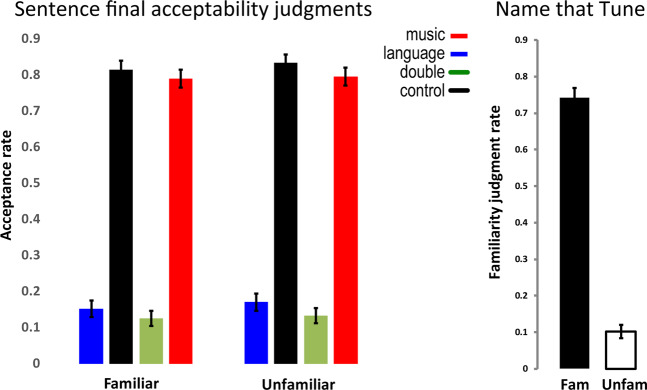
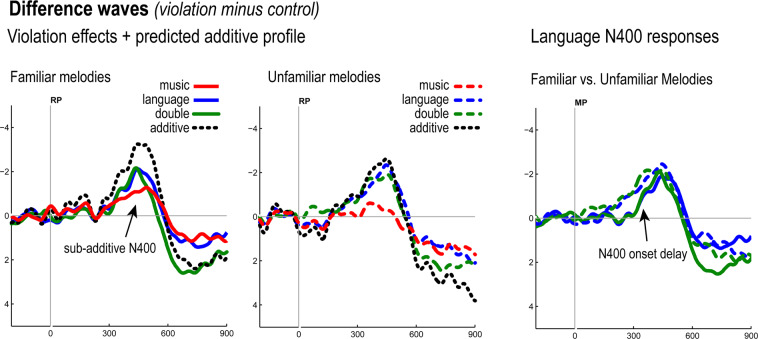
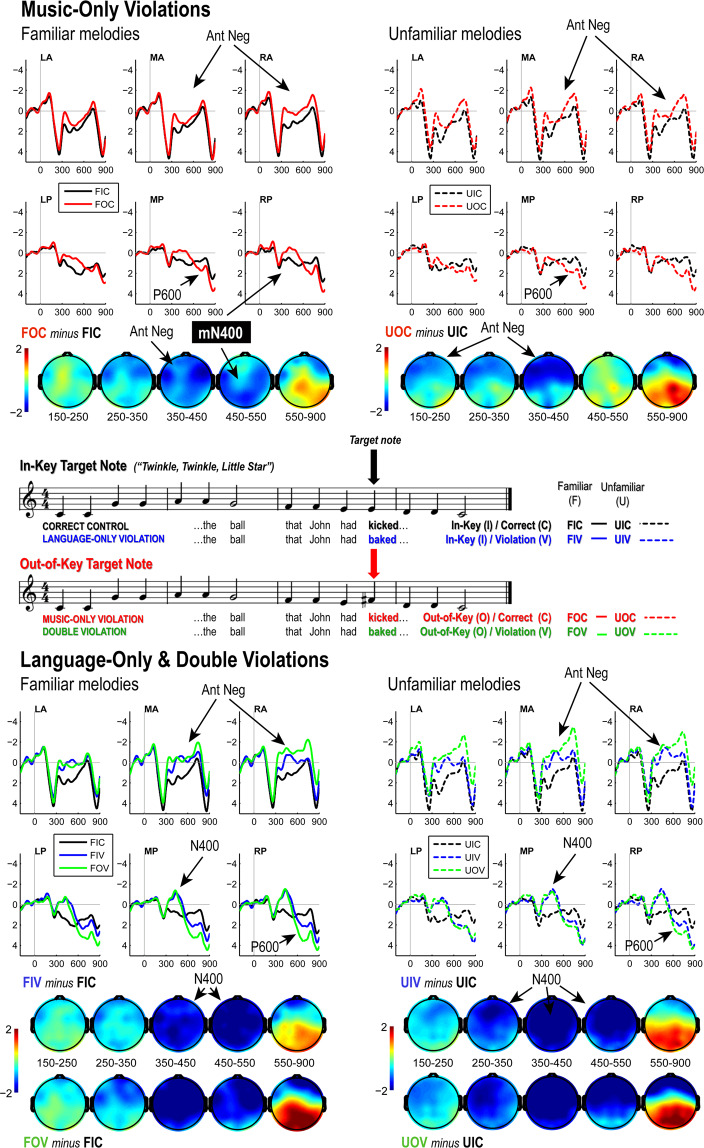
Studies of the relationship of language and music have suggested these two systems may share processing resources involved in the computation/maintenance of abstract hierarchical structure (syntax). One type of evidence comes from ERP interference studies involving concurrent language/music processing showing interaction effects when both processing streams are simultaneously perturbed by violations (e.g., syntactically incorrect words paired with incongruent completion of a chord progression). Here, we employ this interference methodology to target the mechanisms supporting long term memory (LTM) access/retrieval in language and music. We used melody stimuli from previous work showing out-of-key or unexpected notes may elicit a musical analogue of language N400 effects, but only for familiar melodies, and not for unfamiliar ones. Target notes in these melodies were time-locked to visually presented target words in sentence contexts manipulating lexical/conceptual semantic congruity. Our study succeeded in eliciting expected N400 responses from each cognitive domain independently. Among several new findings we argue to be of interest, these data demonstrate that: (i) language N400 effects are delayed in onset by concurrent music processing only when melodies are familiar, and (ii) double violations with familiar melodies (but not with unfamiliar ones) yield a sub-additive N400 response. In addition: (iii) early negativities (RAN effects), which previous work has connected to musical syntax, along with the music N400, were together delayed in onset for familiar melodies relative to the timing of these effects reported in the previous music-only study using these same stimuli, and (iv) double violation cases involving unfamiliar/novel melodies also delayed the RAN effect onset. These patterns constitute the first demonstration of N400 interference effects across these domains and together contribute previously undocumented types of interactions to the available pool of findings relevant to understanding whether language and music may rely on shared underlying mechanisms.
对语言和音乐关系的研究表明,这两个系统可能共享涉及抽象层次结构(语法)计算/维护的处理资源。一种证据来自于涉及同时进行语言/音乐处理的 ERP 干扰研究,当两个处理流同时受到违反(例如,与不和谐的和弦进行不匹配的语法不正确的单词)的干扰时,会显示出相互作用的效果。在这里,我们采用这种干扰方法来针对支持语言和音乐长期记忆(LTM)访问/检索的机制。我们使用了先前工作中的旋律刺激,这些刺激表明,不和谐或意外的音符可能会引发语言 N400 效应的音乐类似物,但仅适用于熟悉的旋律,而不适用于不熟悉的旋律。这些旋律中的目标音符与视觉呈现的句子语境中的目标词时间锁定,操纵词汇/概念语义一致性。我们的研究成功地从每个认知领域独立引出了预期的 N400 反应。在我们认为有趣的几项新发现中,这些数据表明:(i)只有在旋律熟悉的情况下,同时进行音乐处理才会延迟语言 N400 效应的起始;(ii)具有熟悉旋律的双重违规(但不具有不熟悉旋律)会产生亚加性的 N400 响应;(iii)先前的工作将早期负性(RAN 效应)与音乐语法联系起来,以及音乐 N400,相对于使用相同刺激的先前仅音乐研究中报告的这些效应的时间,相对于以前仅音乐研究中报告的这些效应的时间,对于熟悉的旋律,它们的起始都会延迟;(iv)涉及不熟悉/新颖旋律的双重违规情况也会延迟 RAN 效应的起始。这些模式构成了这些领域中 N400 干扰效应的首次演示,并且共同为理解语言和音乐是否可能依赖于共享的潜在机制提供了以前未记录的相互作用类型。