Dreyer Chris H, Kjaergaard Kristian, Ding Ming, Qin Ling
Orthopaedic Research Laboratory, Department of Orthopaedics & Traumatology, Odense University Hospital, Department of Clinical Research, University of Southern Denmark, 5000, Odense C, Denmark.
Musculoskeletal Research Laboratory, Department of Orthopaedic Surgery & Traumatology, The Chinese University of Hong Kong, Hong Kong SAR, PR China.
J Orthop Translat. 2020 Jun 7;24:46-57. doi: 10.1016/j.jot.2020.05.005. eCollection 2020 Sep.
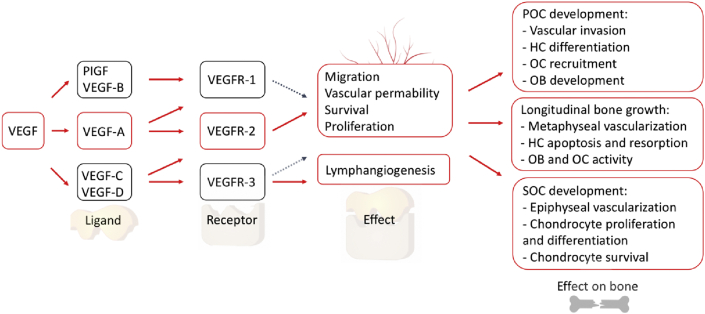
To achieve optimal bone formation one of the most influential parameters has been mentioned to be adequate blood supply. Vascular endothelial growth factor (VEGF) is hereby of particular interest in bone regeneration, because of its primary ability to induce neovascularization and chemokine affection for endothelial cells (EC), and is considered to be the main regulator of vascular formation. However, the growth factor has yet to be implemented in a clinical setting in orthopaedic intervention surgery. We hypothesised that the development of VEGF in vivo for bone formation in the last decade had progressed towards clinical application since the latest systematic review from 2008.
This systematic review recapped the last 13 years of in vivo bone regeneration using vascular endothelial growth factor (VEGF).
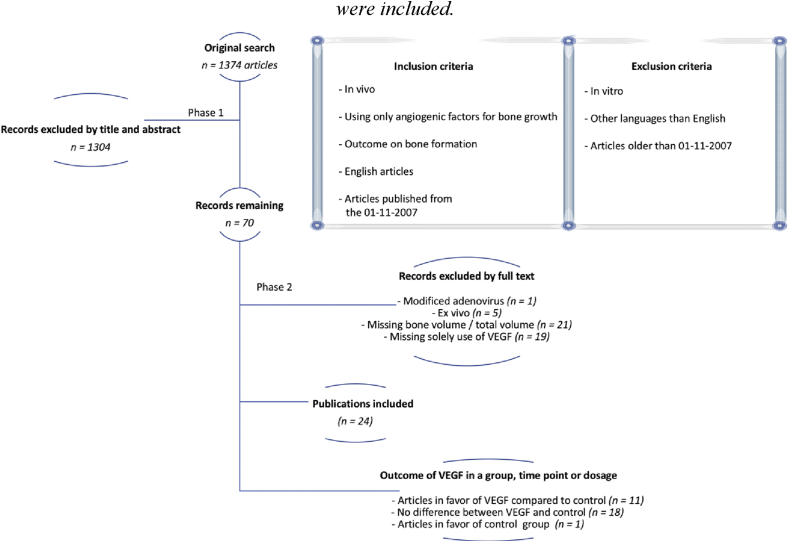
A total of 1374 articles were identified using the PubMed search string . By 3 selection phases 24 published articles were included by the criteria of being in vivo, using only VEGF for bone formation, published after 2007 and written in English. Articles in vitro, written in different languages than English and older than 2007 was excluded. The most recent systematic review on this subject was published in 2008, with the latest included study from 01 to 11-2007. All included studies were classified based on animal, type of defect, scaffold, control group, type of VEGF, release rate, dosage of VEGF, time of evaluation and results. Each study was evaluated for risk of bias by modified CAMARADES quality assessment for the use in experimental animal studies. The score was calculated by peer review journal publication, use of control group, randomisation of groups, justified VEGF dosage, blinding of results, details on animal model, sample size calculation, comply with ethics and no conflict of interest.
No clinical trials or human application studies were obtained from our search. Experimentally, 11 articles using solely VEGF for bone formation had a group or a timepoint significantly better than the corresponding control group. 18 articles revealed no significant difference of VEGF compared to the control group and 1 article reported a significant decreased bone growth using VEGF compared to control.
Based on these results no clinical studies have yet been performed. However, indications in the best use of VEGF from experimental studies could be made towards that the optimal release is within the first three weeks, in defect models, with the best effect before eight weeks. Future designs should incorporate this with standardised and reproducible models for verification towards clinical practice.
This systematic review aims to assess the existing literature to focus on methodologies and outcomes that can provide future knowledge regarding the solitary use of VEGF for bone regeneration in a clinical setting.
为实现最佳的骨形成,充足的血液供应被认为是最具影响力的参数之一。血管内皮生长因子(VEGF)因其诱导新生血管形成的主要能力以及对内皮细胞(EC)的趋化因子作用,在骨再生中备受关注,被视为血管形成的主要调节因子。然而,该生长因子尚未在骨科干预手术的临床环境中得到应用。我们假设,自2008年最新的系统评价以来,过去十年中用于骨形成的体内VEGF的发展已朝着临床应用迈进。
本系统评价总结了过去13年使用血管内皮生长因子(VEGF)进行体内骨再生的情况。
使用PubMed搜索词共识别出1374篇文章。经过三个筛选阶段,根据体内研究、仅使用VEGF进行骨形成、2007年后发表且为英文撰写的标准,纳入了24篇已发表的文章。排除体外研究、非英文撰写以及2007年以前发表的文章。关于该主题的最新系统评价发表于2008年,最新纳入的研究时间为2007年11月1日。所有纳入研究根据动物、缺损类型、支架、对照组、VEGF类型、释放速率、VEGF剂量、评估时间和结果进行分类。每项研究通过用于实验动物研究的改良CAMARADES质量评估来评估偏倚风险。评分通过同行评审期刊发表、对照组的使用、组随机化、合理的VEGF剂量、结果盲法、动物模型细节、样本量计算、符合伦理且无利益冲突来计算。
我们的检索未获得临床试验或人体应用研究。在实验方面,11篇仅使用VEGF进行骨形成的文章中有一组或一个时间点明显优于相应的对照组。18篇文章显示VEGF与对照组相比无显著差异,1篇文章报道使用VEGF与对照组相比骨生长显著降低。
基于这些结果,尚未进行临床研究。然而,从实验研究中可以得出VEGF最佳使用的指征,即最佳释放发生在前三周内,在缺损模型中,八周前效果最佳。未来的设计应将此与标准化和可重复的模型相结合,以验证其临床实用性。
本系统评价旨在评估现有文献,重点关注能够为临床环境中单独使用VEGF进行骨再生提供未来知识的方法和结果。