Azambuja Juliana Hofstatter, Ludwig Nils, Yerneni Saigopalakrishna, Rao Aparna, Braganhol Elizandra, Whiteside Theresa L
Postgraduate Program in Biosciences, Federal University of Health Sciences of Porto Alegre (UFCSPA), Porto Alegre, Brazil.
Department of Pathology, University of Pittsburgh School of Medicine, Pittsburgh, Pennsylvania, USA.
Neurooncol Adv. 2020 May 6;2(1):vdaa056. doi: 10.1093/noajnl/vdaa056. eCollection 2020 Jan-Dec.
Glioblastoma is one of the most immunosuppressive human tumors. Emerging data suggest that glioblastoma-derived exosomes (GBex) reprogram the tumor microenvironment into a tumor-promoting milieu by mechanisms that not yet understood.
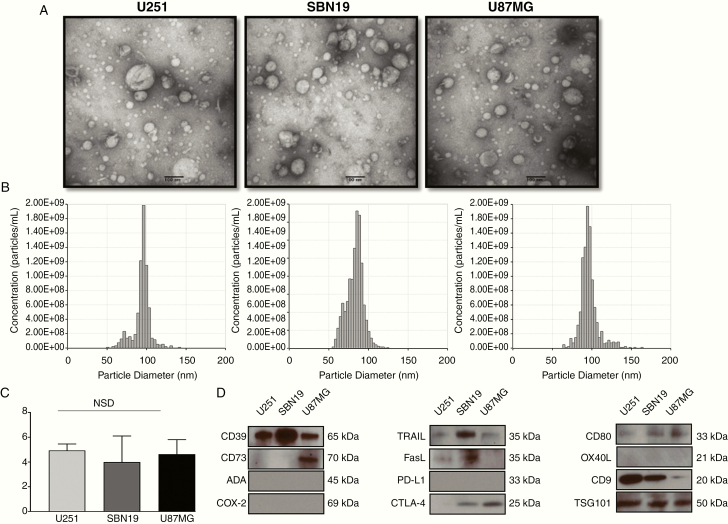
Exosomes were isolated from supernatants of glioblastoma cell lines by size exclusion chromatography. The GBex endosomal origin, size, protein cargos, and ex vivo effects on immune cell functions were determined. GBex were injected intravenously into mice to evaluate their ability to in vivo modulate normal immune cell subsets.
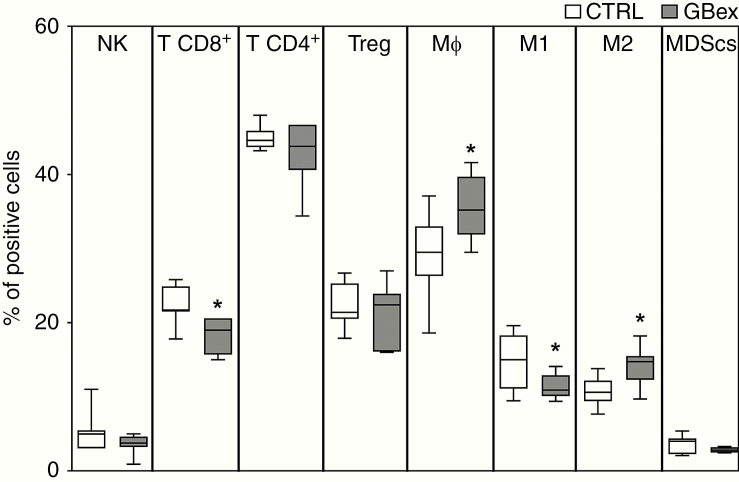
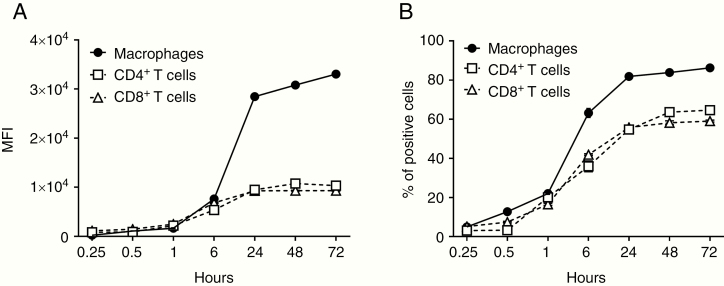
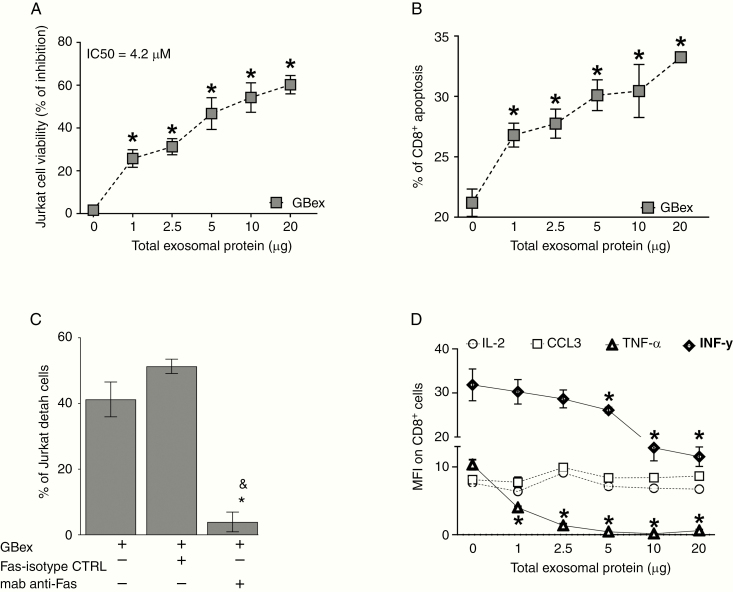
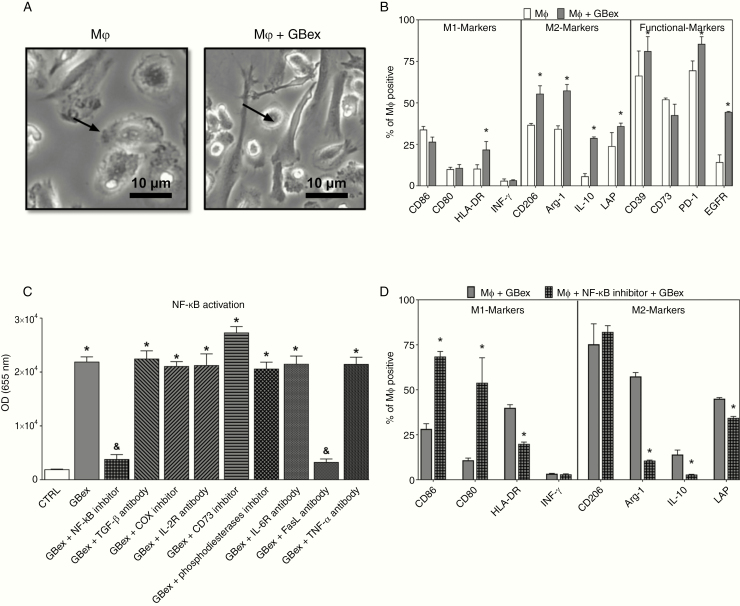
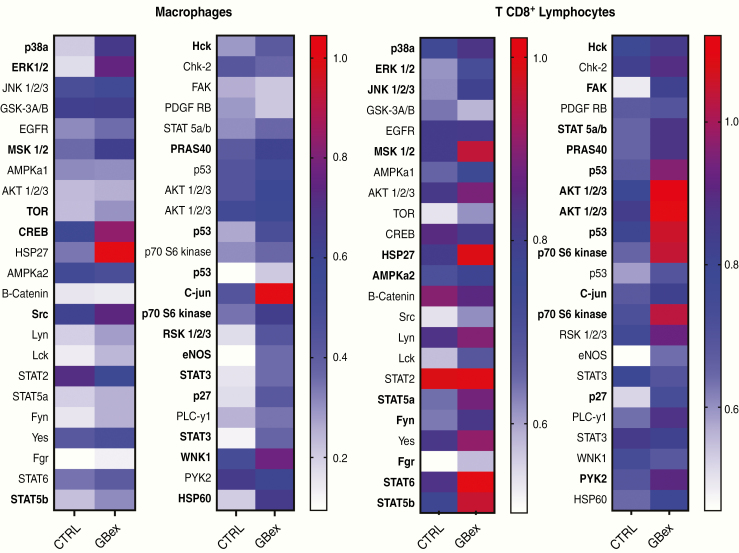
GBex carried immunosuppressive proteins, including FasL, TRAIL, CTLA-4, CD39, and CD73, but contained few immunostimulatory proteins. GBex co-incubated with primary human immune cells induced simultaneous activation of multiple molecular pathways. In CD8 T cells, GBex suppressed TNF-α and INF-γ release and mediated apoptosis. GBex suppressed natural killer (NK) and CD4 T-cell activation. GBex activated the NF-κB pathway in macrophages and promoted their differentiation into M2 cells. Inhibition of the NF-κB pathway in macrophages reversed the GBex-mediated effects. GBex-driven reprogramming of macrophages involved the release of soluble factors that promoted tumor proliferation in vitro. In mice injected with GBex, the frequency of splenic CD8 T cells, NK cells, and M1-like macrophages was reduced, while that of naïve and M2-like macrophages increased ( < .05).
GBex reprogrammed functions of all types of immune cells in vitro and altered their frequency in vivo. By creating and sustaining a highly immunosuppressive environment, GBex play a key role in promoting tumor progression.
胶质母细胞瘤是人类最具免疫抑制性的肿瘤之一。新出现的数据表明,胶质母细胞瘤来源的外泌体(GBex)通过尚未明确的机制将肿瘤微环境重编程为促进肿瘤生长的环境。
通过尺寸排阻色谱法从胶质母细胞瘤细胞系的上清液中分离外泌体。确定GBex的内体来源、大小、蛋白质成分以及对免疫细胞功能的体外影响。将GBex静脉注射到小鼠体内,以评估其在体内调节正常免疫细胞亚群的能力。
GBex携带免疫抑制蛋白,包括FasL、TRAIL、CTLA-4、CD39和CD73,但几乎不包含免疫刺激蛋白。GBex与原代人免疫细胞共孵育可诱导多种分子途径同时激活。在CD8 T细胞中,GBex抑制TNF-α和INF-γ的释放并介导细胞凋亡。GBex抑制自然杀伤(NK)细胞和CD4 T细胞的激活。GBex激活巨噬细胞中的NF-κB途径并促进其分化为M2细胞。抑制巨噬细胞中的NF-κB途径可逆转GBex介导的作用。GBex驱动的巨噬细胞重编程涉及可溶性因子的释放,这些因子在体外促进肿瘤增殖。在注射GBex的小鼠中,脾脏CD8 T细胞、NK细胞和M1样巨噬细胞的频率降低,而幼稚和M2样巨噬细胞的频率增加(P<0.05)。
GBex在体外重编程了所有类型免疫细胞的功能,并在体内改变了它们的频率。通过创造和维持高度免疫抑制的环境,GBex在促进肿瘤进展中起关键作用。