Strisciuglio Teresa, Izzo Raffaele, Barbato Emanuele, Di Gioia Giuseppe, Colaiori Iginio, Fiordelisi Antonella, Morisco Carmine, Bartunek Jozef, Franco Danilo, Ammirati Giuseppe, Pergola Valerio, Imparato Livio, Trimarco Bruno, Esposito Giovanni, Rapacciuolo Antonio
Department of Advanced Biomedical Sciences, University of Naples Federico II, 80131 Naples, Italy.
Cardiovascular Research Center OLV Hospital, 9300 Aalst, Belgium.
J Clin Med. 2020 Jul 7;9(7):2144. doi: 10.3390/jcm9072144.
Insulin resistance (IR) in patients with type 2 diabetes mellitus (T2DM) represents a predictor of coronary artery disease (CAD). However, how IR is able to impact the severity of coronary atherosclerosis in non-diabetic patients is unknown.
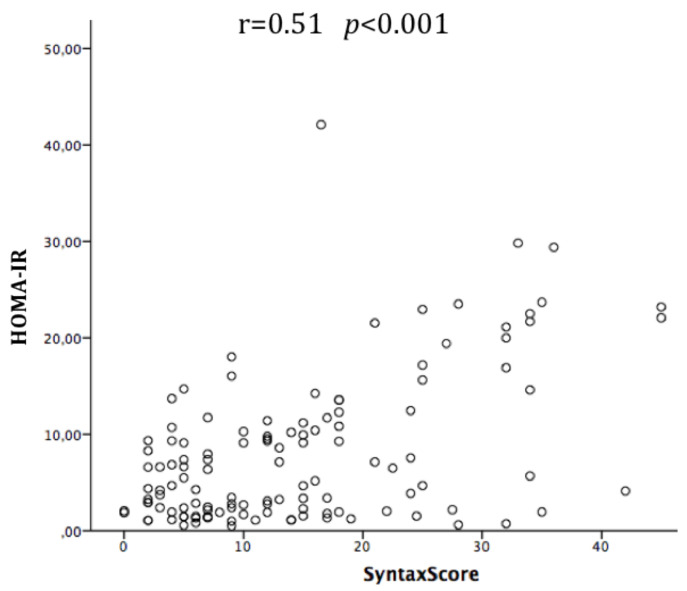
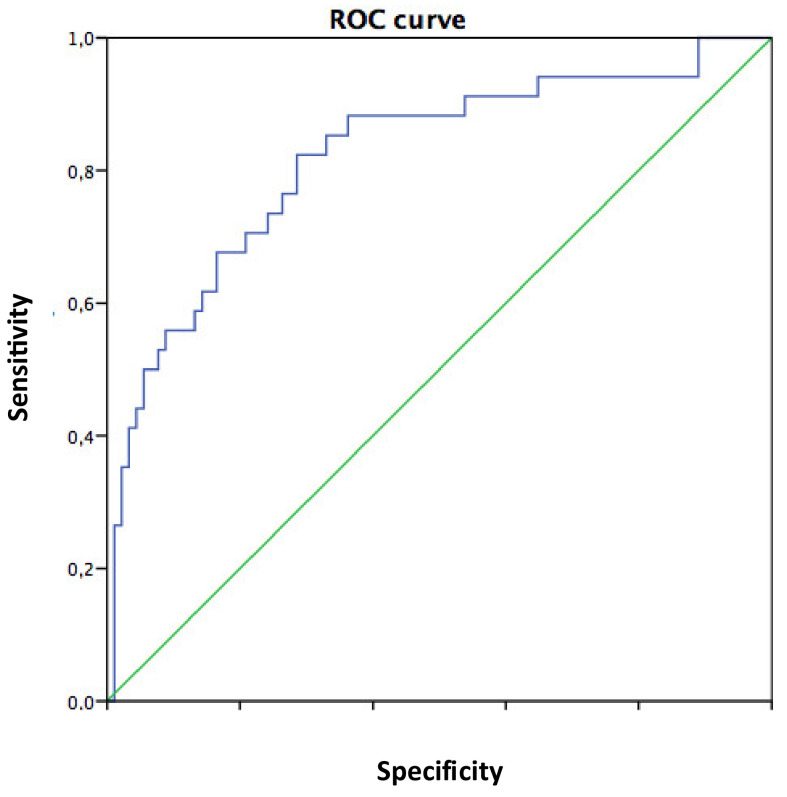
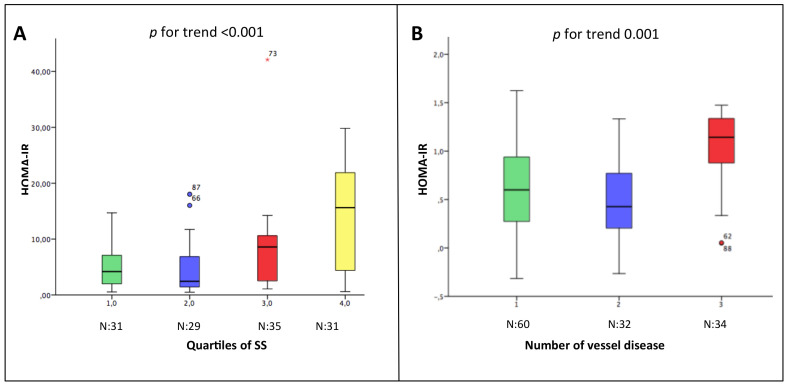
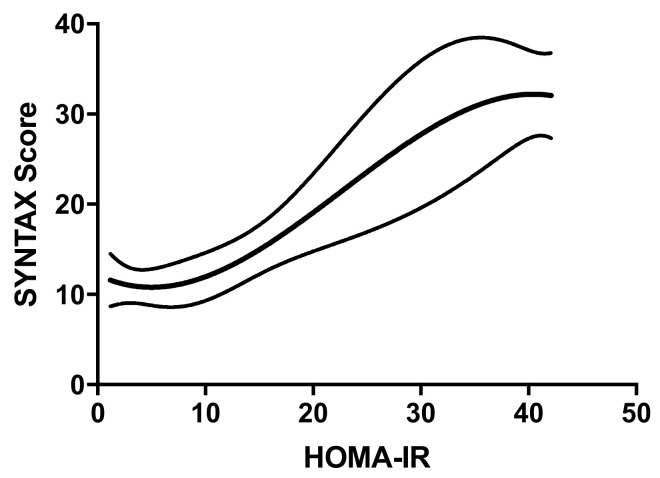
We investigated the relation between the IR and the extent and severity of coronary atherosclerosis in non-diabetic patients referred to coronary angiography (CA) Methods: Consecutive patients undergoing to CA for acute coronary syndromes or stable angina were analyzed. The IR was assessed by mean of the homeostasis model assessment of insulin resistance (HOMA-IR) whereas the SYNTAX score (SS) was used as index of the severity of coronary atherosclerosis Results: Overall, 126 patients were included, with a median SS of 12 (IQR 5.25-20.5). Patients were divided in four groups according to the distribution in quartiles of SS (SS1-2-3-4). A significant correlation between HOMA-IR and SS was observed, especially in women. A progressive increase of HOMA-IR was observed in parallel with the increasing severity (from SS1 to SS4) and extension (1-2-3-vessel disease) of coronary atherosclerosis. Multivariable analysis showed that the HOMA-IR was the strongest independent predictor of severe (SS4) and extensive (three-vessel disease) coronary atherosclerosis.
Insulin resistance goes hand in hand with the extension and severity of coronary atherosclerosis in non-diabetic patients. The HOMA index is an independent predictor of three-vessel disease at CA. The HOMA index could be useful for risk stratification of CAD even in absence of T2DM.
2型糖尿病(T2DM)患者的胰岛素抵抗(IR)是冠状动脉疾病(CAD)的一个预测指标。然而,IR如何影响非糖尿病患者冠状动脉粥样硬化的严重程度尚不清楚。
我们研究了接受冠状动脉造影(CA)的非糖尿病患者中IR与冠状动脉粥样硬化的程度和严重程度之间的关系。
对因急性冠状动脉综合征或稳定型心绞痛接受CA的连续患者进行分析。通过胰岛素抵抗稳态模型评估(HOMA-IR)来评估IR,而SYNTAX评分(SS)用作冠状动脉粥样硬化严重程度的指标。
总体而言,纳入了126例患者,SS中位数为12(四分位间距5.25 - 20.5)。根据SS的四分位数分布将患者分为四组(SS1 - 2 - 3 - 4)。观察到HOMA-IR与SS之间存在显著相关性,尤其是在女性中。随着冠状动脉粥样硬化严重程度(从SS1到SS4)和范围(单支 - 双支 - 三支血管病变)的增加,HOMA-IR呈逐步上升。多变量分析表明,HOMA-IR是严重(SS4)和广泛(三支血管病变)冠状动脉粥样硬化的最强独立预测因子。
在非糖尿病患者中,胰岛素抵抗与冠状动脉粥样硬化的范围和严重程度密切相关。HOMA指数是CA时三支血管病变的独立预测因子。即使在没有T2DM的情况下,HOMA指数对于CAD的风险分层也可能有用。