Department of Fish and Wildlife Conservation, Virginia Polytechnic Institute and State University, Blacksburg, VA 24601;
Laboratory of Malaria and Vector Research, National Institute of Allergy and Infectious Diseases, National Institutes of Health, Bethesda, MD 20892.
Proc Natl Acad Sci U S A. 2020 Jul 28;117(30):17720-17726. doi: 10.1073/pnas.2008410117. Epub 2020 Jul 9.
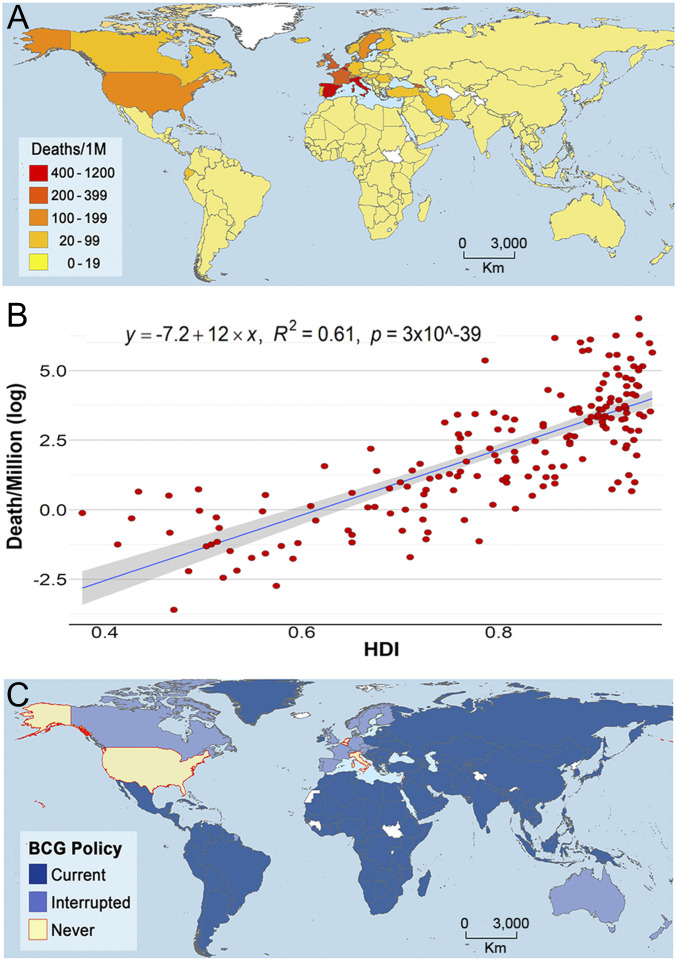
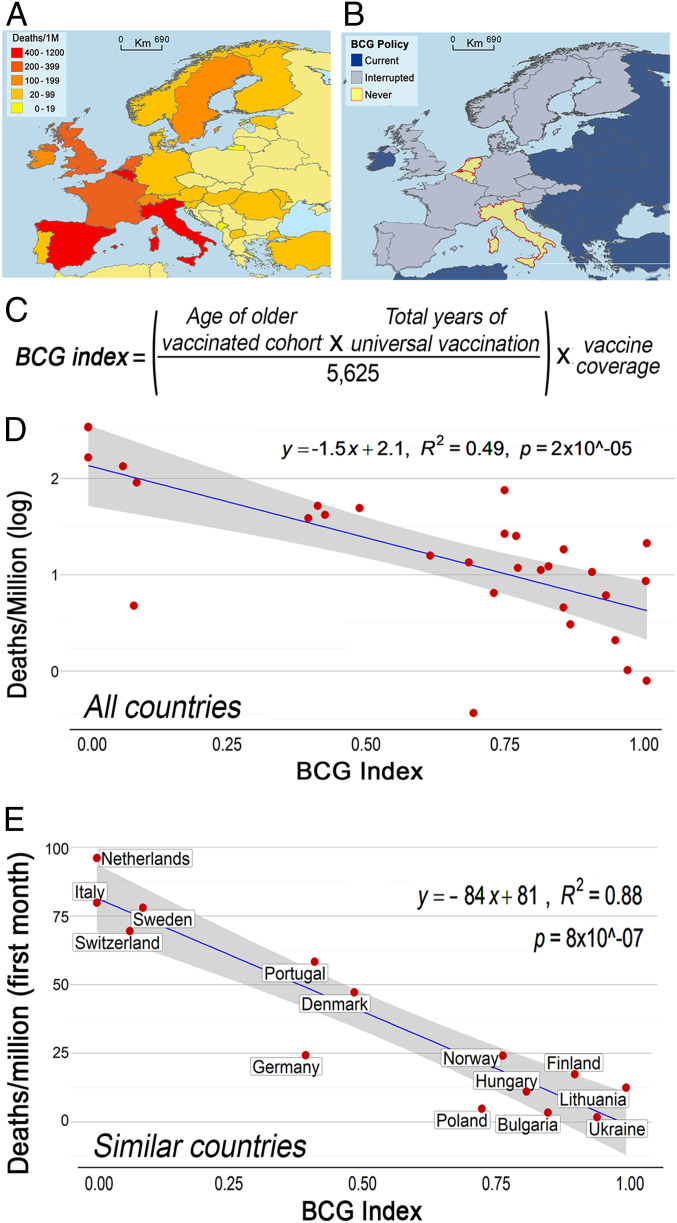
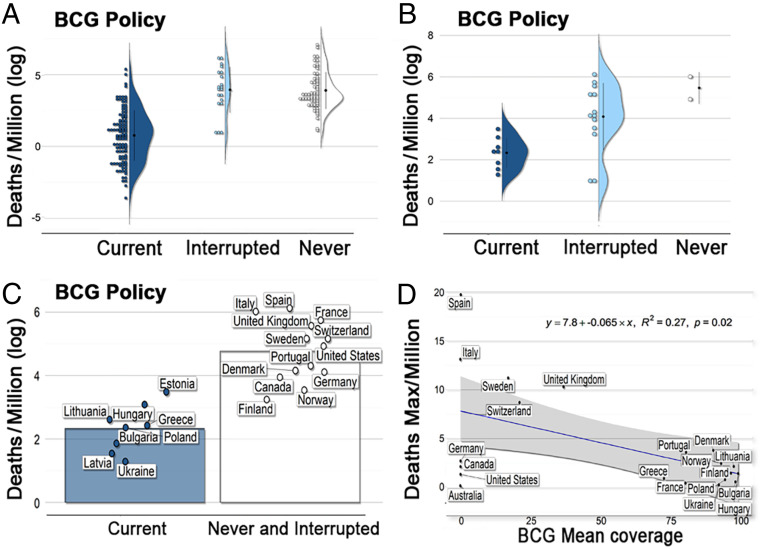
A series of epidemiological explorations has suggested a negative association between national bacillus Calmette-Guérin (BCG) vaccination policy and the prevalence and mortality of coronavirus disease 2019 (COVID-19). However, these comparisons are difficult to validate due to broad differences between countries such as socioeconomic status, demographic structure, rural vs. urban settings, time of arrival of the pandemic, number of diagnostic tests and criteria for testing, and national control strategies to limit the spread of COVID-19. We review evidence for a potential biological basis of BCG cross-protection from severe COVID-19, and refine the epidemiological analysis to mitigate effects of potentially confounding factors (e.g., stage of the COVID-19 epidemic, development, rurality, population density, and age structure). A strong correlation between the BCG index, an estimation of the degree of universal BCG vaccination deployment in a country, and COVID-19 mortality in different socially similar European countries was observed ( = 0.88; = 8 × 10), indicating that every 10% increase in the BCG index was associated with a 10.4% reduction in COVID-19 mortality. Results fail to confirm the null hypothesis of no association between BCG vaccination and COVID-19 mortality, and suggest that BCG could have a protective effect. Nevertheless, the analyses are restricted to coarse-scale signals and should be considered with caution. BCG vaccination clinical trials are required to corroborate the patterns detected here, and to establish causality between BCG vaccination and protection from severe COVID-19. Public health implications of a plausible BCG cross-protection from severe COVID-19 are discussed.
一系列流行病学研究表明,国家卡介苗(BCG)接种政策与 2019 年冠状病毒病(COVID-19)的流行和死亡率之间存在负相关。然而,由于国家之间存在广泛的差异,如社会经济地位、人口结构、城乡环境、大流行的时间、诊断检测数量和检测标准,以及国家控制策略来限制 COVID-19 的传播,这些比较很难验证。我们回顾了 BCG 对 COVID-19 重症的交叉保护的潜在生物学基础的证据,并对流行病学分析进行了细化,以减轻潜在混杂因素的影响(例如,COVID-19 疫情的阶段、发展程度、农村化程度、人口密度和年龄结构)。我们观察到 BCG 指数(一种国家普遍 BCG 接种部署程度的估计)与不同社会相似的欧洲国家 COVID-19 死亡率之间存在很强的相关性( = 0.88; = 8 × 10),这表明 BCG 指数每增加 10%,COVID-19 死亡率就会降低 10.4%。结果未能证实 BCG 接种与 COVID-19 死亡率之间无关联的零假设,并表明 BCG 可能具有保护作用。然而,这些分析仅限于粗粒度的信号,应谨慎考虑。需要进行 BCG 疫苗接种临床试验来证实这里检测到的模式,并确定 BCG 疫苗接种与 COVID-19 重症保护之间的因果关系。讨论了 BCG 对 COVID-19 重症的交叉保护可能带来的公共卫生影响。