Department of Surgery, University of California, Irvine, Orange, CA, USA.
Department of Surgery, University of California, Irvine, Orange, CA, USA; Department of Food Hygiene and Consumer Health Protection, Wroclaw University of Environmental and Life Sciences, Wroclaw, Poland.
J Microbiol Immunol Infect. 2020 Jun;53(3):467-472. doi: 10.1016/j.jmii.2020.03.026. Epub 2020 Mar 28.
The World Health Organization (WHO) has declared the current outbreak of the novel coronavirus (COVID-19) a global pandemic. Many countries are facing increasing numbers of COVID-19 cases, which are, in their origin mostly attributed to regular international flight connections with China. This study aims to investigate this relation by analyzing available data on air traffic volume and the spread of COVID-19 cases.
and findings: We analyzed available data on current domestic and international passenger volume and flight routes and compared these to the distribution of domestic and international COVID-19 cases.
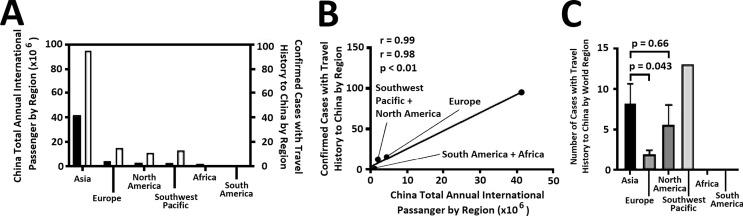
Our data indicate a strong linear correlation between domestic COVID-19 cases and passenger volume for regions within China (r = 0.92, p = 0.19) and a significant correlation between international COVID-19 cases and passenger volume (r = 0.98, p < 0.01).
The number of flight routes as well as total passenger volume are highly relevant risk factors for the spread of current COVID-19. Multiple regions within Asia, as well as some in North America and Europe are at serious risk of constant exposure to COVID-19 from China and other highly infected countries. Risk for COVID-19 exposure remains relatively low in South America and Africa. If adequate measures are taken, including on-site disease detection and temporary passenger quarantine, limited but not terminated air traffic can be a feasible option to prevent a long-term crisis. Reasonable risk calculations and case evaluations per passenger volume are crucial aspects which must be considered when reducing international flights.
世界卫生组织(WHO)已宣布当前新型冠状病毒(COVID-19)爆发为全球大流行。许多国家面临着越来越多的 COVID-19 病例,这些病例最初主要归因于与中国的定期国际航班联系。本研究旨在通过分析有关航空交通量和 COVID-19 病例传播的数据来研究这种关系。
我们分析了有关当前国内和国际客运量和航班航线的现有数据,并将其与国内和国际 COVID-19 病例的分布进行了比较。
我们的数据表明,中国境内地区的国内 COVID-19 病例与客运量之间存在很强的线性相关性(r=0.92,p=0.19),国际 COVID-19 病例与客运量之间存在显著相关性(r=0.98,p<0.01)。
航班航线数量以及总客运量是当前 COVID-19 传播的高度相关的危险因素。亚洲的多个地区,以及北美的一些地区和欧洲,都面临着来自中国和其他高感染国家不断暴露于 COVID-19 的严重风险。南美洲和非洲的 COVID-19 暴露风险仍然相对较低。如果采取适当的措施,包括现场疾病检测和旅客临时隔离,有限但不会终止的航空交通是防止长期危机的可行选择。在减少国际航班时,每个旅客的合理风险计算和病例评估是必须考虑的关键方面。