Department of Civil, Environmental and Mechanical Engineering, University of Trento, via Mesiano 77, 38123 Trento, Italy.
Department of Civil, Environmental and Mechanical Engineering, University of Trento, via Mesiano 77, 38123 Trento, Italy.
Sci Total Environ. 2020 Nov 15;743:140444. doi: 10.1016/j.scitotenv.2020.140444. Epub 2020 Jun 24.
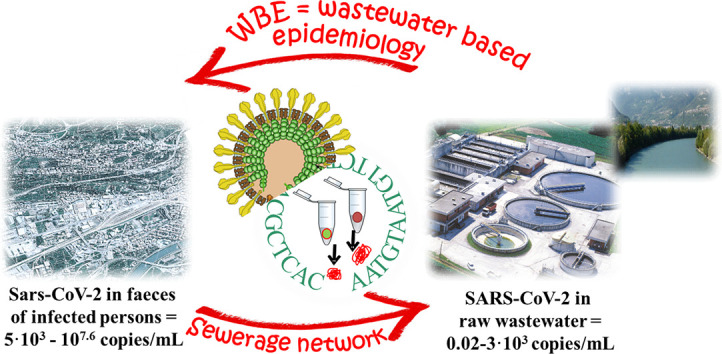
SARS-CoV-2, the virus that causes COVID-19, has been found in the faeces of infected patients in numerous studies. Stool may remain positive for SARS-CoV-2, even when the respiratory tract becomes negative, and the interaction with the gastrointestinal tract poses a series of questions about wastewater and its treatments. This review aims to understand the viral load of SARS-CoV-2 in faeces and sewage and its fate in wastewater treatment plants (WWTPs). The viral load in the faeces of persons testing positive for SARS-CoV-2 was estimated at between 5·10 to 10 copies/mL, depending on the infection course. In the sewerage, faeces undergo dilution and viral load decreases considerably in the wastewater entering a WWTP with a range from 2 copies/100 mL to 3·10 copies/mL, depending on the level of the epidemic. Monitoring of SARS-CoV-2 in sewage, although no evidence of COVID-19 transmission has been found via this route, could be advantageously exploited as an early warning of outbreaks. Preliminary studies on WBE seem promising; but high uncertainty of viral loads in wastewater and faeces remains, and further research is needed. The detection of SARS-CoV-2 in sewage, based on RNA sequences and RT-PCR, requires a shared approach on sample pre-treatment and on-site collection to ensure comparable results. The finding of viral RNA in stools does not imply that the virus is viable and infectious. Viability of CoVs such as SARS-CoV-2 decreases in wastewater - due to temperature, pH, solids, micropollutants - but high inactivation in WWTPs can be obtained only by using disinfection (free chlorine, UVC light). A reduction in the quantity of disinfectants can be obtained by implementing Membrane-Bioreactors with ultrafiltration to separate SARS-CoV-2 virions with a size of 60-140 nm. In sludge treatment, thermophilic digestion is effective, based on the general consensus that CoVs are highly sensitive to increased temperatures.
导致 COVID-19 的 SARS-CoV-2 病毒已在许多研究中在感染患者的粪便中被发现。即使呼吸道转为阴性,粪便仍可能呈 SARS-CoV-2 阳性,而与胃肠道的相互作用引发了一系列有关废水及其处理的问题。本综述旨在了解粪便和污水中 SARS-CoV-2 的病毒载量及其在废水处理厂(WWTP)中的命运。检测到的 SARS-CoV-2 阳性患者粪便中的病毒载量估计在 5.10 到 10 拷贝/毫升之间,具体取决于感染过程。在污水中,粪便会被稀释,而进入 WWTP 的废水中的病毒载量会大大降低,范围从 2 拷贝/100 毫升到 3.10 拷贝/毫升,具体取决于疫情水平。尽管没有发现通过这种途径传播 COVID-19 的证据,但对污水中 SARS-CoV-2 的监测可作为疫情爆发的早期预警,具有优势。尽管初步研究表明 WBE 似乎很有前景;但废水和粪便中病毒载量的高度不确定性仍需要进一步研究。基于 RNA 序列和 RT-PCR 检测污水中的 SARS-CoV-2 需要共享样本预处理和现场采集的方法,以确保可比的结果。在粪便中检测到 SARS-CoV-2 的病毒 RNA 并不意味着病毒具有活力和传染性。SARS-CoV-2 等冠状病毒的活力会因温度、pH 值、固体、微污染物等因素在废水中下降,但只有通过使用消毒剂(游离氯、UVC 光)才能在 WWTP 中实现高灭活。通过实施带有超滤的膜-生物反应器,可以将 SARS-CoV-2 病毒粒子(大小为 60-140nm)分离出来,从而减少消毒剂的用量。基于冠状病毒对高温高度敏感的共识,在污泥处理中,高温消化是有效的。