Section of Structural and Synthetic Biology, Department of Infectious Disease, Imperial College London, London, SW7 2AZ, UK.
University of Birmingham, College of Medical Dental Schools, Institute of Cancer and Genomics Sciences, Birmingham Centre for Genome Biology, Vincent Drive, Edgbaston, Birmingham, B15 2TT, UK.
Semin Cell Dev Biol. 2021 May;113:14-26. doi: 10.1016/j.semcdb.2020.07.004. Epub 2020 Jul 9.
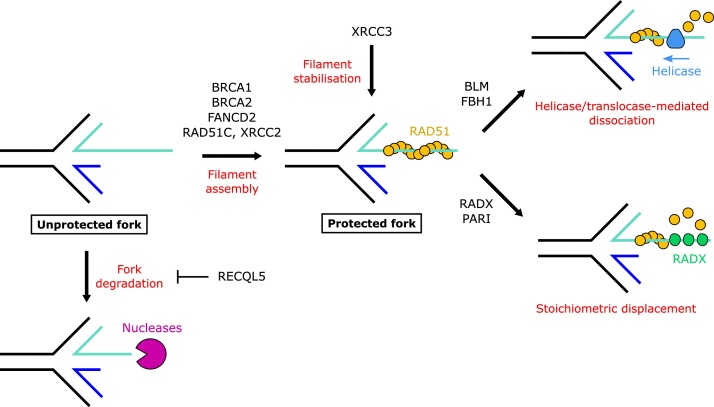
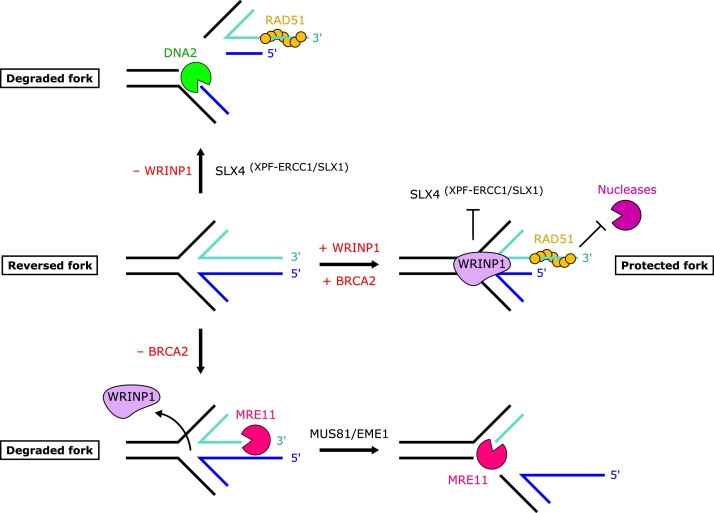
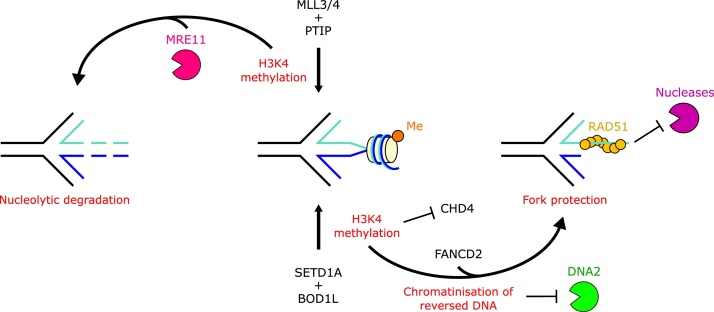
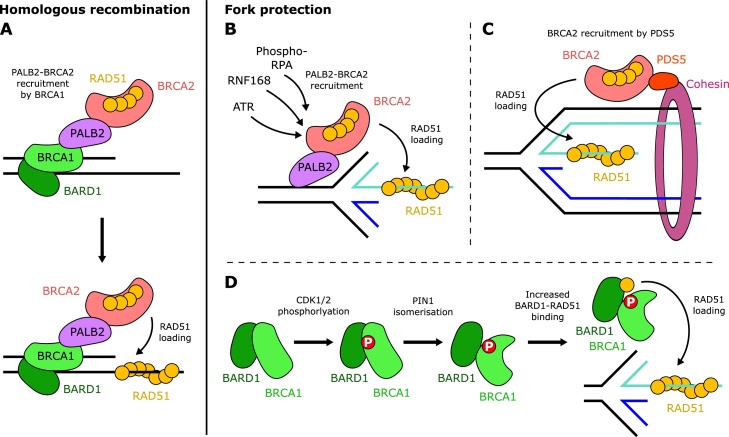
In response to replication hindrances, DNA replication forks frequently stall and are remodelled into a four-way junction. In such a structure the annealed nascent strand is thought to resemble a DNA double-strand break and remodelled forks are vulnerable to nuclease attack by MRE11 and DNA2. Proteins that promote the recruitment, loading and stabilisation of RAD51 onto single-stranded DNA for homology search and strand exchange in homologous recombination (HR) repair and inter-strand cross-link repair also act to set up RAD51-mediated protection of nascent DNA at stalled replication forks. However, despite the similarities of these pathways, several lines of evidence indicate that fork protection is not simply analogous to the RAD51 loading step of HR. Protection of stalled forks not only requires separate functions of a number of recombination proteins, but also utilises nucleases important for the resection steps of HR in alternative ways. Here we discuss how fork protection arises and how its differences with HR give insights into the differing contexts of these two pathways.
为了应对复制阻碍,DNA 复制叉经常会停滞,并被重塑成四叉结。在这种结构中,退火的新生链被认为类似于 DNA 双链断裂,并且重塑的叉容易受到 MRE11 和 DNA2 核酸酶的攻击。促进 RAD51 募集、加载和稳定到单链 DNA 上以进行同源搜索和链交换的蛋白质在同源重组 (HR) 修复和链间交联修复中也起到了作用,以建立 RAD51 介导的停滞复制叉处新生 DNA 的保护。然而,尽管这些途径具有相似性,但有几条证据表明叉保护不仅仅类似于 HR 的 RAD51 加载步骤。停滞叉的保护不仅需要许多重组蛋白的单独功能,而且还以不同的方式利用 HR 的切除步骤的核酸酶。在这里,我们讨论了叉保护是如何产生的,以及它与 HR 的区别如何为这两种途径的不同背景提供了见解。