Department of Microbiology, Yonsei University College of Medicine, Seoul, South Korea.
Brain Korea 21 PLUS Project for Medical Science, Yonsei University College of Medicine, Seoul, South Korea.
Front Immunol. 2020 Jun 23;11:1305. doi: 10.3389/fimmu.2020.01305. eCollection 2020.
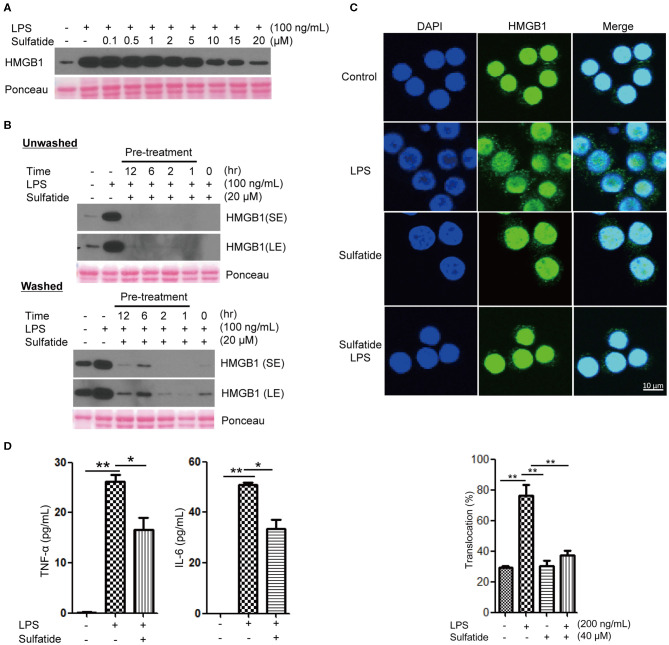
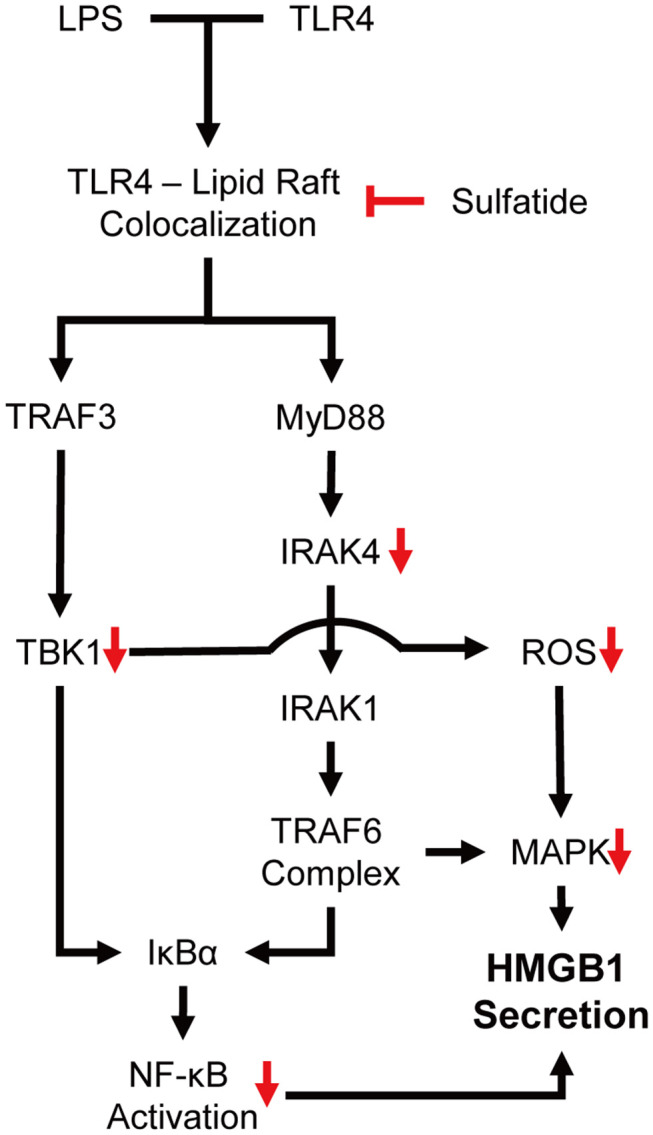
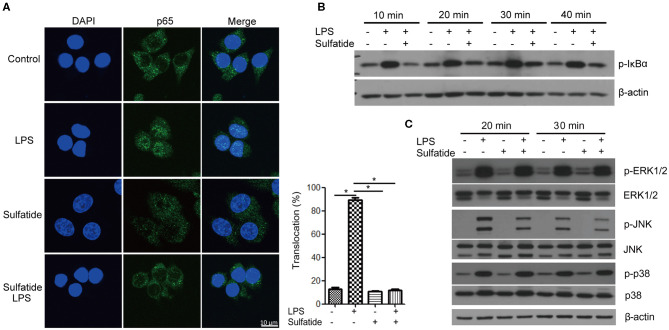
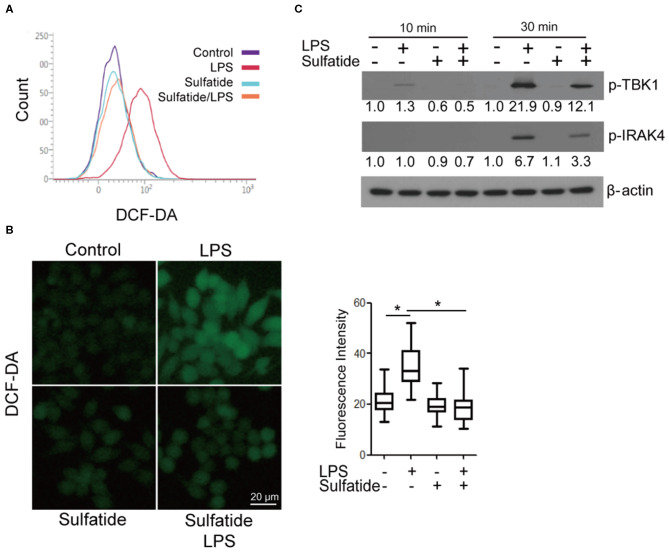
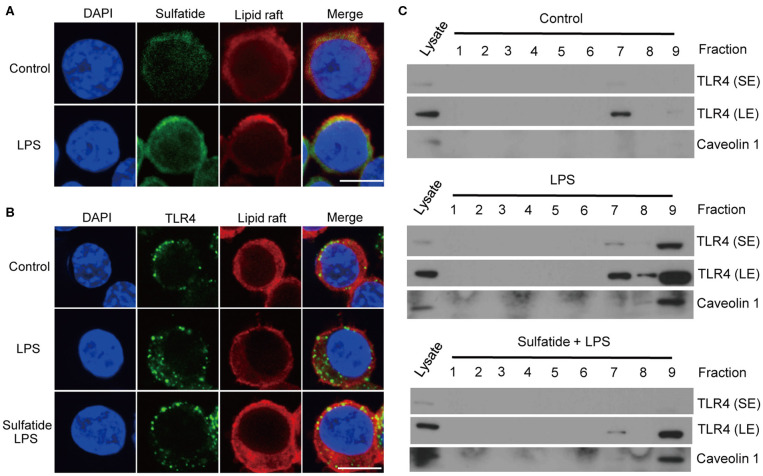
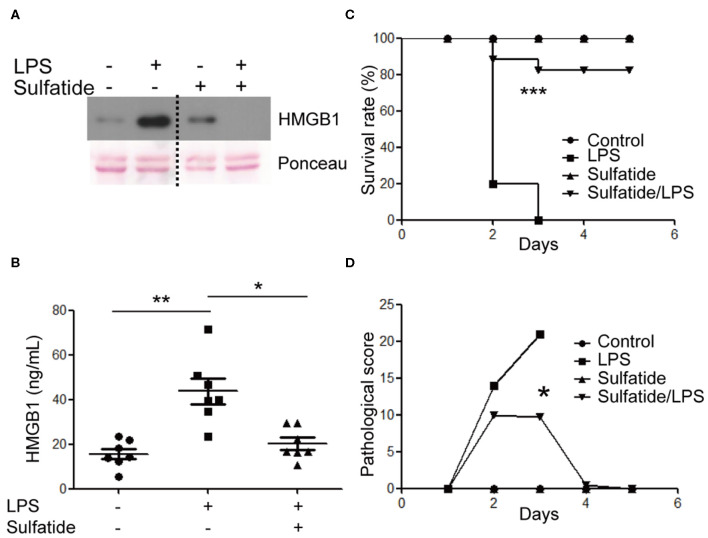
The high mobility group box 1 (HMGB1) is a well-known late mediator of sepsis, secreted by multiple stimuli, involving pathways, such as the mitogen-activated protein kinase (MAPK) and nuclear factor kappa B (NF-κB) pathways, and reactive oxygen species (ROS) under inflammation. Sulfatide, in contrast, is a sphingolipid commonly found in myelin sheets with a disputed immunological role. We sought to determine the immunological characteristics of sulfatide in the periphery by analyzing the secretion of HMGB1 triggered by lipopolysaccharide (LPS) stimulation in Raw 264.7 cells. Suppression of HMGB1 secretion by inhibiting its cytosolic translocation was observed after pre-treatment with sulfatide before LPS stimulation. Further analysis of the downstream molecules of toll-like receptor (TLR) signaling revealed suppression of c-Jun N-terminal kinase (JNK) phosphorylation and p65 translocation. LPS-mediated ROS production was also decreased when sulfatide pre-treatment was provided, caused by the down-regulation of the phosphorylation of activators, such as IRAK4 and TBK1. Investigation of the upstream mechanism that encompasses all the aforementioned inhibitory characteristics unveiled the involvement of lipid rafts. In addition to the co-localization of biotinylated sulfatide and monosialotetrahexosylganglioside, a decrease in LPS-induced co-localization of TLR4 and lipid raft markers was observed when sulfatide treatment was given before LPS stimulation. Overall, sulfatide was found to exert its anti-inflammatory properties by hindering the co-localization of TLR4 and lipid rafts, nullifying the effect of LPS on TLR4 signaling. Similar effects of sulfatide were also confirmed in the LPS-mediated murine experimental sepsis model, showing decreased levels of serum HMGB1, increased survivability, and reduced pathological severity.
高迁移率族蛋白 B1(HMGB1)是一种众所周知的脓毒症晚期介质,可被多种刺激物分泌,涉及丝裂原活化蛋白激酶(MAPK)和核因子κB(NF-κB)途径以及炎症下的活性氧(ROS)等途径。相比之下,神经节苷脂是一种普遍存在于髓鞘片的鞘脂,其免疫学作用存在争议。我们试图通过分析脂多糖(LPS)刺激 Raw 264.7 细胞后 HMGB1 的分泌来确定神经节苷脂在外周的免疫学特征。在用 LPS 刺激之前,用神经节苷脂预处理可抑制 HMGB1 的细胞浆易位,从而观察到 HMGB1 分泌的抑制。对 Toll 样受体(TLR)信号转导的下游分子的进一步分析显示,c-Jun N 末端激酶(JNK)磷酸化和 p65易位受到抑制。当提供神经节苷脂预处理时,LPS 介导的 ROS 产生也减少,这是由于 IRAK4 和 TBK1 等激活物的磷酸化下调所致。对包含所有上述抑制特征的上游机制的研究揭示了脂筏的参与。除了生物素化神经节苷脂和单唾液酸四己糖神经节苷脂的共定位外,在用 LPS 刺激之前给予神经节苷脂处理时,还观察到 LPS 诱导的 TLR4 和脂质筏标志物的共定位减少。总的来说,神经节苷脂通过阻碍 TLR4 和脂质筏的共定位来发挥其抗炎特性,从而消除 LPS 对 TLR4 信号转导的影响。在 LPS 介导的小鼠实验性脓毒症模型中也证实了神经节苷脂的类似作用,表现为血清 HMGB1 水平降低、存活率增加和病理严重程度降低。