Xu Xinxiang, Du Xin, Wang Fen, Sha Jianchuan, Chen Qian, Tian Ge, Zhu Zhanling, Ge Shunfeng, Jiang Yuanmao
State Key Laboratory of Crop Biology, College of Horticulture Science and Engineering, Shandong Agricultural University, Tai'an, China.
Front Plant Sci. 2020 Jun 23;11:904. doi: 10.3389/fpls.2020.00904. eCollection 2020.
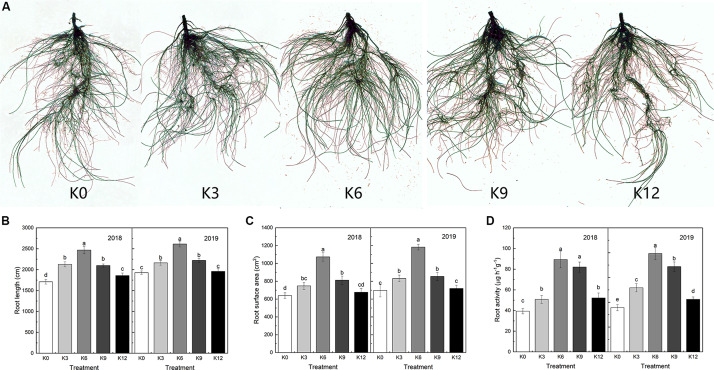
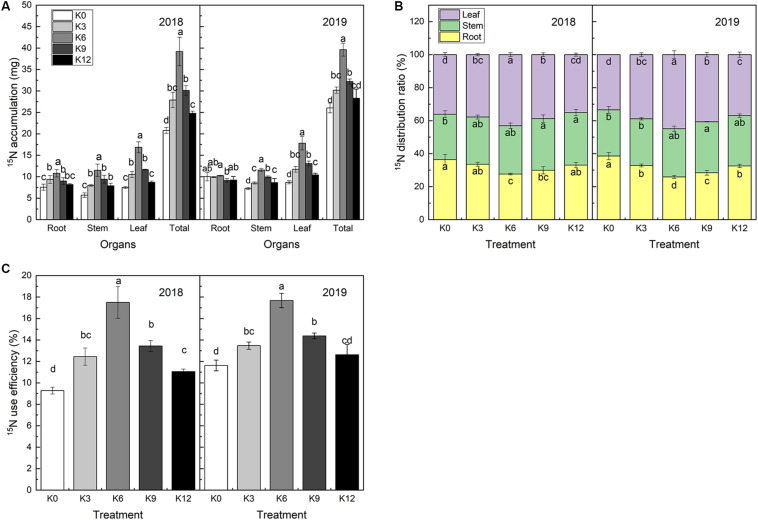
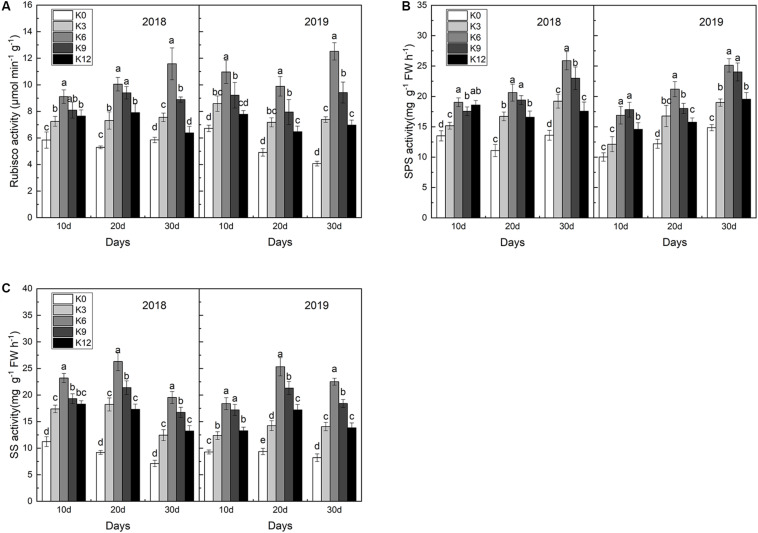
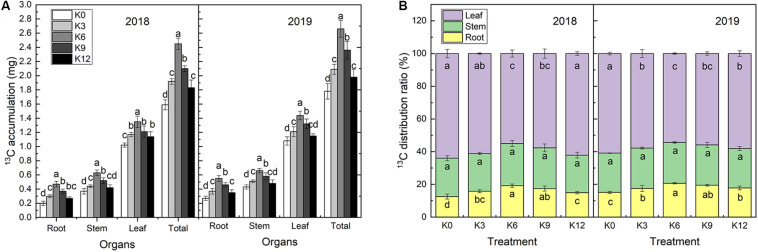
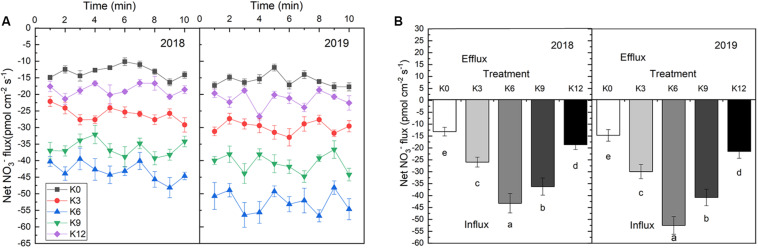
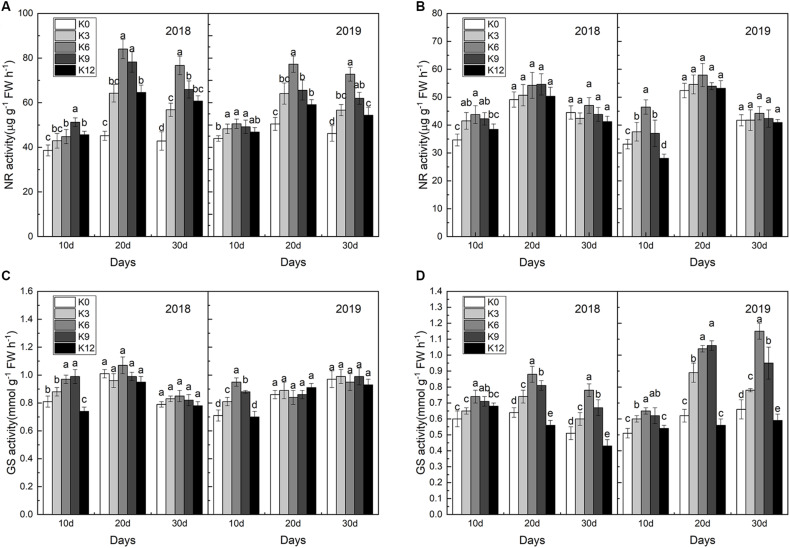
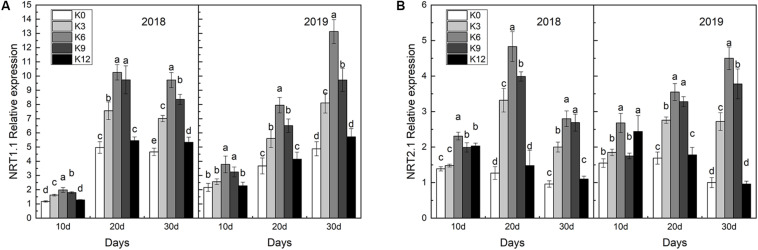
Nitrogen (N) is one of the most required mineral elements for plant growth, and potassium (K) plays a vital role in nitrogen metabolism, both elements being widely applied as fertilizers in agricultural production. However, the exact relationship between K and nitrogen use efficiency (NUE) remains unclear. Apple dwarf rootstock seedlings (M9T337) were used to study the impacts of different K levels on plant growth, nitrogen metabolism, and carbon (C) assimilation in water culture experiments for 2 years. The results showed that both deficiency and excess K inhibited the growth and root development of M9T337 seedlings. When the K supply concentration was 0 mM and 12 mM, the biomass of each organ, root-shoot ratio, root activity and NO ion flow rate decreased significantly, net photosynthetic rate ( ) and photochemical efficiency ( / ) being lower. Meanwhile, seedlings treated with 6 mM K had higher N and C metabolizing enzyme activities and higher nitrate transporter gene expression levels (; ). C and N labeling results showed that deficiency and excess K could not only reduce N absorption and C assimilation accumulation of M9T337 seedlings, but also reduced the N distribution ratio in leaves and C distribution ratio in roots. These results suggest that appropriate K supply (6 mM) was optimal as it enhanced photoassimilate transport from leaves to roots and increased NUE by influencing photosynthesis, C and N metabolizing enzyme activities, nitrate assimilation gene activities, and nitrate transport.
氮(N)是植物生长所需的最重要矿质元素之一,钾(K)在氮代谢中起着至关重要的作用,这两种元素在农业生产中都作为肥料被广泛施用。然而,钾与氮利用效率(NUE)之间的确切关系仍不清楚。在为期两年的水培实验中,以苹果矮化砧木幼苗(M9T337)为材料,研究了不同钾水平对植物生长、氮代谢和碳(C)同化的影响。结果表明,低钾和高钾均抑制了M9T337幼苗的生长和根系发育。当钾供应浓度为0 mM和12 mM时,各器官生物量、根冠比、根系活力和NO离子流速均显著降低,净光合速率( )和光化学效率( / )较低。同时,6 mM钾处理的幼苗具有较高的氮和碳代谢酶活性以及较高的硝酸盐转运蛋白基因表达水平(; )。碳和氮标记结果表明,低钾和高钾不仅会降低M9T337幼苗的氮吸收和碳同化积累,还会降低叶片中的氮分配比例和根系中的碳分配比例。这些结果表明,适宜的钾供应(6 mM)是最佳的,因为它通过影响光合作用、碳和氮代谢酶活性、硝酸盐同化基因活性以及硝酸盐转运,增强了光合同化物从叶片到根系的运输并提高了氮利用效率。