Energy-Rich Compounds Production by Photosynthetic Carbon Fixation Research Center, Shandong Key Lab of Applied Mycology, College of Life Sciences, Qingdao Agricultural University, Qingdao 266109, China.
College of Food Science and Engineering, Qingdao Agricultural University, Qingdao 266109, China.
Molecules. 2020 Jul 9;25(14):3136. doi: 10.3390/molecules25143136.
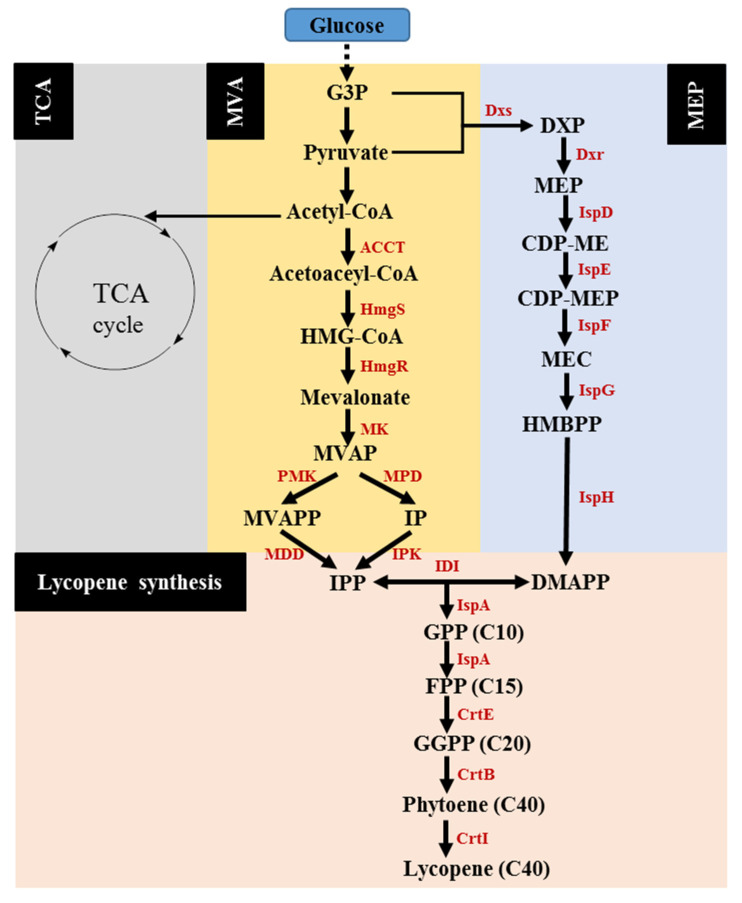
Lycopene, a potent antioxidant, has been widely used in the fields of pharmaceuticals, nutraceuticals, and cosmetics. However, the production of lycopene extracted from natural sources is far from meeting the demand. Consequently, synthetic biology and metabolic engineering have been employed to develop microbial cell factories for lycopene production. Due to the advantages of rapid growth, complete genetic background, and a reliable genetic operation technique, has become the preferred host cell for microbial biochemicals production. In this review, the recent advances in biological lycopene production using engineered strains are summarized: First, modification of the endogenous MEP pathway and introduction of the heterogeneous MVA pathway for lycopene production are outlined. Second, the common challenges and strategies for lycopene biosynthesis are also presented, such as the optimization of other metabolic pathways, modulation of regulatory networks, and optimization of auxiliary carbon sources and the fermentation process. Finally, the future prospects for the improvement of lycopene biosynthesis are also discussed.
番茄红素是一种强效抗氧化剂,已广泛应用于制药、营养保健品和化妆品等领域。然而,从天然来源提取的番茄红素的产量远远不能满足需求。因此,合成生物学和代谢工程被用于开发用于生产番茄红素的微生物细胞工厂。由于具有生长迅速、遗传背景完整和可靠的遗传操作技术等优点, 已成为微生物生化产品生产的首选宿主细胞。在本文综述中,总结了利用工程化 菌株进行生物法生产番茄红素的最新进展:首先,概述了通过修饰内源 MEP 途径和引入异源 MVA 途径来生产番茄红素。其次,还介绍了番茄红素生物合成的常见挑战和策略,如优化其他代谢途径、调控网络的调节以及辅助碳源和发酵过程的优化。最后,还讨论了提高番茄红素生物合成的未来前景。