Key Laboratory of Virtual Geographic Environment (Nanjing Normal University), Ministry of Education, Nanjing 210023, China.
State Key Laboratory Cultivation Base of Geographical Environment Evolution (Jiangsu Province), Nanjing 210023, China.
Sensors (Basel). 2020 Jul 9;20(14):3832. doi: 10.3390/s20143832.
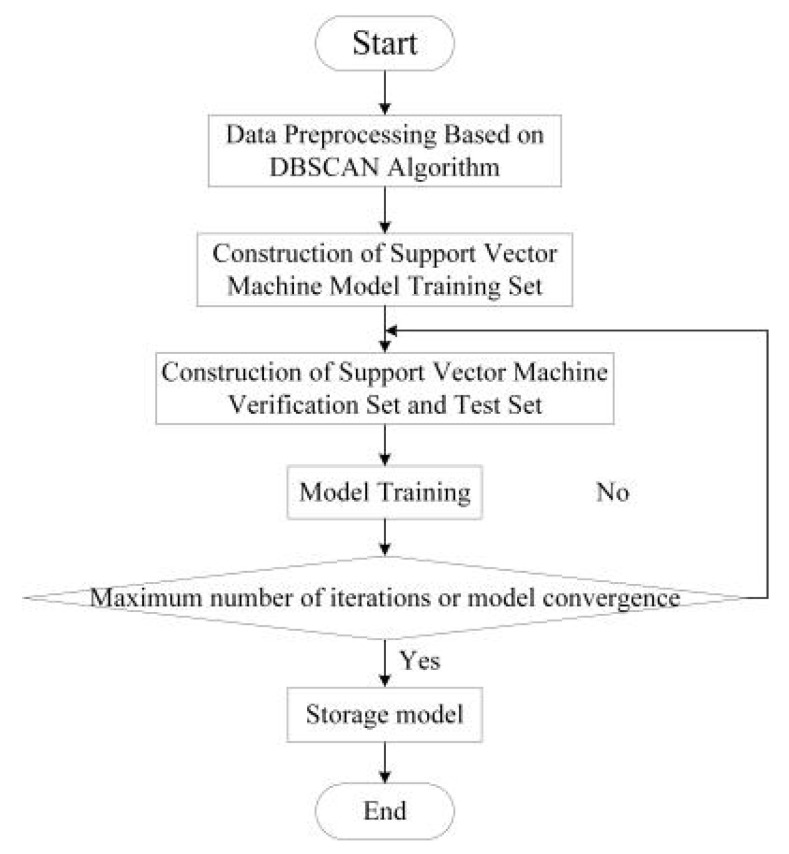
Target Tracking (TT) is a fundamental application of wireless sensor networks. TT based on received signal strength indication (RSSI) is by far the cheapest and simplest approach, but suffers from a low stability and precision owing to multiple paths, occlusions, and decalibration effects. To address this problem, we propose an innovative TT algorithm, known as the SVM+KF method, which combines the support vector machine (SVM) and an improved Kalman filter (KF). We first use the SVM to obtain an initial estimate of the target's position based on the RSSI. This enhances the ability of our algorithm to process nonlinear data. We then apply an improved KF to modify this estimated position. Our improved KF adds the threshold value of the innovation update in the traditional KF. This value changes dynamically according to the target speed and network parameters to ensure the stability of the results. Simulations and real experiments in different scenarios demonstrate that our algorithm provides a superior tracking accuracy and stability compared to similar algorithms.
目标跟踪(TT)是无线传感器网络的一项基本应用。基于接收信号强度指示(RSSI)的 TT 是迄今为止最便宜、最简单的方法,但由于多径、遮挡和失准效应,其稳定性和精度较低。为了解决这个问题,我们提出了一种创新的 TT 算法,称为 SVM+KF 方法,它结合了支持向量机(SVM)和改进的卡尔曼滤波器(KF)。我们首先使用 SVM 根据 RSSI 获得目标位置的初始估计,从而提高了算法处理非线性数据的能力。然后,我们应用改进的 KF 来修正这个估计位置。我们的改进 KF 在传统 KF 中添加了创新更新的阈值。该值根据目标速度和网络参数动态变化,以确保结果的稳定性。在不同场景下的仿真和实际实验表明,与类似算法相比,我们的算法提供了更高的跟踪精度和稳定性。