Pavic M, Bogowicz M, Kraft J, Vuong D, Mayinger M, Kroeze S G C, Friess M, Frauenfelder T, Andratschke N, Huellner M, Weder W, Guckenberger M, Tanadini-Lang S, Opitz I
Department of Radiation Oncology, University Hospital Zurich and University Zurich, Rämistrasse 100, 8091, Zurich, Switzerland.
Department of Thoracic Surgery, University Hospital Zurich and University Zurich, Rämistrasse 100, 8091, Zurich, Switzerland.
EJNMMI Res. 2020 Jul 13;10(1):81. doi: 10.1186/s13550-020-00669-3.
Careful selection of malignant pleural mesothelioma (MPM) patients for curative treatment is of highest importance, as the multimodal treatment regimen is challenging for patients and harbors a high risk of substantial toxicity. Radiomics-a quantitative method for image analysis-has shown its prognostic ability in different tumor entities and could therefore play an important role in optimizing patient selection for radical cancer treatment. So far, radiomics as a prognostic tool in MPM was not investigated.
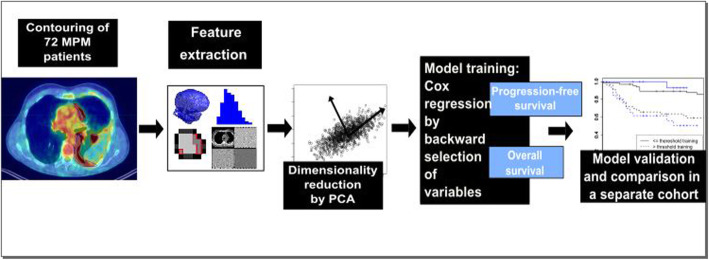
This study is based on 72 MPM patients treated with surgery in a curative intent at our institution between 2009 and 2017. Pre-treatment Fluorine-18 fluorodeoxyglucose (FDG) PET and CT scans were used for radiomics outcome modeling. After extraction of 1404 CT and 1410 FDG PET features from each image, a preselection by principal component analysis was performed to include only robust, non-redundant features for the cox regression to predict the progression-free survival (PFS) and the overall survival (OS). Results were validated on a separate cohort. Additionally, SUVmax and SUVmean, and volume were tested for their prognostic ability for PFS and OS.
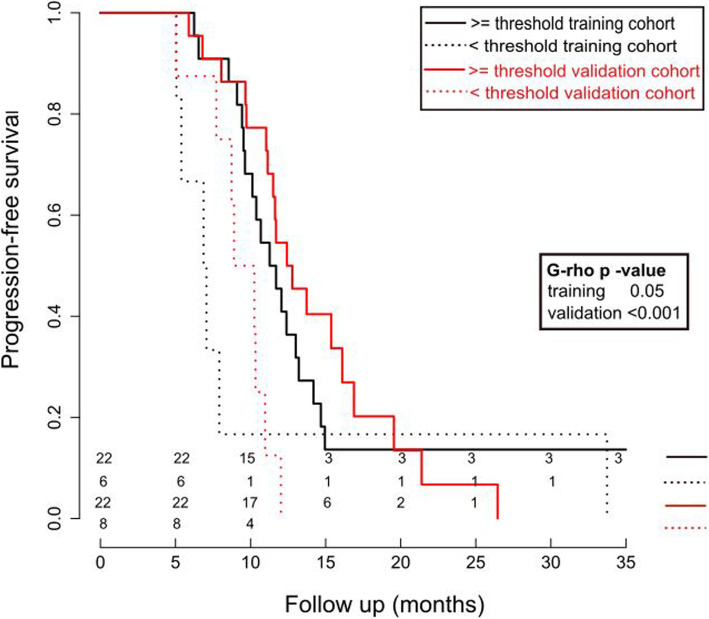
For the PFS a concordance index (c-index) of 0.67 (95% CI 0.52-0.82) and 0.66 (95% CI 0.57-0.78) for the training cohort (n = 36) and internal validation cohort (n = 36), respectively, were obtained for the PET radiomics model. The PFS advantage of the low-risk group translated also into an OS advantage. On CT images, no radiomics model could be trained. SUV max and SUV mean were also not prognostic in terms of PFS and OS.
We were able to build a successful FDG PET radiomics model for the prediction of PFS in MPM. Radiomics could serve as a tool to aid clinical decision support systems for treatment of MPM in future.
由于多模式治疗方案对恶性胸膜间皮瘤(MPM)患者具有挑战性且毒性风险高,因此仔细选择适合根治性治疗的MPM患者至关重要。放射组学——一种图像分析的定量方法——已在不同肿瘤实体中显示出其预后能力,因此在优化癌症根治性治疗的患者选择方面可能发挥重要作用。到目前为止,尚未研究放射组学作为MPM预后工具的情况。
本研究基于2009年至2017年间在本机构接受根治性手术治疗的72例MPM患者。治疗前的氟-18氟脱氧葡萄糖(FDG)PET和CT扫描用于放射组学结果建模。从每个图像中提取1404个CT特征和1410个FDG PET特征后,通过主成分分析进行预选,仅纳入稳健、非冗余的特征用于Cox回归,以预测无进展生存期(PFS)和总生存期(OS)。结果在一个独立队列中进行验证。此外,还测试了SUVmax、SUVmean和体积对PFS和OS的预后能力。
对于PFS,PET放射组学模型在训练队列(n = 36)和内部验证队列(n = 36)中的一致性指数(c-index)分别为0.67(95%CI 0.52 - 0.82)和0.66(95%CI 0.57 - 0.78)。低风险组的PFS优势也转化为OS优势。在CT图像上,无法训练放射组学模型。SUV max和SUV mean在PFS和OS方面也无预后价值。
我们成功构建了一个用于预测MPM患者PFS的FDG PET放射组学模型。放射组学未来可作为一种工具辅助MPM治疗的临床决策支持系统。