Laboratório de Informação em Saúde, Instituto de Comunicação e Informação Científica e Tecnológica em Saúde, Fundação Oswaldo Cruz, Rio de Janeiro, Brazil.
Laboratoire Mixte International Sentinela, Fundação Oswaldo Cruz, Universidade de Brasília, Institut de Recherche pour le Développement, Rio de Janeiro, Brazil.
JMIR Public Health Surveill. 2020 Sep 1;6(3):e15409. doi: 10.2196/15409.
Cross-border malaria is a significant obstacle to achieving malaria control and elimination worldwide.
This study aimed to build a cross-border surveillance system that can make comparable and qualified data available to all parties involved in malaria control between French Guiana and Brazil.
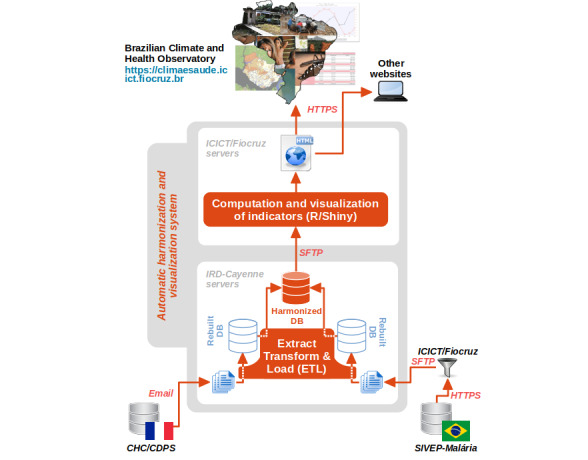
Data reconciliation rules based on expert knowledge were defined and applied to the heterogeneous data provided by the existing malaria surveillance systems of both countries. Visualization dashboards were designed to facilitate progressive data exploration, analysis, and interpretation. Dedicated advanced open source and robust software solutions were chosen to facilitate solution sharing and reuse.
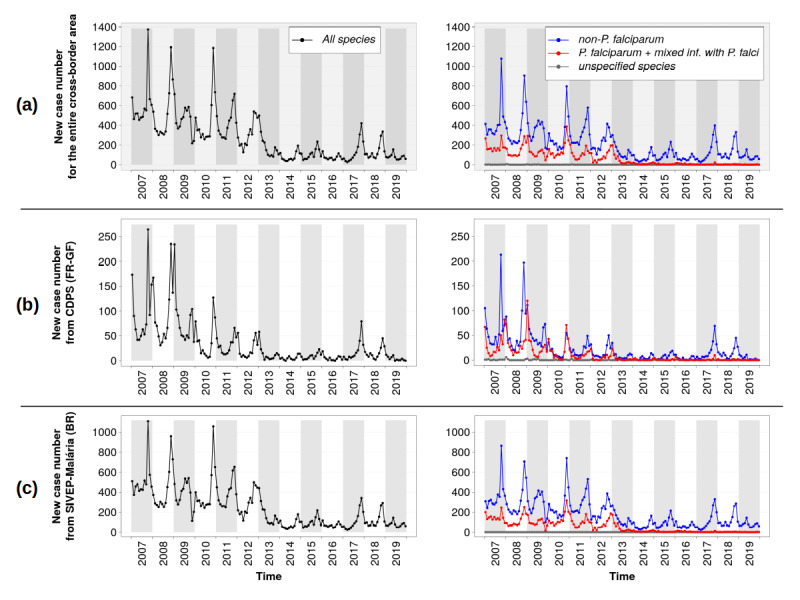
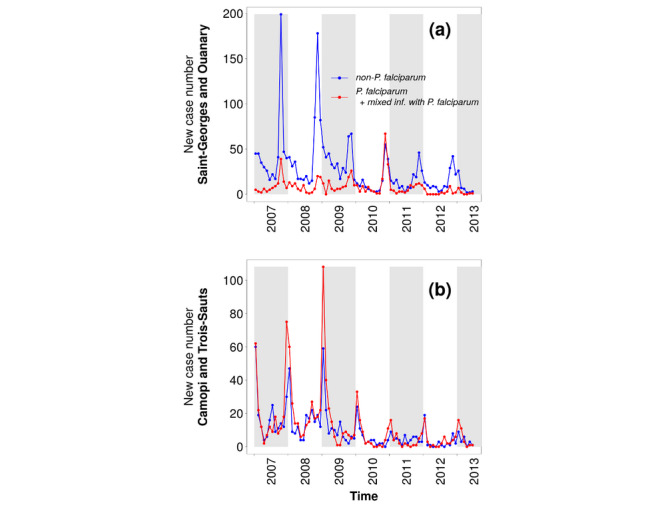
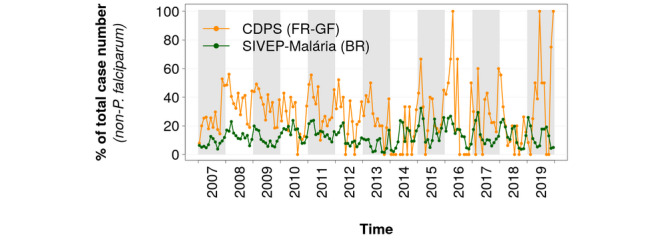
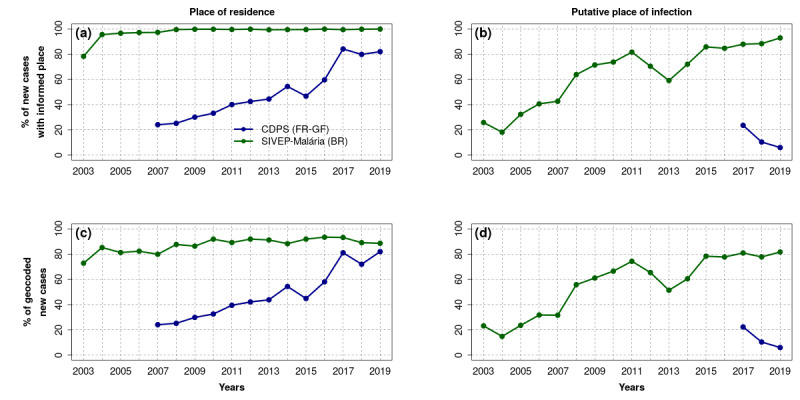
A database gathering the harmonized data on cross-border malaria epidemiology is updated monthly with new individual malaria cases from both countries. Online dashboards permit a progressive and user-friendly visualization of raw data and epidemiological indicators, in the form of time series, maps, and data quality indexes. The monitoring system was shown to be able to identify changes in time series that are related to control actions, as well as differentiated changes according to space and to population subgroups.
This cross-border monitoring tool could help produce new scientific evidence on cross-border malaria dynamics, implementing cross-border cooperation for malaria control and elimination, and can be quickly adapted to other cross-border contexts.
跨境疟疾是全球实现疟疾控制和消除的重大障碍。
本研究旨在建立一个跨境监测系统,为法属圭亚那和巴西之间参与疟疾控制的所有各方提供可比和合格的数据。
根据专家知识定义了数据协调规则,并将其应用于两国现有疟疾监测系统提供的异构数据。设计了可视化仪表板,以方便逐步探索、分析和解释数据。选择了专门的先进开源和强大的软件解决方案,以促进解决方案的共享和重用。
一个汇集跨境疟疾流行病学协调数据的数据库每月都会更新两国的新的个体疟疾病例。在线仪表板以时间序列、地图和数据质量指标的形式,允许对原始数据和流行病学指标进行逐步和用户友好的可视化。监测系统能够识别与控制措施相关的时间序列变化,以及根据空间和人口亚组进行区分变化。
这种跨境监测工具可以帮助产生有关跨境疟疾动态的新科学证据,实施跨境合作以控制和消除疟疾,并可以快速适应其他跨境情况。