Department of Evolutionary Studies of Biosystems, SOKENDAI (The Graduate University for Advanced Studies), Kanagawa 240-0193, Japan.
Bioproduction Research Institute, National Institute of Advanced Industrial Science and Technology (AIST), Sapporo 062-8517, Japan.
Genes (Basel). 2020 Jul 10;11(7):775. doi: 10.3390/genes11070775.
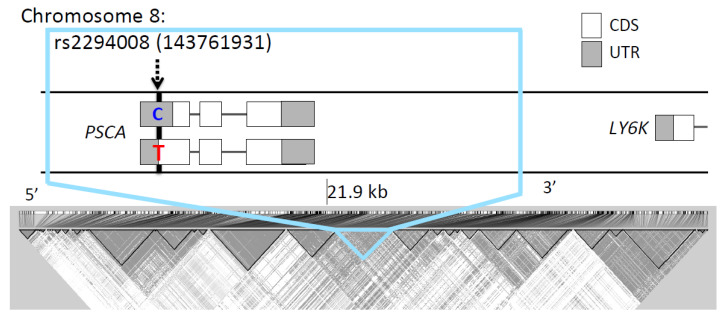
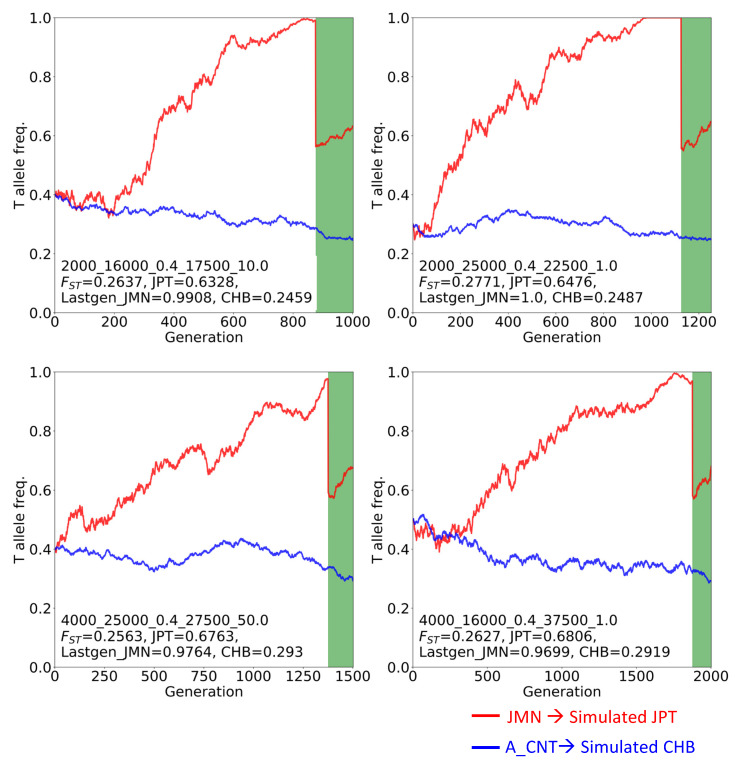
A genome wide association study reported that the T allele of rs2294008 in a cancer-related gene, , is a risk allele for diffuse-type gastric cancer. This allele has the highest frequency (0.63) in Japanese in Tokyo (JPT) among 26 populations in the 1000 Genomes Project database. ≈ 0.26 at this single nucleotide polymorphism is one of the highest between JPT and the genetically close Han Chinese in Beijing (CHB). To understand the evolutionary history of the alleles in , we addressed: (i) whether the C non-risk allele at rs2294008 is under positive selection, and (ii) why the mainland Japanese population has a higher T allele frequency than other populations. We found that haplotypes harboring the C allele are composed of two subhaplotypes. We detected that positive selection on both subhaplotypes has occurred in the East Asian lineage. However, the selection on one of the subhaplotypes in JPT seems to have been relaxed or ceased after divergence from the continental population; this may have caused the elevation of T allele frequency. Based on simulations under the dual structure model (a specific demography for the Japanese) and phylogenetic analysis with ancient DNA, the T allele at rs2294008 might have had high frequency in the Jomon people (one of the ancestral populations of the modern Japanese); this may explain the high T allele frequency in the extant Japanese.
全基因组关联研究报告称,癌症相关基因 rs2294008 中的 T 等位基因是弥漫型胃癌的风险等位基因。在 1000 基因组计划数据库中 26 个人群中,东京的日本人(JPT)中该等位基因的频率最高(0.63)。在这个单核苷酸多态性位点,JPT 与遗传上相近的北京汉族人(CHB)之间的差异 ≈ 0.26,这是最高的差异之一。为了了解 基因中这些等位基因的进化历史,我们解决了以下两个问题:(i)rs2294008 处的 C 非风险等位基因是否受到正选择,以及(ii)为什么日本大陆人群的 T 等位基因频率高于其他人群。我们发现,携带 C 等位基因的单倍型由两个亚单倍型组成。我们检测到东亚血统中的两个亚单倍型都发生了正选择。然而,在与大陆人群分化后,JPT 中一个亚单倍型的选择似乎已经放松或停止;这可能导致 T 等位基因频率升高。基于双结构模型(日本特定的人口统计学)下的模拟和带有古 DNA 的系统发育分析,rs2294008 处的 T 等位基因可能在绳文人(现代日本人的一个祖先群体)中具有较高的频率;这可以解释现代日本人中 T 等位基因频率较高的原因。