Gangneux Jean-Pierre, Reizine Florian, Guegan Hélène, Pinceaux Kieran, Le Balch Pierre, Prat Emilie, Pelletier Romain, Belaz Sorya, Le Souhaitier Mathieu, Le Tulzo Yves, Seguin Philippe, Lederlin Mathieu, Tadié Jean-Marc, Robert-Gangneux Florence
Service de Parasitologie-Mycologie, CHU Rennes, F-35033 Rennes, France.
Irset (Institut de Recherche en Santé, Environnement et Travail)-UMR_S 1085, Univ Rennes, CHU Rennes, Inserm, EHESP, F-35000 Rennes, France.
J Fungi (Basel). 2020 Jul 10;6(3):105. doi: 10.3390/jof6030105.
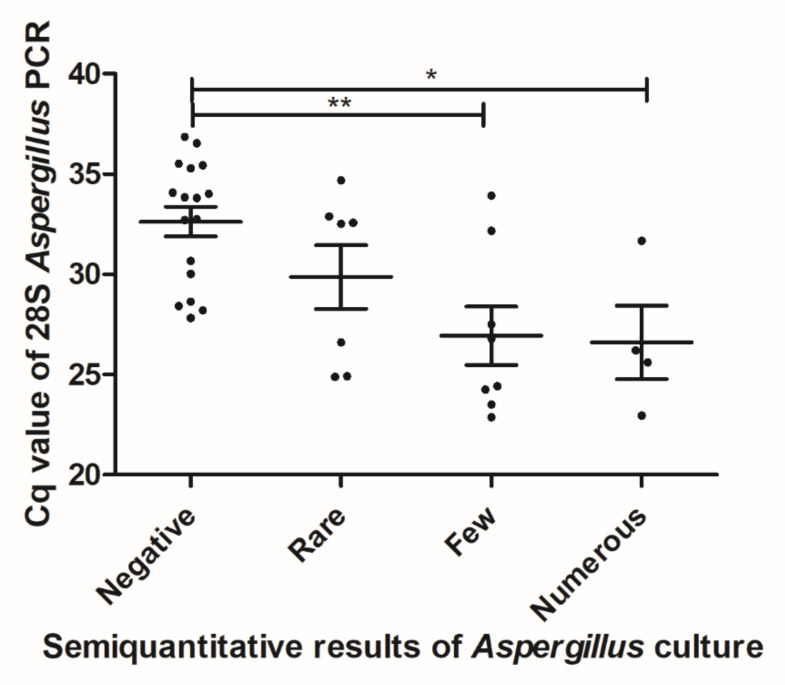
(1) Background: The diagnosis of invasive aspergillosis (IA) in an intensive care unit (ICU)remains a challenge and the COVID-19 epidemic makes it even harder. Here, we evaluatedAspergillus PCR input to help classifying IA in SARS-CoV-2-infected patients. (2) Methods: 45COVID-19 patients were prospectively monitored twice weekly for Aspergillus markers and anti-Aspergillus serology. We evaluated the concordance between (Ι) Aspergillus PCR and culture inrespiratory samples, and (ΙΙ) blood PCR and serum galactomannan. Patients were classified asputative/proven/colonized using AspICU algorithm and two other methods. (3) Results: Theconcordance of techniques applied on respiratory and blood samples was moderate (kappa = 0.58and kappa = 0.63, respectively), with a higher sensitivity of PCR. According to AspICU, 9/45 patientswere classified as putative IA. When incorporating PCR results, 15 were putative IA because theymet all criteria, probably with a lack of specificity in the context of COVID-19. Using a modifiedAspICU algorithm, eight patients were classified as colonized and seven as putative IA. (4)Conclusion: An appreciation of the fungal burden using PCR and Aspergillus serology was addedto propose a modified AspICU algorithm. This proof of concept seemed relevant, as it was inagreement with the outcome of patients, but will need validation in larger cohorts.
(1) 背景:重症监护病房(ICU)中侵袭性曲霉病(IA)的诊断仍然是一项挑战,而新冠疫情使这一挑战更加艰巨。在此,我们评估了曲霉PCR检测结果,以辅助对感染严重急性呼吸综合征冠状病毒2(SARS-CoV-2)的患者进行IA分类。(2) 方法:对45例新冠患者每周进行两次前瞻性监测,检测曲霉标志物和抗曲霉血清学指标。我们评估了(Ⅰ)呼吸道样本中曲霉PCR与培养结果之间的一致性,以及(Ⅱ)血液PCR与血清半乳甘露聚糖之间的一致性。使用AspICU算法和其他两种方法将患者分类为疑似/确诊/定植。(3) 结果:应用于呼吸道和血液样本的检测技术一致性中等(kappa值分别为0.58和0.63),PCR的敏感性更高。根据AspICU算法,45例患者中有9例被分类为疑似IA。纳入PCR结果后,15例被分类为疑似IA,因为他们符合所有标准,这可能是由于在新冠背景下缺乏特异性。使用改良的AspICU算法,8例患者被分类为定植,7例被分类为疑似IA。(4) 结论:增加了对PCR和曲霉血清学检测结果中真菌负荷的评估,以提出改良的AspICU算法。这一概念验证似乎具有相关性,因为它与患者的预后一致,但需要在更大的队列中进行验证。