Department of Biology, Clark University, 950 Main Street, Worcester, MA, 01610, USA.
BMC Evol Biol. 2020 Jul 14;20(1):84. doi: 10.1186/s12862-020-01636-1.
Diverse architectures of nervous systems (NSs) such as a plexus in cnidarians or a more centralized nervous system (CNS) in insects and vertebrates are present across Metazoa, but it is unclear what selection pressures drove evolution and diversification of NSs. One underlying aspect of this diversity lies in the cellular and molecular mechanisms driving neurogenesis, i.e. generation of neurons from neural precursor cells (NPCs). In cnidarians, vertebrates, and arthropods, homologs of SoxB and bHLH proneural genes control different steps of neurogenesis, suggesting that some neurogenic mechanisms may be conserved. However, data are lacking for spiralian taxa.
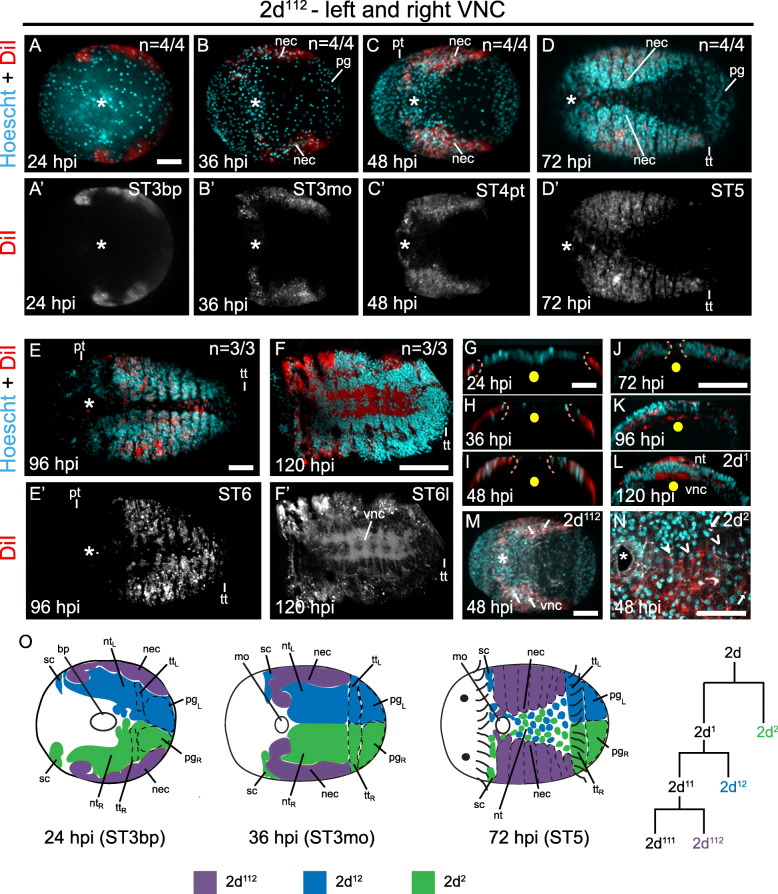
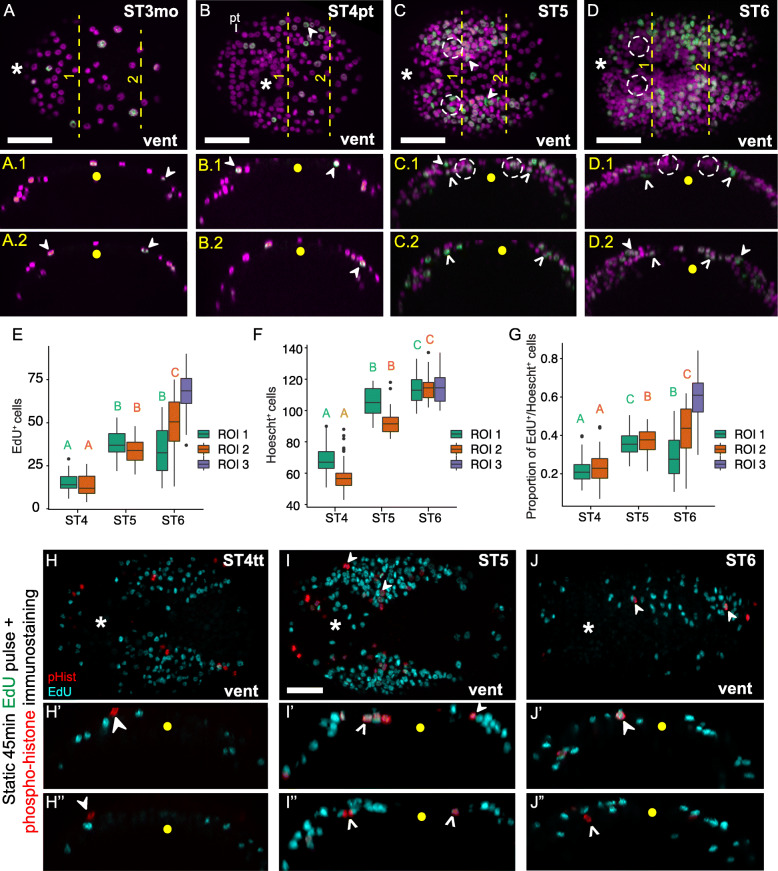
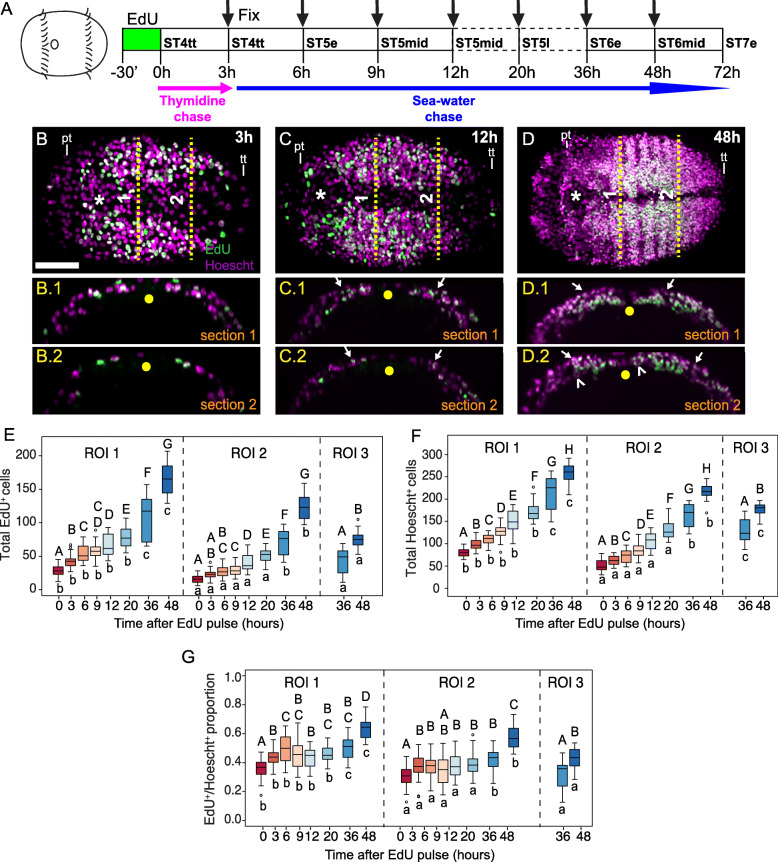
To that end, we characterized NPCs and their daughters at different stages of neurogenesis in the spiralian annelid Capitella teleta. We assessed cellular division patterns in the neuroectoderm using static and pulse-chase labeling with thymidine analogs (EdU and BrdU), which enabled identification of NPCs that underwent multiple rounds of division. Actively-dividing brain NPCs were found to be apically-localized, whereas actively-dividing NPCs for the ventral nerve cord (VNC) were found apically, basally, and closer to the ventral midline. We used lineage tracing to characterize the changing boundary of the trunk neuroectoderm. Finally, to start to generate a genetic hierarchy, we performed double-fluorescent in-situ hybridization (FISH) and single-FISH plus EdU labeling for neurogenic gene homologs. In the brain and VNC, Ct-soxB1 and Ct-neurogenin were expressed in a large proportion of apically-localized, EdU NPCs. In contrast, Ct-ash1 was expressed in a small subset of apically-localized, EdU NPCs and subsurface, EdU cells, but not in Ct-neuroD or Ct-elav1 cells, which also were subsurface.
Our data suggest a putative genetic hierarchy with Ct-soxB1 and Ct-neurogenin at the top, followed by Ct-ash1, then Ct-neuroD, and finally Ct-elav1. Comparison of our data with that from Platynereis dumerilii revealed expression of neurogenin homologs in proliferating NPCs in annelids, which appears different than the expression of vertebrate neurogenin homologs in cells that are exiting the cell cycle. Furthermore, differences between neurogenesis in the head versus trunk of C. teleta suggest that these two tissues may be independent developmental modules, possibly with differing evolutionary trajectories.
刺胞动物的神经丛或昆虫和脊椎动物的更集中的神经系统 (CNS) 等不同结构的神经系统 (NS) 存在于后生动物中,但尚不清楚是什么选择压力推动了 NS 的进化和多样化。这种多样性的一个潜在方面在于驱动神经发生的细胞和分子机制,即从神经前体细胞 (NPC) 产生神经元。在刺胞动物、脊椎动物和节肢动物中,SoxB 和 bHLH 原神经基因的同源物控制神经发生的不同步骤,这表明一些神经发生机制可能是保守的。然而,缺乏螺旋体分类群的数据。
为此,我们在螺旋体环节动物 Capitella teleta 中描述了神经发生的不同阶段的 NPC 及其后代。我们使用胸腺嘧啶类似物 (EdU 和 BrdU) 的静态和脉冲追踪标记来评估神经外胚层中的细胞分裂模式,这使我们能够鉴定经历多次分裂的 NPC。发现活跃分裂的大脑 NPC 位于顶端,而活跃分裂的腹神经索 (VNC) NPC 位于顶端、基部和更靠近腹中线。我们使用谱系追踪来描述躯干神经外胚层的变化边界。最后,为了开始生成遗传层次结构,我们进行了双荧光原位杂交 (FISH) 和神经发生基因同源物的单-FISH 加 EdU 标记。在大脑和 VNC 中,Ct-soxB1 和 Ct-neurogenin 在大量顶端定位的 EdU NPC 中表达。相比之下,Ct-ash1 仅在一小部分顶端定位的 EdU NPC 和亚表面的 EdU 细胞中表达,但在 Ct-neuroD 或 Ct-elav1 细胞中不表达,这些细胞也在亚表面。
我们的数据表明存在一个假定的遗传层次结构,Ct-soxB1 和 Ct-neurogenin 位于顶部,其次是 Ct-ash1,然后是 Ct-neuroD,最后是 Ct-elav1。将我们的数据与 Platynereis dumerilii 的数据进行比较表明,神经发生基因的同源物在环节动物的增殖 NPC 中表达,这与脊椎动物神经发生基因的同源物在退出细胞周期的细胞中表达不同。此外,C. teleta 头部和躯干的神经发生之间的差异表明这两个组织可能是独立的发育模块,可能具有不同的进化轨迹。