School of Stomatology, Bengbu Medical College, Bengbu, 2033, Anhui, China.
School of Public Health and Community Medicine, Faculty of Medicine, University of New South Wales, Kensington, 233000, NSW, Australia.
Respir Res. 2020 Jul 14;21(1):182. doi: 10.1186/s12931-020-01445-6.
Severe acute respiratory syndrome (SARS)-CoV-2-induced coronavirus disease-2019 (COVID-19) is a pandemic disease that affects > 2.8 million people worldwide, with numbers increasing dramatically daily. However, there is no specific treatment for COVID-19 and much remains unknown about this disease. Angiotensin-converting enzyme (ACE)2 is a cellular receptor of SARS-CoV-2. It is cleaved by type II transmembrane serine protease (TMPRSS)2 and disintegrin and metallopeptidase domain (ADAM)17 to assist viral entry into host cells. Clinically, SARS-CoV-2 infection may result in acute lung injury and lung fibrosis, but the underlying mechanisms of COVID-19 induced lung fibrosis are not fully understood.
The networks of ACE2 and its interacting molecules were identified using bioinformatic methods. Their gene and protein expressions were measured in human epithelial cells after 24 h SARS-CoV-2 infection, or in existing datasets of lung fibrosis patients.
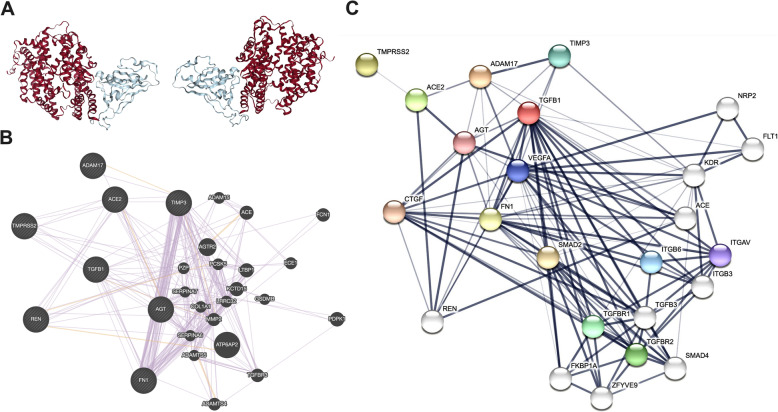
We confirmed the binding of SARS-CoV-2 and ACE2 by bioinformatic analysis. TMPRSS2, ADAM17, tissue inhibitor of metalloproteinase (TIMP)3, angiotensinogen (AGT), transformation growth factor beta (TGFB1), connective tissue growth factor (CTGF), vascular endothelial growth factor (VEGF) A and fibronectin (FN) were interacted with ACE2, and the mRNA and protein of these molecules were expressed in lung epithelial cells. SARS-CoV-2 infection increased ACE2, TGFB1, CTGF and FN1 mRNA that were drivers of lung fibrosis. These changes were also found in lung tissues from lung fibrosis patients.
Therefore, SARS-CoV-2 binds with ACE2 and activates fibrosis-related genes and processes to induce lung fibrosis.
严重急性呼吸系统综合征冠状病毒 2 型(SARS-CoV-2)引起的 2019 年冠状病毒病(COVID-19)是一种全球性疾病,影响全球超过 280 万人,且每日新增病例数呈指数级增长。然而,目前尚无针对 COVID-19 的特定治疗方法,人们对这种疾病仍知之甚少。血管紧张素转换酶(ACE)2 是 SARS-CoV-2 的细胞受体。它被 II 型跨膜丝氨酸蛋白酶(TMPRSS)2 和解整合素金属蛋白酶域(ADAM)17 切割,以协助病毒进入宿主细胞。临床上,SARS-CoV-2 感染可能导致急性肺损伤和肺纤维化,但 COVID-19 诱导肺纤维化的潜在机制尚不完全清楚。
使用生物信息学方法鉴定 ACE2 及其相互作用分子的网络。在人上皮细胞感染 SARS-CoV-2 24 小时后,或在肺纤维化患者的现有数据集内,测量这些基因和蛋白的表达。
我们通过生物信息学分析证实了 SARS-CoV-2 与 ACE2 的结合。TMPRSS2、ADAM17、金属蛋白酶组织抑制剂 3(TIMP3)、血管紧张素原(AGT)、转化生长因子β(TGFB1)、结缔组织生长因子(CTGF)、血管内皮生长因子 A(VEGF A)和纤维连接蛋白(FN)与 ACE2 相互作用,这些分子的 mRNA 和蛋白在肺上皮细胞中表达。SARS-CoV-2 感染增加了 ACE2、TGFB1、CTGF 和 FN1 的 mRNA,这些都是肺纤维化的驱动基因。这些变化也存在于肺纤维化患者的肺组织中。
因此,SARS-CoV-2 与 ACE2 结合并激活与纤维化相关的基因和过程,导致肺纤维化。