Berg Lars M, Ankjell Torun K S, Sun Yi-Qian, Trovik Tordis A, Rikardsen Oddveig G, Sjögren Anders, Moen Ketil, Hellem Sølve, Bugten Vegard
Department of Clinical Dentistry, Faculty of Health Sciences, UiT The Arctic University of Norway, Tromsø, Norway.
ENT Department, University Hospital in Northern Norway, Tromsø, Norway.
Int J Otolaryngol. 2020 Jun 30;2020:2856460. doi: 10.1155/2020/2856460. eCollection 2020.
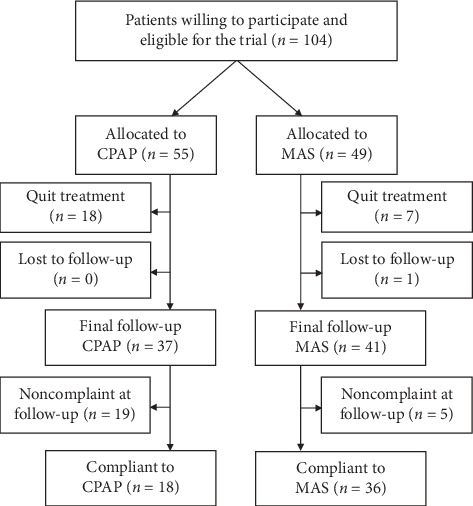
In this randomized controlled trial, patients with nonsevere obstructive sleep apnea (OSA) were treated with continuous positive airway pressure (CPAP) or a twin block mandibular advancement splint (MAS). The primary objective was to compare how CPAP and MAS treatments change the health-related quality of life (HRQoL) and self-reported sleep quality of patients after 12 months of treatment. In total, 104 patients were recruited: 55 were allocated to the CPAP treatment group and 49 to the MAS treatment group. We used the SF36 questionnaire to evaluate HRQoL and the Pittsburgh Sleep Quality Index (PSQI) to evaluate sleep quality. All patients were included in the intention-to-treat analyses. These analyses showed improvements in the SF36 physical component score (from 48.8 ± 7.6 at baseline to 50.5 ± 8.0 at follow-up, =0.03) in the CPAP treatment group and in the mental component score (from 44.9 ± 12.1 to 49.3 ± 9.2, =0.009) in the MAS treatment group. The PSQI global score improved in both the CPAP (from 7.7 ± 3.5 to 6.6 ± 2.9, =0.006) and the MAS (8.0 ± 3.1 to 6.1 ± 2.6, < 0.001) treatment groups. No difference was found between the treatment groups in any of the SF36 scores or PSQI global score at the final follow-up ( > 0.05) in any analysis. The improvement in the SF36 vitality domain moderately correlated to the improvement in the PSQI global score in both groups (CPAP: ||=0.47, < 0.001; MAS: ||=0.36, =0.01). In the MAS treatment group, we also found a weak correlation between improvements in the SF36 mental component score and PSQI global score (||=0.28, =0.05). In conclusion, CPAP and MAS treatments lead to similar improvements in the HRQoL and self-reported sleep quality in nonsevere OSA. Improvements in aspects of HRQoL seem to be moderately correlated to the self-reported sleep quality in both CPAP and MAS treatments.
在这项随机对照试验中,非重度阻塞性睡眠呼吸暂停(OSA)患者接受持续气道正压通气(CPAP)或双阻板下颌前移矫治器(MAS)治疗。主要目的是比较CPAP和MAS治疗12个月后对患者健康相关生活质量(HRQoL)和自我报告睡眠质量的影响。总共招募了104名患者:55名被分配到CPAP治疗组,49名被分配到MAS治疗组。我们使用SF36问卷评估HRQoL,使用匹兹堡睡眠质量指数(PSQI)评估睡眠质量。所有患者均纳入意向性分析。这些分析显示,CPAP治疗组的SF36身体成分评分有所改善(从基线时的48.8±7.6提高到随访时的50.5±8.0,P=0.03),MAS治疗组的心理成分评分有所改善(从44.9±12.1提高到49.3±9.2,P=0.009)。CPAP治疗组(从7.7±3.5降至6.6±2.9,P=0.006)和MAS治疗组(从8.0±3.1降至6.1±2.6,P<0.001)的PSQI总体评分均有所改善。在任何分析中,最终随访时各治疗组在任何SF36评分或PSQI总体评分上均未发现差异(P>0.05)。两组中,SF36活力领域的改善与PSQI总体评分的改善呈中度相关(CPAP组:r=0.47,P<0.001;MAS组:r=0.36,P=0.01)。在MAS治疗组中,我们还发现SF36心理成分评分的改善与PSQI总体评分的改善之间存在弱相关性(r=0.28,P=0.05)。总之,CPAP和MAS治疗在非重度OSA患者的HRQoL和自我报告睡眠质量方面带来了相似的改善。在CPAP和MAS治疗中,HRQoL方面的改善似乎与自我报告的睡眠质量呈中度相关。