Department of Environmental Health, University of Cincinnati College of Medicine, Cincinnati, OH, USA.
Department of Environmental and Occupational Health, University of Nevada Las Vegas, School of Public Health, Las Vegas, NV, USA.
Environ Res. 2020 Jul;186:109583. doi: 10.1016/j.envres.2020.109583. Epub 2020 Apr 25.
It is unclear whether cadmium (Cd) exposure during fetal brain development is associated with child neurobehavior.
To examine the potential associations between Cd exposure during pregnancy and neurobehavior among children.
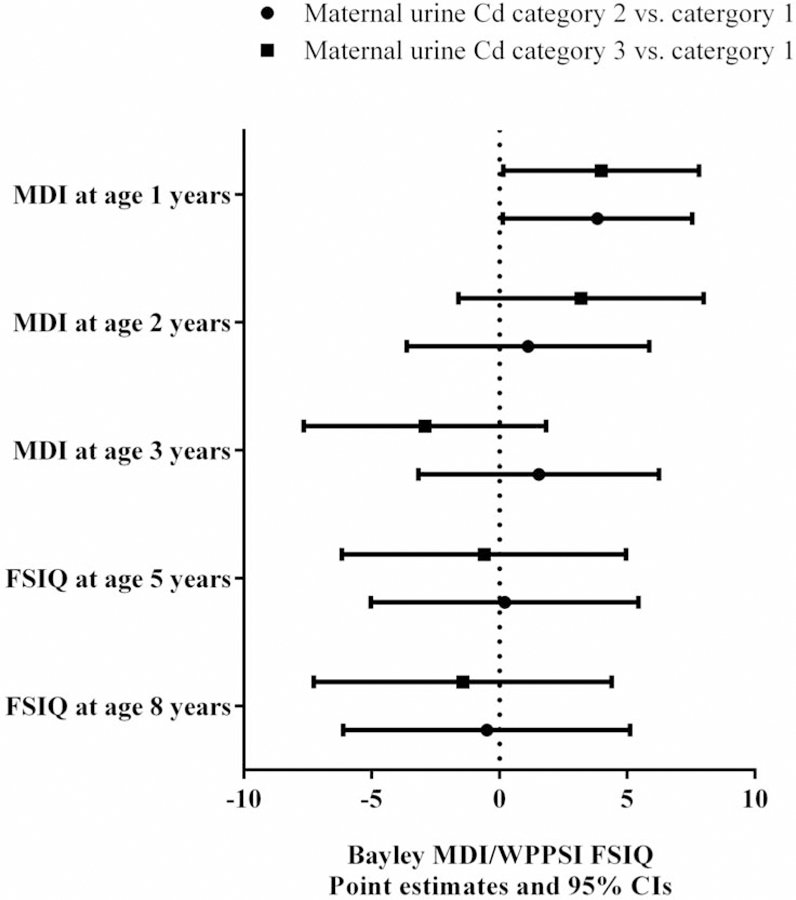
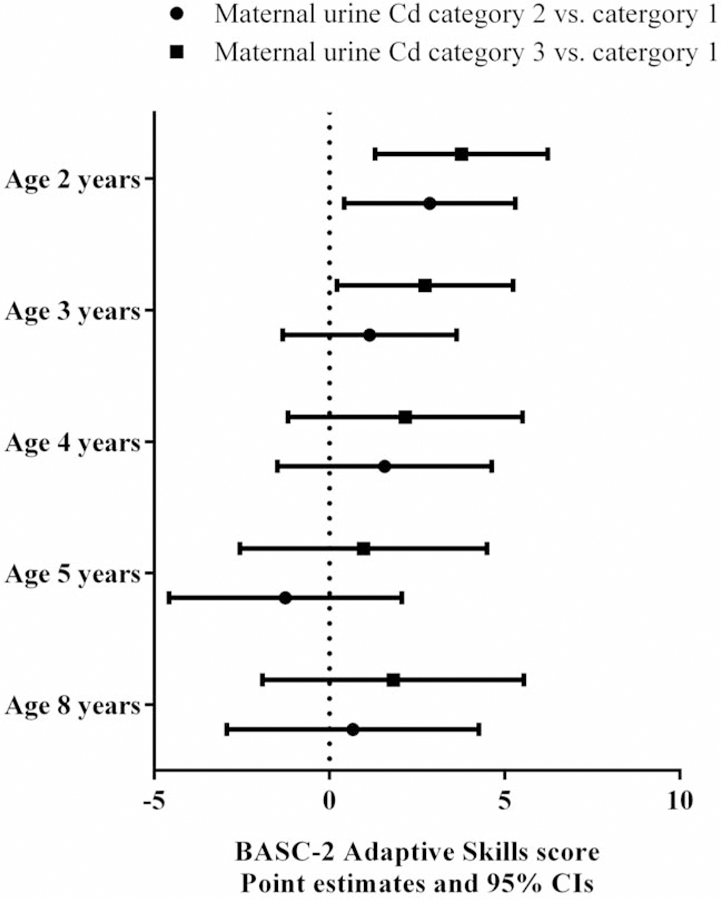
We used data from 276 children in the Health Outcomes and Measures of the Environment (HOME) Study, a well-established prospective pregnancy and birth cohort. We measured maternal urinary Cd concentrations at 26 weeks of gestation. For cognitive function, we assessed Mental Development Index (MDI) and Full-Scale Intelligence Quotient (FSIQ) using the Bayley Scales of Infant Development-II, the Wechsler Preschool and Primary Scales of Intelligence-III, or the Wechsler Intelligence Scales for Children-IV at ages 1, 2, 3, 5, and 8 years. We assessed child behaviors using the Behavior Assessment System for Children-2 at ages 2, 3, 4, 5, and 8 years, yielding four composite measures: Externalizing Problems, Internalizing Problems, Behavioral Symptoms Index, and Adaptive Skills. We used linear mixed models with covariate adjustment to estimate the associations between maternal urinary Cd concentrations and child neurobehavior.
We categorized study participants into three groups based on maternal urinary Cd concentrations (Group 1: < limit of detection (LOD), Group 2: 0.06-0.22 μg/g creatinine, Group 3: >0.22 μg/g creatinine). In linear mixed models adjusting for maternal and child characteristics, maternal urinary Cd levels were not significantly associated with cognitive function at ages 1, 2, 3, 5, and 8 years or with behavioral composite measures at 2, 3, 4, 5, and 8 years.
No significant associations were observed between maternal urinary Cd and cognitive or behavioral measures in children at 1-8 years of age in this study.
胎儿大脑发育过程中镉(Cd)暴露是否与儿童神经行为有关尚不清楚。
研究妊娠期间 Cd 暴露与儿童神经行为之间的潜在关联。
我们使用了健康结果和环境测量(HOME)研究中 276 名儿童的数据,该研究是一个成熟的前瞻性妊娠和出生队列。我们在妊娠 26 周时测量了母亲尿液中的 Cd 浓度。对于认知功能,我们使用贝利婴幼儿发展量表 II、韦氏学前和小学智力量表 III 或韦氏儿童智力量表 IV 在 1、2、3、5 和 8 岁时评估了精神发育指数(MDI)和全量表智商(FSIQ)。我们使用行为评估系统儿童-2 在 2、3、4、5 和 8 岁时评估了儿童行为,得出了四个综合指标:外化问题、内化问题、行为症状指数和适应技能。我们使用带有协变量调整的线性混合模型来估计母亲尿液 Cd 浓度与儿童神经行为之间的关系。
我们根据母亲尿液 Cd 浓度将研究参与者分为三组(第 1 组:<检测限(LOD),第 2 组:0.06-0.22μg/g 肌酐,第 3 组:>0.22μg/g 肌酐)。在调整了母亲和儿童特征的线性混合模型中,母亲尿液 Cd 水平与 1、2、3、5 和 8 岁时的认知功能或 2、3、4、5 和 8 岁时的行为综合指标均无显著相关性。
在这项研究中,没有观察到母亲尿液 Cd 与 1-8 岁儿童的认知或行为测量之间存在显著关联。