Tung Pei Wen, Burt Amber, Karagas Margaret, Jackson Brian P, Punshon Tracy, Lester Barry, Marsit Carmen J
Gangarosa Department of Environmental Health, Emory University, Atlanta, GA.
Department of Epidemiology, Geisel School of Medicine at Dartmouth, Lebanon, NH.
Environ Epidemiol. 2022 Jan 28;6(1):e194. doi: 10.1097/EE9.0000000000000194. eCollection 2022 Feb.
Prenatal exposure to metals can affect the developing fetus and negatively impact neurobehavior. The associations between individual metals and neurodevelopment have been examined, but little work has explored the potentially detrimental neurodevelopmental outcomes associated with the combined impact of coexisting metals. The objective of this study is to evaluate prenatal metal exposure mixtures in the placenta to elucidate the link between their combined effects on newborn neurobehavior.
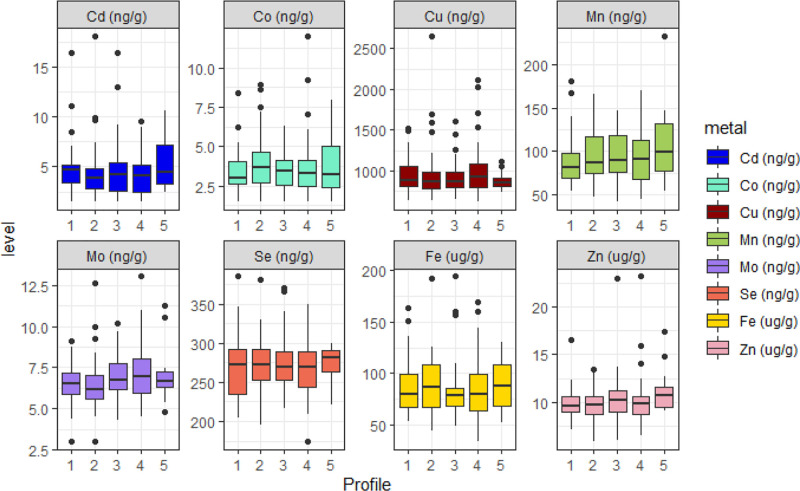
This study included 192 infants with available placental metal and NICU Network Neurobehavioral Scale data at 24 hours-72 hours age. Eight essential and nonessential metals (cadmium, cobalt, copper, iron, manganese, molybdenum, selenium, zinc) detected in more than 80% of samples were tested for associations with atypical neurobehavior indicated by NICU Network Neurobehavioral Scale using logistic regression and in a quantile g-computation analysis to evaluate the joint association between placental metal mixture and neurobehavioral profiles.
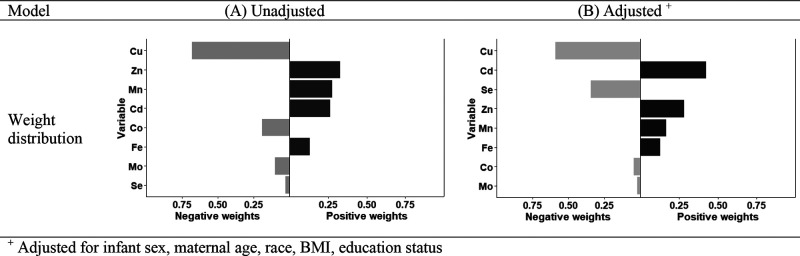
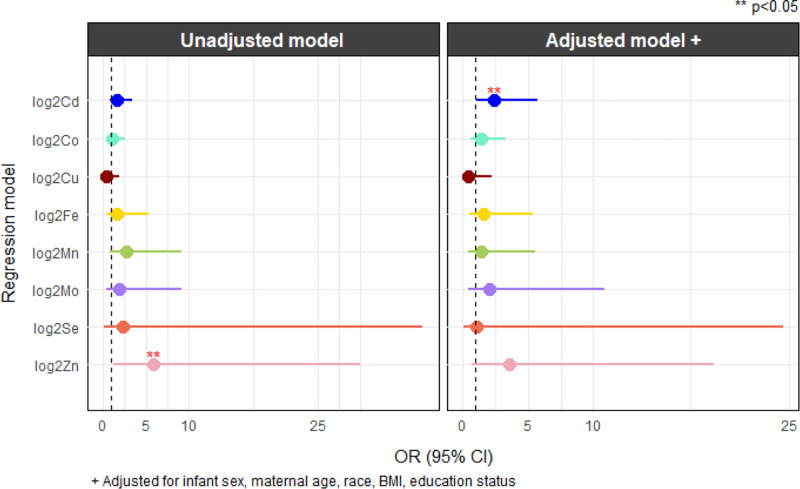
Individually, a doubling of placental cadmium concentrations was associated with an increased likelihood of being in the atypical neurobehavioral profile (OR = 2.39; 95% CI = 1.05 to 5.71). In the mixture analysis, joint effects of a quartile increase in exposure to all metals was associated with 3-fold increased odds of newborns being assigned to the atypical profile (OR = 3.23; 95% CI = 0.92 to 11.36), with cadmium having the largest weight in the mixture effect.
Prenatal exposure to relatively low levels of a mixture of placental metals was associated with adverse newborn neurobehavior. Examining prenatal metal exposures as a mixture is important for understanding the harmful effects of concomitant exposures in the vulnerable populations.
孕期接触金属会影响胎儿发育,并对神经行为产生负面影响。虽然已经对单一金属与神经发育之间的关联进行了研究,但很少有研究探讨共存金属的综合影响可能导致的有害神经发育结果。本研究的目的是评估胎盘中的产前金属暴露混合物,以阐明它们对新生儿神经行为的联合影响之间的联系。
本研究纳入了192名在24小时至72小时龄时有可用胎盘金属和新生儿重症监护病房网络神经行为量表数据的婴儿。对在超过80%的样本中检测到的八种必需和非必需金属(镉、钴、铜、铁、锰、钼、硒、锌)进行检测,以使用逻辑回归和分位数g计算分析来评估胎盘金属混合物与神经行为特征之间的关联,该分析用于评估胎盘金属混合物与神经行为特征之间的联合关联,NICU网络神经行为量表显示的非典型神经行为。
单独来看,胎盘镉浓度翻倍与处于非典型神经行为特征的可能性增加有关(OR = 2.39;95% CI = 1.05至5.71)。在混合物分析中,所有金属暴露增加四分位数的联合效应与新生儿被归类为非典型特征的几率增加3倍有关(OR = 3.23;95% CI = 0.92至11.36),其中镉在混合物效应中权重最大。
产前接触相对低水平的胎盘金属混合物与新生儿不良神经行为有关。将产前金属暴露作为混合物进行研究对于理解弱势群体中同时接触的有害影响很重要。