Faculty of Life Science and Biotechnology, Kunming University of Science and Technology, Kunming 650500, People's Republic of China.
Medical School, Kunming University of Science and Technology, Kunming 650500, People's Republic of China.
Drug Des Devel Ther. 2020 Jul 1;14:2535-2547. doi: 10.2147/DDDT.S254218. eCollection 2020.
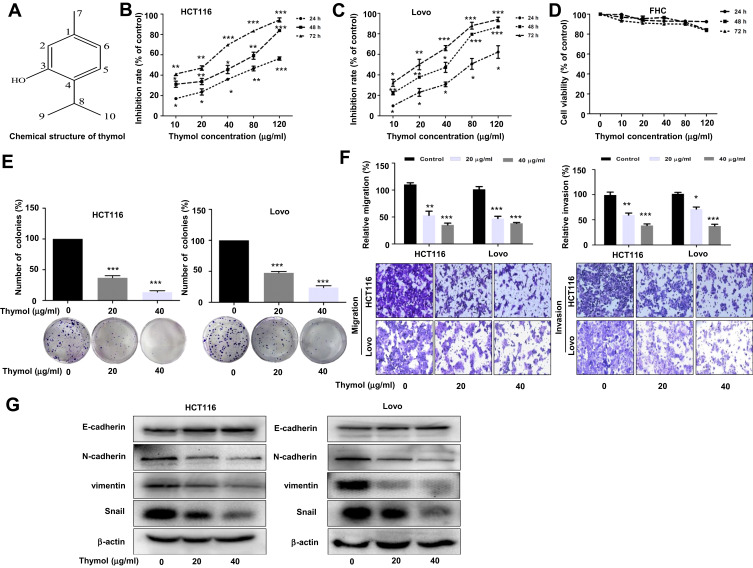
Colorectal cancer (CRC) is one of the most commonly occurring cancers and is associated with high morbidity and mortality. Nevertheless, there is currently no safe and effective treatment for this condition. Thymol is a phenolic compound that is recognized as safe for use in food as well as medical and cosmetic fields. Increasing evidence has indicated that thymol exerts prominent antitumor effects in a variety of cancers, including CRC. However, how thymol elicits these effects on CRC and the associated underlying mechanisms remains unclear.
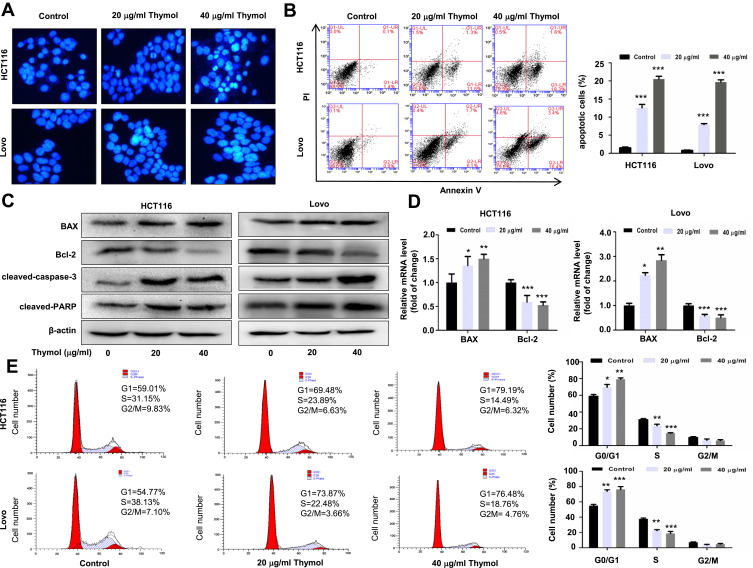
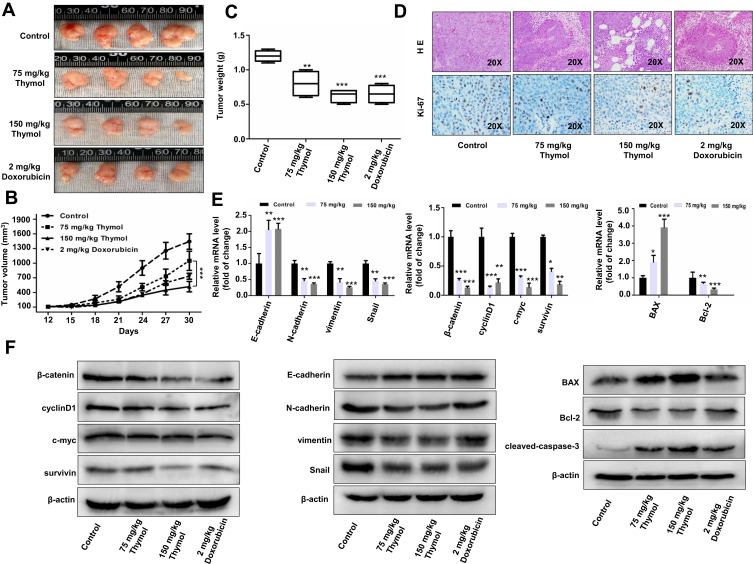
HCT116 and Lovo cells were treated with different concentrations of thymol. Cell Counting Kit-8 (CCK-8) and transwell migration and invasion assays were used to evaluate cell proliferation, migration, and invasion, respectively. Cell apoptosis and cell cycle distribution were measured by flow cytometry. RT-qPCR, Western blot, and immunohistochemistry were used to detect the expression of related genes and their protein products.
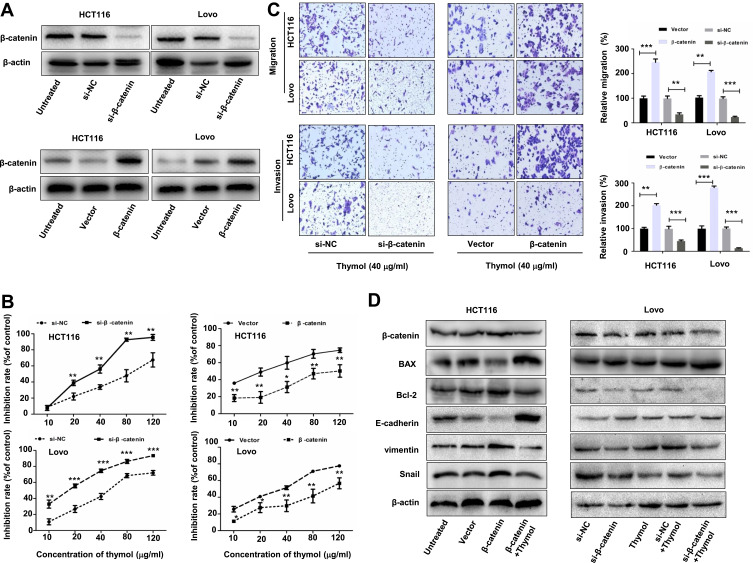
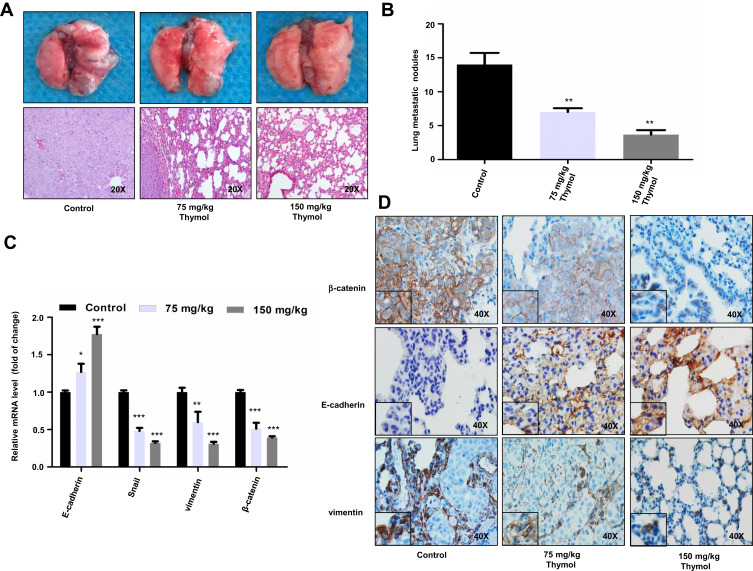
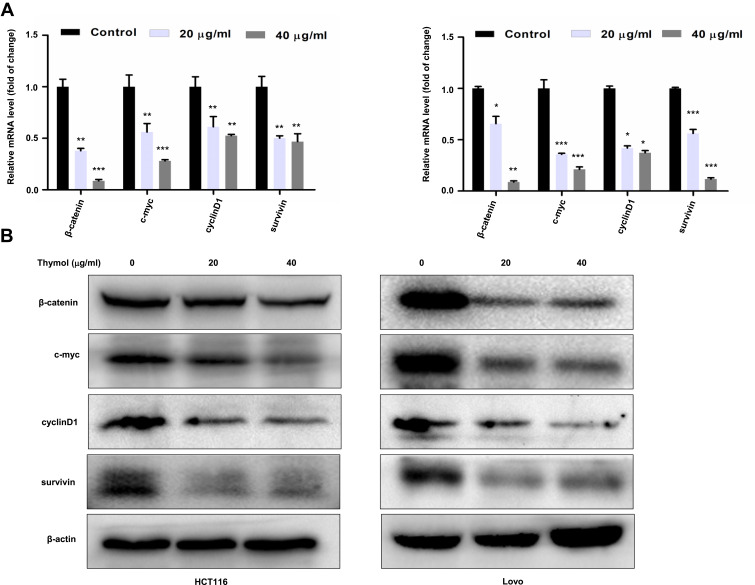
In this study, we tested the antitumor activity of thymol extracted from a Chinese medicinal herb, L. We show that thymol treatment in vitro inhibited cell proliferation and induced apoptosis and cell cycle arrest in CRC. Furthermore, in vivo treatment with 75 and 150 mg/kg thymol led to a significant decrease in tumor volume. Thymol administration induced CRC cell apoptosis through activation of the BAX/Bcl-2 signaling pathway. In addition, thymol suppressed CRC cell epithelial-mesenchymal transition (EMT), invasion, and metastasis via inhibiting the activation of the Wnt/β-catenin pathway, both in vitro and in vivo.
Thymol may prevent CRC progression through inhibition of the Wnt/β-catenin signaling pathway, highlighting its potential as a novel therapeutic option for the treatment of CRC.
结直肠癌(CRC)是最常见的癌症之一,与高发病率和死亡率相关。然而,目前针对这种疾病尚无安全有效的治疗方法。百里香酚是一种酚类化合物,被认为在食品、医疗和化妆品领域使用安全。越来越多的证据表明,百里香酚在包括 CRC 在内的多种癌症中发挥着显著的抗肿瘤作用。然而,百里香酚如何对 CRC 产生这些作用以及相关的潜在机制尚不清楚。
用不同浓度的百里香酚处理 HCT116 和 Lovo 细胞。使用细胞计数试剂盒-8(CCK-8)和 Transwell 迁移和侵袭实验分别评估细胞增殖、迁移和侵袭。通过流式细胞术测量细胞凋亡和细胞周期分布。RT-qPCR、Western blot 和免疫组织化学用于检测相关基因及其蛋白产物的表达。
在这项研究中,我们测试了来自中国草药 L. 的百里香酚提取物的抗肿瘤活性。我们表明,体外百里香酚处理抑制 CRC 细胞增殖并诱导细胞凋亡和细胞周期停滞。此外,75 和 150 mg/kg 百里香酚的体内治疗导致肿瘤体积显著减小。百里香酚通过激活 BAX/Bcl-2 信号通路诱导 CRC 细胞凋亡。此外,百里香酚通过抑制 Wnt/β-catenin 通路的激活,在体外和体内均抑制 CRC 细胞上皮-间充质转化(EMT)、侵袭和转移。
百里香酚可能通过抑制 Wnt/β-catenin 信号通路来预防 CRC 的进展,突出了其作为治疗 CRC 的一种新的治疗选择的潜力。