Department of Internal Medicine, Pulmonology, Allergy and Clinical Immunology, Central Clinical Hospital of the Ministry of National Defense, Military Institute of Medicine in Warsaw, Warsaw, Poland.
Department of Clinical Immunology, Medical University of Warsaw, Warsaw, Poland.
Front Immunol. 2020 May 20;11:981. doi: 10.3389/fimmu.2020.00981. eCollection 2020.
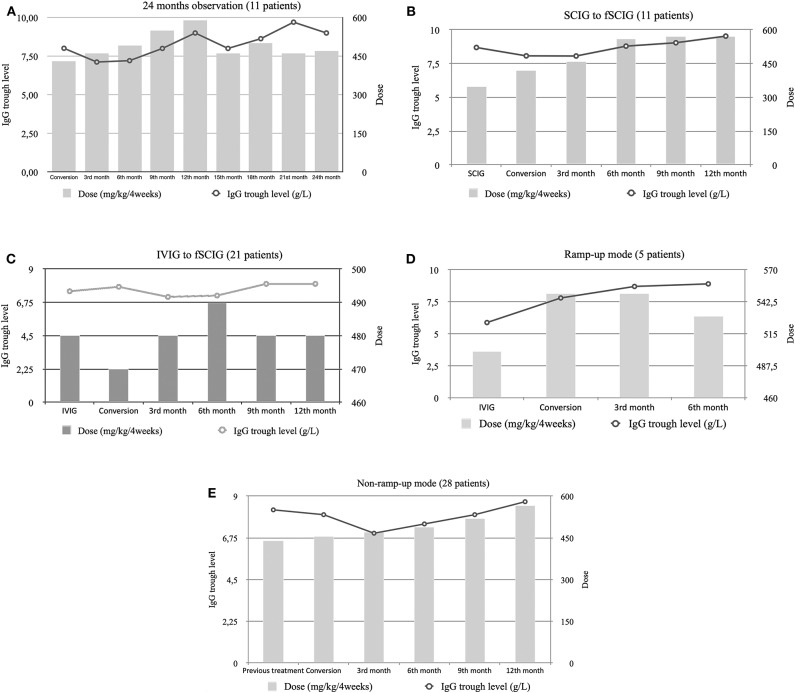
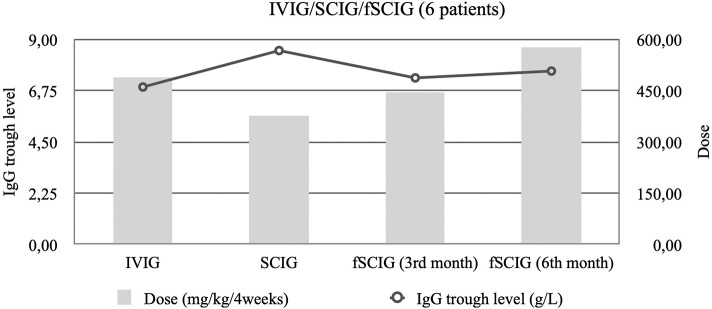
Facilitated subcutaneous immunoglobulin (fSCIG) replacement therapy is the latest method of IgG administration; however, real-life data are limited. We retrospectively analyzed the everyday experience of fSCIG administration, particularly, the method used to switch from intravenous immunoglobulin (IVIG) or subcutaneous immunoglobulin (SCIG) to fSCIG and the dosing modifications required. Of the 39 adult patients with primary immunodeficiency (PID) who received fSCIG, 34 remained on the therapy at the end of the study. The median observation time was 18 (range, 3-24) months. Two patients were IgG-treatment-naïve; 23 had previously received IVIG and 14 had received SCIG. In 25 cases, a non-ramp-up dosing mode was used to switch to fSCIG (including two half-monthly doses given biweekly in 14 cases, and full monthly doses given in 11 cases), a ramp-up mode was used in six cases; other methods were used in eight cases. The median IgG trough level at baseline was 7.9 g/L ( = 38), 7.9 g/L ( = 32) at Month 6, 9.0 g/L ( = 30) at Month 12, 8.6 g/L ( = 22) at Month 18, and 9.0 g/L ( = 11) at Month 24. No serious bacterial infections or hospitalizations due to PID complications occurred. At the end of the study, 24 patients (71%) received fSCIG every 4 weeks, six (18%) received fSCIG every 3 weeks, and four (12%) received fSCIG biweekly. In conclusion, our study provides real-life evidence of clinical efficacy of personalized fSCIG treatment when switching from prior immunoglobulin replacement using various switching modes and dosing frequencies.
皮下免疫球蛋白(SCIG)输注疗法是最新的 IgG 给药方法;然而,目前实际数据有限。我们回顾性分析了 SCIG 日常给药经验,特别是从静脉免疫球蛋白(IVIG)或 SCIG 转换为 SCIG 的方法以及所需的剂量调整。在接受 SCIG 治疗的 39 例原发性免疫缺陷(PID)成年患者中,34 例在研究结束时仍在接受治疗。中位观察时间为 18(范围 3-24)个月。2 例患者为 IgG 治疗初治患者;23 例患者先前接受过 IVIG 治疗,14 例患者接受过 SCIG 治疗。25 例患者采用非爬坡剂量模式转换为 SCIG(包括 14 例每两周给予 2 次半剂量,11 例给予全剂量),6 例患者采用爬坡剂量模式,8 例患者采用其他方法。基线时 IgG 谷值水平中位数为 7.9 g/L( = 38),第 6 个月时为 7.9 g/L( = 32),第 12 个月时为 9.0 g/L( = 30),第 18 个月时为 8.6 g/L( = 22),第 24 个月时为 9.0 g/L( = 11)。没有发生严重细菌感染或因 PID 并发症住院。研究结束时,24 例(71%)患者每 4 周接受 SCIG 治疗,6 例(18%)患者每 3 周接受 SCIG 治疗,4 例(12%)患者每 2 周接受 SCIG 治疗。总之,本研究提供了在各种转换模式和剂量频率下,从先前的免疫球蛋白替代治疗转换为个体化 SCIG 治疗的临床疗效的真实证据。