Francois Jean Marie, Alkim Ceren, Morin Nicolas
Toulouse Biotechnology Institute, CNRS, INRA, LISBP INSA, 135 Avenue de Rangueil, Toulouse Cedex 04, 31077 France.
Toulouse White Biotechnology (TWB, UMS INRA/INSA/CNRS), NAPA CENTER Bât B, 3 Rue Ariane 31520, Ramonville Saint-Agnes, France.
Biotechnol Biofuels. 2020 Jul 8;13:118. doi: 10.1186/s13068-020-01744-6. eCollection 2020.
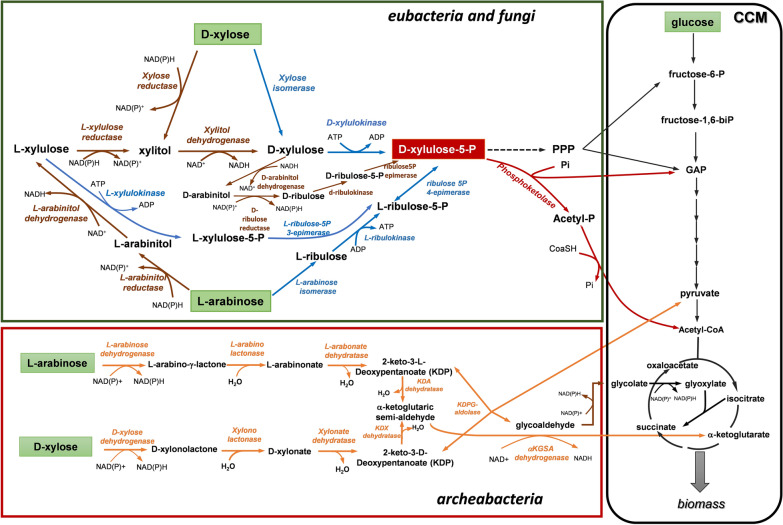
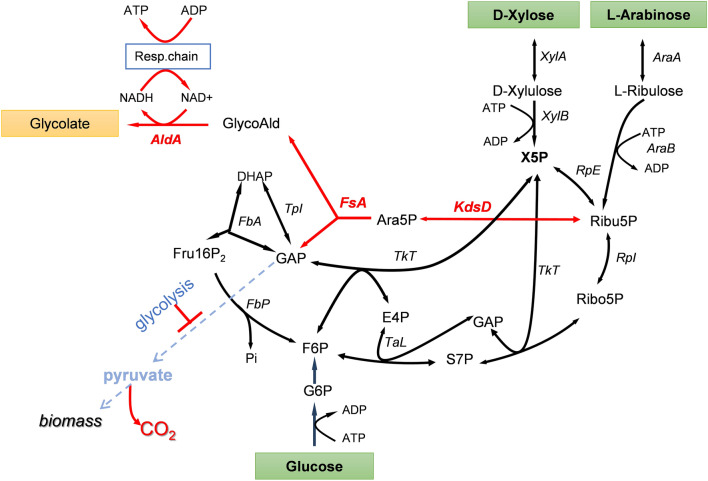
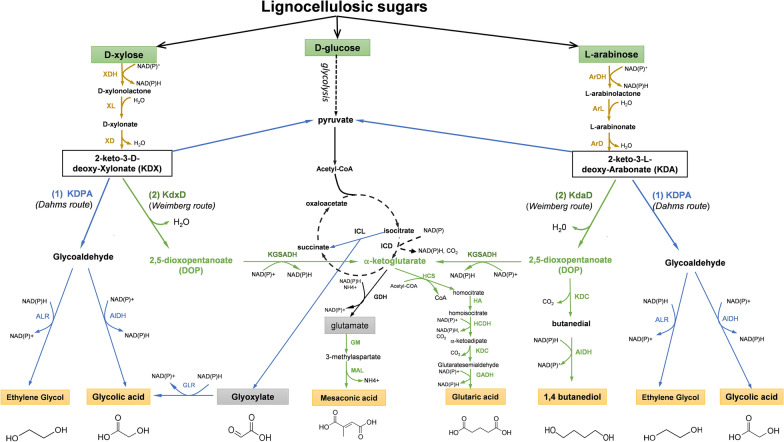
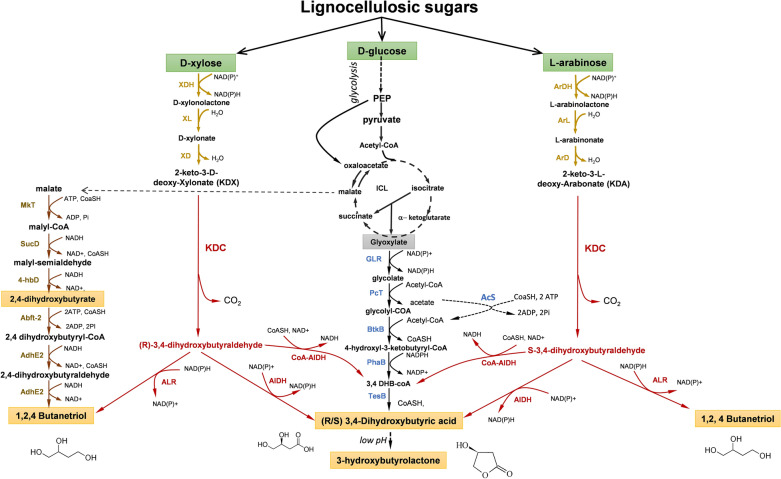
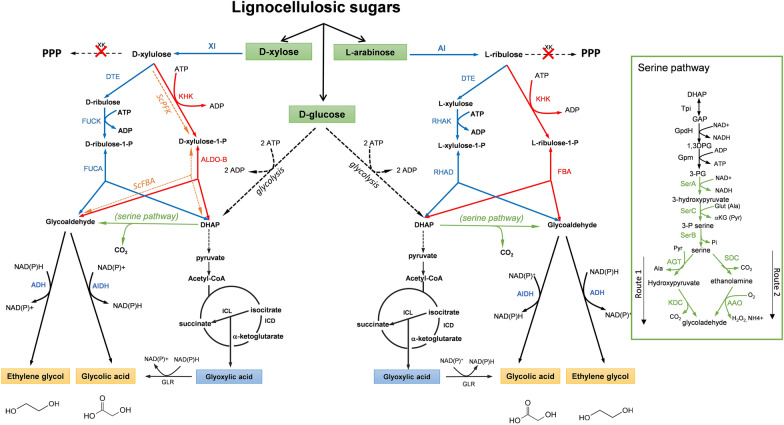
Lignocellulose is the most abundant biomass on earth with an annual production of about 2 × 10 tons. It is an inedible renewable carbonaceous resource that is very rich in pentose and hexose sugars. The ability of microorganisms to use lignocellulosic sugars can be exploited for the production of biofuels and chemicals, and their concurrent biotechnological processes could advantageously replace petrochemicals' processes in a medium to long term, sustaining the emerging of a new economy based on bio-based products from renewable carbon sources. One of the major issues to reach this objective is to rewire the microbial metabolism to optimally configure conversion of these lignocellulosic-derived sugars into bio-based products in a sustainable and competitive manner. Systems' metabolic engineering encompassing synthetic biology and evolutionary engineering appears to be the most promising scientific and technological approaches to meet this challenge. In this review, we examine the most recent advances and strategies to redesign natural and to implement non-natural pathways in microbial metabolic framework for the assimilation and conversion of pentose and hexose sugars derived from lignocellulosic material into industrial relevant chemical compounds leading to maximal yield, titer and productivity. These include glycolic, glutaric, mesaconic and 3,4-dihydroxybutyric acid as organic acids, monoethylene glycol, 1,4-butanediol and 1,2,4-butanetriol, as alcohols. We also discuss the big challenges that still remain to enable microbial processes to become industrially attractive and economically profitable.
木质纤维素是地球上最丰富的生物质,年产量约为2×10吨。它是一种不可食用的可再生含碳资源,富含戊糖和己糖。微生物利用木质纤维素糖的能力可用于生产生物燃料和化学品,其同步生物技术过程从中长期来看可有利地替代石化过程,推动基于可再生碳源的生物基产品的新经济的兴起。实现这一目标的主要问题之一是重新调整微生物代谢,以可持续和有竞争力的方式将这些木质纤维素衍生的糖最佳地转化为生物基产品。涵盖合成生物学和进化工程的系统代谢工程似乎是应对这一挑战最有前景的科学技术方法。在本综述中,我们研究了在微生物代谢框架中重新设计天然途径和实施非天然途径的最新进展和策略,用于将木质纤维素材料衍生的戊糖和己糖同化和转化为与工业相关的化合物,以实现最大产量、滴度和生产率。这些化合物包括作为有机酸的乙醇酸、戊二酸、甲基丙烯酸和3,4 - 二羟基丁酸,以及作为醇类的单乙二醇、1,4 - 丁二醇和1,2,4 - 丁三醇。我们还讨论了使微生物过程具有工业吸引力和经济可行性仍面临的重大挑战。