Gous Natasha, Fischer Alex E, Rhagnath Naleni, Phatsoane Mothepane, Majam Mohammed, Lalla-Edward Samanta T
SystemOne, LLC, Weltevreden Park, South Africa.
Ezintsha, Wits Reproductive Health and HIV Institute, University of the Witwatersrand, Johannesburg, South Africa.
South Afr J HIV Med. 2020 Jun 30;21(1):1088. doi: 10.4102/sajhivmed.v21i1.1088. eCollection 2020.
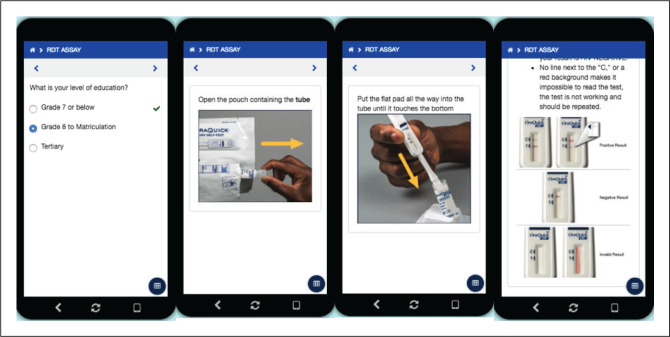
Human immunodeficiency virus self-testing (HIVST) reduces barriers associated with facility-based testing; however, no formal mechanism exists for users to self-report results or link to care. The Aspect HIVST mobile application (app) was developed for use in South Africa.
This study evaluated the acceptability and feasibility of the Aspect HIVST app for individuals from the inner city of Johannesburg.
This cross-sectional pilot, with a convenience sample of 300 adults, was conducted in July 2018. Participants were provided an OraQuick HIVST kit and a smartphone preloaded with the app, then asked to follow the in-app instructions for use (IFU) to complete the HIVST and upload results. Trained healthcare workers (HCWs) observed and recorded any deviations from the IFU, and conducted a post-test survey to assess acceptability. Feasibility was evaluated by the number of participants who agreed to participate, completed the self-test, and uploaded all information onto the app correctly.
Most participants (98.7%) found the app easy to use. To reduce difficulties related to the IFU (26; 8.7%), participants suggested multimedia supplements (4; 1.3%), additional languages (4; 1.3%) and simplified instructions (5; 1.7%). All individuals approached, agreed to participate, 267 (89.0%) correctly completed all steps and 210 (78.7%) successfully captured all information on the app. Most errors (26; 8.7%) were testing errors and 1 (0.3%) was from the app sequence. Twelve (4.5%) errors were with test strip imaging and 72 (27.0%) discordances were with demographic information.
Despite some challenges with IFU interpretation and data capture via the app, this pilot showed that the Aspect HIVST app is an acceptable way to upload mobile HIVST results and demographic information to a central database.
人类免疫缺陷病毒自我检测(HIVST)减少了与基于医疗机构检测相关的障碍;然而,用户没有正式的机制来自我报告检测结果或与医疗服务建立联系。Aspect HIVST移动应用程序(应用)专为在南非使用而开发。
本研究评估了Aspect HIVST应用程序对约翰内斯堡市中心个人的可接受性和可行性。
2018年7月进行了这项横断面试点研究,采用便利抽样法选取了300名成年人。为参与者提供了一个OraQuick HIVST检测试剂盒和一部预装有该应用程序的智能手机,然后要求他们按照应用程序内的使用说明(IFU)完成HIVST检测并上传结果。经过培训的医护人员观察并记录任何与IFU不符的情况,并进行检测后调查以评估可接受性。通过同意参与、完成自我检测并将所有信息正确上传到应用程序的参与者数量来评估可行性。
大多数参与者(98.7%)认为该应用程序易于使用。为减少与IFU相关的困难(26例;8.7%),参与者建议提供多媒体补充内容(4例;1.3%)、增加语言版本(4例;1.3%)和简化说明(5例;1.7%)。所有接触到的个体都同意参与,267人(89.0%)正确完成了所有步骤,210人(78.7%)成功在应用程序上录入了所有信息。大多数错误(26例;8.7%)是检测错误,1例(0.3%)来自应用程序顺序。12例(4.5%)错误出现在试纸条成像方面,72例(27.0%)不一致出现在人口统计学信息方面。
尽管在IFU解读和通过应用程序进行数据录入方面存在一些挑战,但这项试点研究表明,Aspect HIVST应用程序是将移动HIVST检测结果和人口统计学信息上传到中央数据库的一种可接受方式。