RECOVER Injury Research Centre, Faculty of Health and Behavioural Sciences, The University of Queensland, Brisbane, Australia.
The Australian e-Health Research Centre, Commonwealth Scientific & Industrial Research Organisation Health & Biosecurity, Brisbane, Australia.
J Med Internet Res. 2020 Jul 8;22(7):e17559. doi: 10.2196/17559.
Telemonitoring enables care providers to remotely support outpatients in self-managing chronic heart failure (CHF), but the objective assessment of patient compliance with self-management recommendations has seldom been studied.
This study aimed to evaluate patient compliance with self-management recommendations of an innovative telemonitoring enhanced care program for CHF (ITEC-CHF).
We conducted a multicenter randomized controlled trial with a 6-month follow-up. The ITEC-CHF program comprised the provision of Bluetooth-enabled scales linked to a call center and nurse care services to assist participants with weight monitoring compliance. Compliance was defined a priori as weighing at least 4 days per week, analyzed objectively from weight recordings on the scales. The intention-to-treat principle was used to perform the analysis.
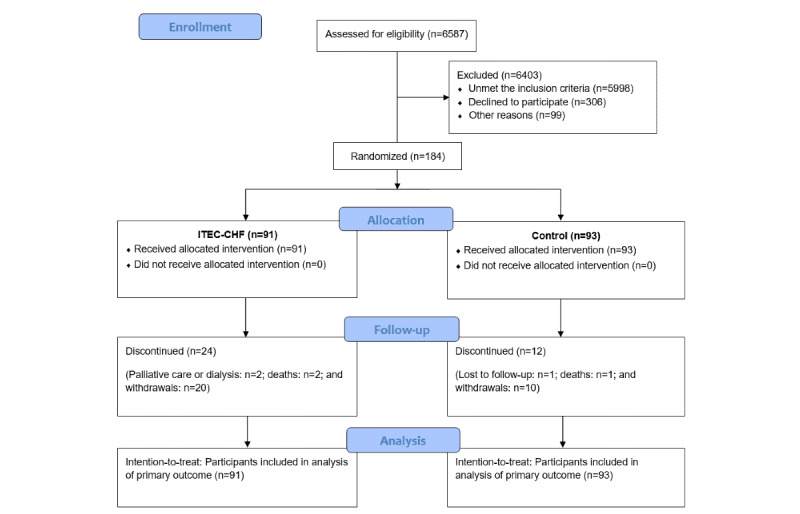
A total of 184 participants (141/184, 76.6% male), with a mean age of 70.1 (SD 12.3) years, were randomized to receive either ITEC-CHF (n=91) or usual care (control; n=93), of which 67 ITEC-CHF and 81 control participants completed the intervention. For the compliance criterion of weighing at least 4 days per week, the proportion of compliant participants in the ITEC-CHF group was not significantly higher than that in the control group (ITEC-CHF: 67/91, 74% vs control: 56/91, 60%; P=.06). However, the proportion of ITEC-CHF participants achieving the stricter compliance standard of at least 6 days a week was significantly higher than that in the control group (ITEC-CHF: 41/91, 45% vs control: 23/93, 25%; P=.005).
ITEC-CHF improved participant compliance with weight monitoring, although the withdrawal rate was high. Telemonitoring is a promising method for supporting both patients and clinicians in the management of CHF. However, further refinements are required to optimize this model of care.
Australian New Zealand Clinical Trial Registry ACTRN12614000916640; https://www.anzctr.org.au/Trial/Registration/TrialReview.aspx?id=366691.
远程监护使医护人员能够远程支持慢性心力衰竭(CHF)患者进行自我管理,但很少有研究客观评估患者对自我管理建议的依从性。
本研究旨在评估一种创新的远程监护增强型 CHF 护理计划(ITEC-CHF)中患者对自我管理建议的依从性。
我们进行了一项多中心随机对照试验,随访时间为 6 个月。ITEC-CHF 计划包括提供与呼叫中心和护士护理服务相连接的蓝牙秤,以帮助参与者遵守体重监测的依从性。依从性预先定义为每周至少称重 4 天,通过对秤上的体重记录进行客观分析来衡量。采用意向治疗原则进行分析。
共有 184 名参与者(141/184,76.6%为男性),平均年龄为 70.1(SD 12.3)岁,被随机分为接受 ITEC-CHF(n=91)或常规护理(对照组;n=93),其中 67 名 ITEC-CHF 和 81 名对照组参与者完成了干预。对于每周至少称重 4 天的依从性标准,ITEC-CHF 组的依从性参与者比例显著高于对照组(ITEC-CHF:67/91,74% vs 对照组:56/91,60%;P=.06)。然而,ITEC-CHF 组达到每周至少 6 天的更严格依从性标准的参与者比例显著高于对照组(ITEC-CHF:41/91,45% vs 对照组:23/93,25%;P=.005)。
ITEC-CHF 提高了参与者对体重监测的依从性,尽管退出率较高。远程监护是一种有前途的方法,可以支持患者和临床医生管理 CHF。然而,需要进一步改进,以优化这种护理模式。
澳大利亚新西兰临床试验注册 ACTRN12614000916640;https://www.anzctr.org.au/Trial/Registration/TrialReview.aspx?id=366691。