• 文献检索
  • 文档翻译
  • 深度研究
  • 学术资讯
  • Suppr Zotero 插件Zotero 插件
  • 邀请有礼
  • 套餐&价格
  • 历史记录
应用&插件
Suppr Zotero 插件Zotero 插件浏览器插件Mac 客户端Windows 客户端微信小程序
定价
高级版会员购买积分包购买API积分包
服务
文献检索文档翻译深度研究API 文档MCP 服务
关于我们
关于 Suppr公司介绍联系我们用户协议隐私条款
关注我们

Suppr 超能文献

核心技术专利:CN118964589B侵权必究
粤ICP备2023148730 号-1Suppr @ 2026

文献检索

告别复杂PubMed语法,用中文像聊天一样搜索,搜遍4000万医学文献。AI智能推荐,让科研检索更轻松。

立即免费搜索

文件翻译

保留排版,准确专业,支持PDF/Word/PPT等文件格式,支持 12+语言互译。

免费翻译文档

深度研究

AI帮你快速写综述,25分钟生成高质量综述,智能提取关键信息,辅助科研写作。

立即免费体验

预测以往疫情和 COVID-19 的努力。

Forecasting efforts from prior epidemics and COVID-19 predictions.

机构信息

Center for Global Health, Perelman School of Medicine, University of Pennsylvania, Philadelphia, PA, USA.

Quantitative Sciences, Flatiron Health, New York, NY, USA.

出版信息

Eur J Epidemiol. 2020 Aug;35(8):727-729. doi: 10.1007/s10654-020-00661-0. Epub 2020 Jul 17.

DOI:10.1007/s10654-020-00661-0
PMID:32676971
原文链接:https://pmc.ncbi.nlm.nih.gov/articles/PMC7366467/
Abstract

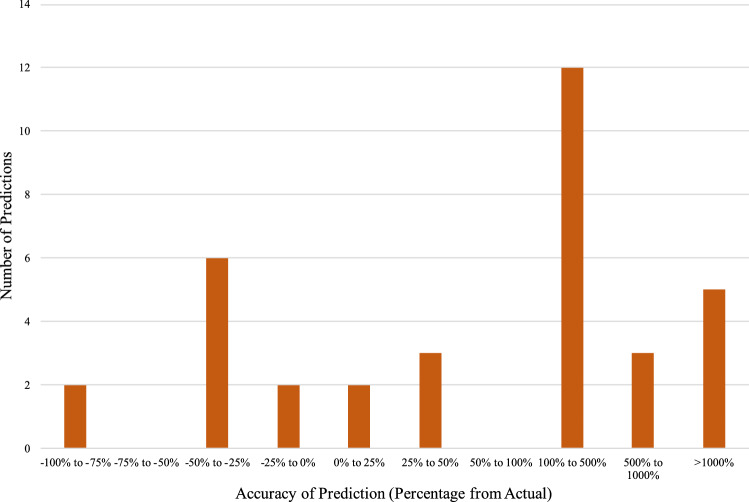
Since the onset of the COVID-19 pandemic, countless disease prediction models have emerged, shaping the focus of news media, policymakers, and broader society. We reviewed the accuracy of forecasts made during prior twenty-first century epidemics, namely SARS, H1N1, and Ebola. We found that while disease prediction models were relatively nascent as a research focus during SARS and H1N1, for Ebola, numerous such forecasts were published. We found that forecasts of deaths for Ebola were often far from the eventual reality, with a strong tendency to over predict. Given the societal prominence of these models, it is crucial that their uncertainty be communicated. Otherwise, we will be unaware if we are being falsely lulled into complacency or unjustifiably shocked into action.

摘要

自 COVID-19 大流行以来,出现了无数疾病预测模型,这些模型成为了新闻媒体、政策制定者和更广泛的社会关注的焦点。我们回顾了 21 世纪之前发生的 SARS、H1N1 和埃博拉等疫情期间做出的预测的准确性。我们发现,虽然疾病预测模型在 SARS 和 H1N1 期间作为一个研究重点还相对较新,但在埃博拉疫情期间,已经发布了许多此类预测。我们发现,埃博拉死亡人数的预测往往与实际情况相去甚远,存在强烈的高估趋势。鉴于这些模型在社会上的重要性,必须要对其不确定性进行沟通。否则,我们将无法确定自己是否被错误地安抚而自满,或者是否被不合理地吓得采取行动。
https://cdn.ncbi.nlm.nih.gov/pmc/blobs/5c40/7366467/44a0f48c7d5f/10654_2020_661_Fig1_HTML.jpg

相似文献

1
Forecasting efforts from prior epidemics and COVID-19 predictions.预测以往疫情和 COVID-19 的努力。
Eur J Epidemiol. 2020 Aug;35(8):727-729. doi: 10.1007/s10654-020-00661-0. Epub 2020 Jul 17.
2
Echoes of 2009 H1N1 Influenza Pandemic in the COVID Pandemic.新冠疫情与 2009 年 H1N1 流感大流行的回声。
Clin Ther. 2020 May;42(5):736-740. doi: 10.1016/j.clinthera.2020.04.003. Epub 2020 Apr 11.
3
What to expect for the influenza season 2020/21 with the ongoing COVID-19 pandemic in the World Health Organization European Region.在世界卫生组织欧洲区域持续存在新冠疫情的情况下,2020/21年流感季的情况预计如何。
Euro Surveill. 2020 Oct;25(42). doi: 10.2807/1560-7917.ES.2020.25.42.2001816.
4
Ebola prepared these countries for coronavirus - but now even they are floundering.埃博拉疫情让这些国家为应对新冠病毒做了准备——但如今就连它们也在苦苦挣扎。
Nature. 2020 Jul;583(7818):667-668. doi: 10.1038/d41586-020-02173-z.
5
[Forecasting the Pandemic: The Role of Mathematical Models].预测大流行:数学模型的作用
Acta Med Port. 2020 Nov 2;33(11):713-715. doi: 10.20344/amp.15049.
6
Phenomenological Modelling of COVID-19 Epidemics in Sri Lanka, Italy, the United States, and Hebei Province of China.斯里兰卡、意大利、美国和中国河北省 COVID-19 疫情的现象学建模。
Comput Math Methods Med. 2020 Oct 18;2020:6397063. doi: 10.1155/2020/6397063. eCollection 2020.
7
Adapting Ebola training to educate healthcare workers during the SARS-2-CoV pandemic.调整埃博拉培训以在严重急性呼吸综合征冠状病毒2(SARS-CoV-2)大流行期间对医护人员进行教育。
Am J Disaster Med. 2020;15(2):137-140. doi: 10.5055/ajdm.2020.0363.
8
Wrong but Useful - What Covid-19 Epidemiologic Models Can and Cannot Tell Us.错误但有用——新冠疫情流行病学模型能告诉我们什么及不能告诉我们什么
N Engl J Med. 2020 Jul 23;383(4):303-305. doi: 10.1056/NEJMp2016822. Epub 2020 May 15.
9
COVID-19 and the next influenza season.新型冠状病毒肺炎与下一个流感季节。
Sci Adv. 2020 Jul 29;6(31):eabd0086. doi: 10.1126/sciadv.abd0086. eCollection 2020 Jul.
10
COVID-19 amidst Ebola's retreat.在埃博拉疫情消退之际的新冠疫情。
Science. 2020 May 1;368(6490):445. doi: 10.1126/science.abc4859.

引用本文的文献

1
Deep learning in public health: Comparative predictive models for COVID-19 case forecasting.深度学习在公共卫生领域的应用:用于 COVID-19 病例预测的比较预测模型。
PLoS One. 2024 Mar 14;19(3):e0294289. doi: 10.1371/journal.pone.0294289. eCollection 2024.
2
Role of vaccine in fighting the variants of COVID-19.疫苗在抗击新冠病毒变种中的作用。
Chaos Solitons Fractals. 2023 Mar;168:113159. doi: 10.1016/j.chaos.2023.113159. Epub 2023 Jan 18.
3
A Study on the Structural Relationships between COVID-19 Coping Strategies, Positive Expectations, and the Behavioral Intentions of Various Tourism-Related Behaviors.

本文引用的文献

1
Forecasting for COVID-19 has failed.对新冠疫情的预测失败了。
Int J Forecast. 2022 Apr-Jun;38(2):423-438. doi: 10.1016/j.ijforecast.2020.08.004. Epub 2020 Aug 25.
2
Advanced forecasting of SARS-CoV-2-related deaths in Italy, Germany, Spain, and New York State.意大利、德国、西班牙和纽约州与新冠病毒相关死亡人数的高级预测。
Allergy. 2020 Jul;75(7):1813-1815. doi: 10.1111/all.14327. Epub 2020 May 11.
3
Caution Warranted: Using the Institute for Health Metrics and Evaluation Model for Predicting the Course of the COVID-19 Pandemic.
一项关于新冠疫情应对策略、积极期望与各类旅游相关行为意向之间结构关系的研究。
Int J Environ Res Public Health. 2023 Jan 12;20(2):1424. doi: 10.3390/ijerph20021424.
4
Forecasting COVID-19 Infection Trends and New Hospital Admissions in Spain due to SARS-CoV-2 Variant of Concern Omicron.预测西班牙因新冠病毒变异株奥密克戎引起的COVID-19感染趋势和新入院人数。
Arch Bronconeumol. 2022 Feb;58(2):200-202. doi: 10.1016/j.arbres.2022.01.001. Epub 2022 Jan 11.
5
Leveraging weather data for forecasting cases-to-mortality rates due to COVID-19.利用天气数据预测新型冠状病毒肺炎的病例死亡率。
Chaos Solitons Fractals. 2021 Nov;152:111340. doi: 10.1016/j.chaos.2021.111340. Epub 2021 Aug 18.
6
How well did experts and laypeople forecast the size of the COVID-19 pandemic?专家和非专业人士对 COVID-19 大流行规模的预测有多准确?
PLoS One. 2021 May 5;16(5):e0250935. doi: 10.1371/journal.pone.0250935. eCollection 2021.
7
SARS-CoV-2 infection in India bucks the trend: Trained innate immunity?印度的 SARS-CoV-2 感染与趋势不符:训练有素的先天免疫?
Am J Hum Biol. 2021 Nov;33(6):e23504. doi: 10.1002/ajhb.23504. Epub 2020 Sep 23.
注意:使用健康指标与评估研究所模型预测 COVID-19 大流行的进程存在风险。
Ann Intern Med. 2020 Aug 4;173(3):226-227. doi: 10.7326/M20-1565. Epub 2020 Apr 14.
4
When will the battle against novel coronavirus end in Wuhan: A SEIR modeling analysis.武汉抗击新冠病毒之战何时结束:SEIR 模型分析
J Glob Health. 2020 Jun;10(1):011002. doi: 10.7189/jogh.10.011002.
5
Forecasting the 2014 West African Ebola Outbreak.预测 2014 年西非埃博拉疫情爆发
Epidemiol Rev. 2019 Jan 31;41(1):34-50. doi: 10.1093/epirev/mxz013.
6
Estimating the Reproduction Number of Ebola Virus (EBOV) During the 2014 Outbreak in West Africa.估算2014年西非埃博拉病毒(EBOV)疫情期间的繁殖数
PLoS Curr. 2014 Sep 2;6:ecurrents.outbreaks.91afb5e0f279e7f29e7056095255b288. doi: 10.1371/currents.outbreaks.91afb5e0f279e7f29e7056095255b288.
7
A simple approximate mathematical model to predict the number of severe acute respiratory syndrome cases and deaths.一个用于预测严重急性呼吸综合征病例数和死亡数的简单近似数学模型。
J Epidemiol Community Health. 2003 Oct;57(10):831-5. doi: 10.1136/jech.57.10.831.
8
Estimating the human health risk from possible BSE infection of the British sheep flock.评估英国羊群可能感染牛海绵状脑病对人类健康造成的风险。
Nature. 2002 Jan 24;415(6870):420-4. doi: 10.1038/nature709. Epub 2002 Jan 9.