Ioannidis John P A, Cripps Sally, Tanner Martin A
Stanford Prevention Research Center, Department of Medicine, and Departments of Epidemiology and Population Health, of Biomedical Data Science, and of Statistics, Stanford University, and Meta-Research Innovation Center at Stanford (METRICS), Stanford, CA, USA.
School of Mathematics and Statistics, The University of Sydney and Data Analytics for Resources and Environments (DARE) Australian Research Council, Sydney, Australia.
Int J Forecast. 2022 Apr-Jun;38(2):423-438. doi: 10.1016/j.ijforecast.2020.08.004. Epub 2020 Aug 25.
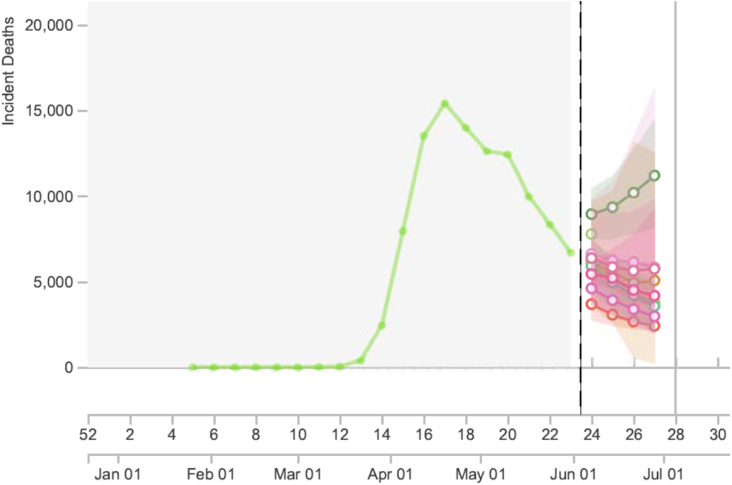
Epidemic forecasting has a dubious track-record, and its failures became more prominent with COVID-19. Poor data input, wrong modeling assumptions, high sensitivity of estimates, lack of incorporation of epidemiological features, poor past evidence on effects of available interventions, lack of transparency, errors, lack of determinacy, consideration of only one or a few dimensions of the problem at hand, lack of expertise in crucial disciplines, groupthink and bandwagon effects, and selective reporting are some of the causes of these failures. Nevertheless, epidemic forecasting is unlikely to be abandoned. Some (but not all) of these problems can be fixed. Careful modeling of predictive distributions rather than focusing on point estimates, considering multiple dimensions of impact, and continuously reappraising models based on their validated performance may help. If extreme values are considered, extremes should be considered for the consequences of multiple dimensions of impact so as to continuously calibrate predictive insights and decision-making. When major decisions (e.g. draconian lockdowns) are based on forecasts, the harms (in terms of health, economy, and society at large) and the asymmetry of risks need to be approached in a holistic fashion, considering the totality of the evidence.
疫情预测的记录不佳,随着新冠疫情的出现,其预测失败的情况愈发明显。数据输入不佳、建模假设错误、估计的高敏感性、未纳入流行病学特征、现有干预措施效果的过往证据不足、缺乏透明度、错误、缺乏确定性、仅考虑手头问题的一个或几个维度、关键学科缺乏专业知识、群体思维和跟风效应以及选择性报告等,都是导致这些失败的部分原因。尽管如此,疫情预测不太可能被放弃。其中一些(但不是全部)问题是可以解决的。仔细构建预测分布模型而非专注于点估计、考虑影响的多个维度,并根据模型的验证性能不断重新评估模型,可能会有所帮助。如果考虑极端值,那么对于影响的多个维度的后果都应考虑极端情况,以便不断校准预测见解和决策。当重大决策(如严格的封锁措施)基于预测做出时,需要从整体上考虑危害(在健康、经济和整个社会方面)以及风险的不对称性,同时考虑全部证据。