• 文献检索
  • 文档翻译
  • 深度研究
  • 学术资讯
  • Suppr Zotero 插件Zotero 插件
  • 邀请有礼
  • 套餐&价格
  • 历史记录
应用&插件
Suppr Zotero 插件Zotero 插件浏览器插件Mac 客户端Windows 客户端微信小程序
定价
高级版会员购买积分包购买API积分包
服务
文献检索文档翻译深度研究API 文档MCP 服务
关于我们
关于 Suppr公司介绍联系我们用户协议隐私条款
关注我们

Suppr 超能文献

核心技术专利:CN118964589B侵权必究
粤ICP备2023148730 号-1Suppr @ 2026

文献检索

告别复杂PubMed语法,用中文像聊天一样搜索,搜遍4000万医学文献。AI智能推荐,让科研检索更轻松。

立即免费搜索

文件翻译

保留排版,准确专业,支持PDF/Word/PPT等文件格式,支持 12+语言互译。

免费翻译文档

深度研究

AI帮你快速写综述,25分钟生成高质量综述,智能提取关键信息,辅助科研写作。

立即免费体验

武汉抗击新冠病毒之战何时结束:SEIR 模型分析

When will the battle against novel coronavirus end in Wuhan: A SEIR modeling analysis.

机构信息

Wuhan Ammunition Life-Tech Co Ltd, Wuhan, Hubei, China.

Clinics of Oilcrops Research Institute, CAAS, Wuhan, Hubei, China.

出版信息

J Glob Health. 2020 Jun;10(1):011002. doi: 10.7189/jogh.10.011002.

DOI:10.7189/jogh.10.011002
PMID:32257174
原文链接:https://pmc.ncbi.nlm.nih.gov/articles/PMC7125416/
Abstract

BACKGROUND

Recent outbreak of 2019-nCoV in Wuhan raised serious public health concerns. By February 15, 2020 in Wuhan, the total number of confirmed infection cases has reached 37 914, and the number of deaths has reached 1123, accounting for 56.9% of the total confirmed cases and 73.7% of the total deaths in China. People are eager to know when the epidemic will be completely controlled and when people's work and life will be on the right track.

METHOD

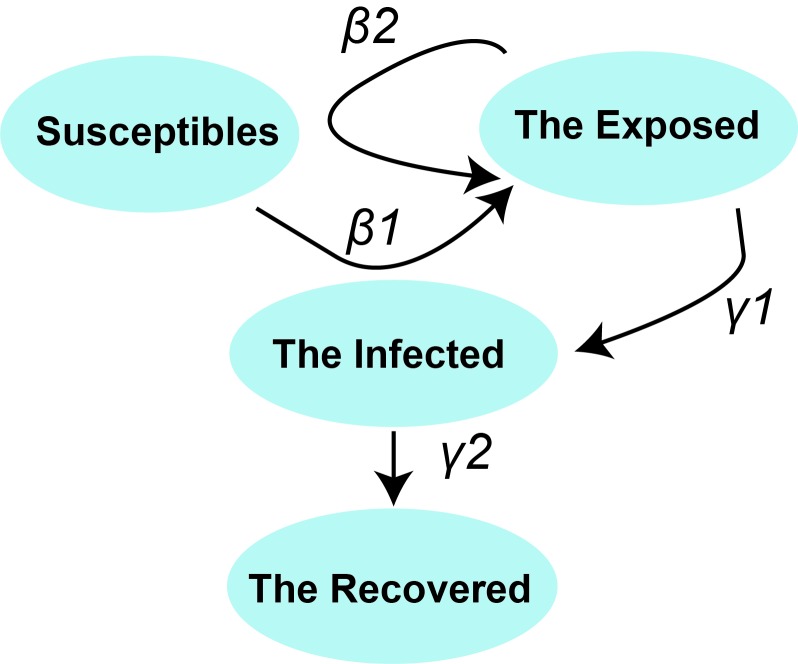
In this study we analyzed the epidemic dynamics and trend of 2019-nCoV in Wuhan by using the data after the closure of Wuhan city till February 12, 2020 based on the SEIR modeling method.

RESULTS

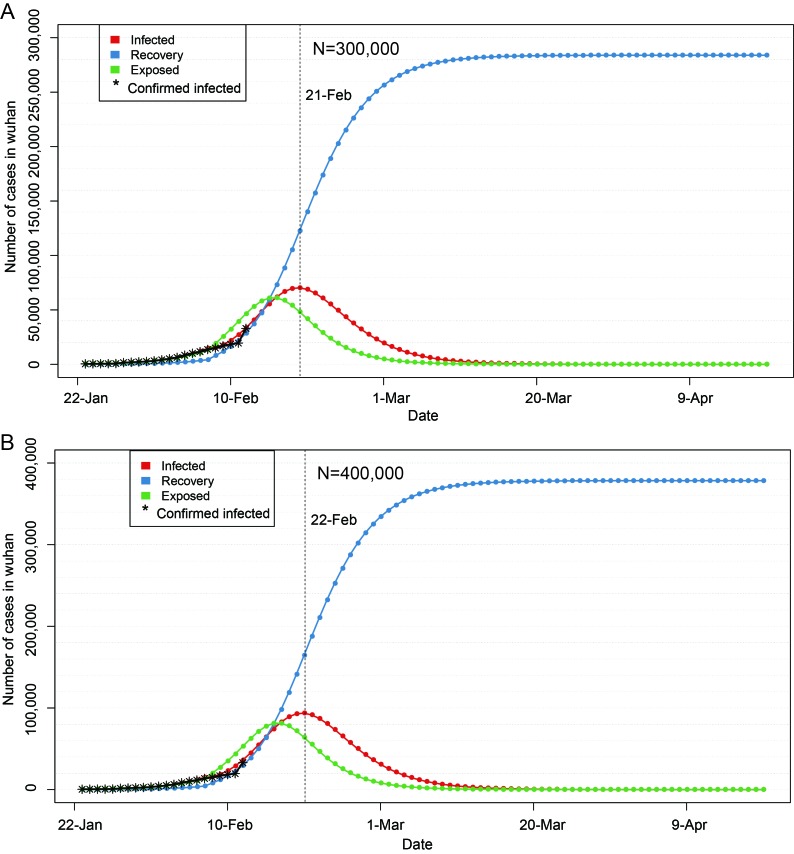
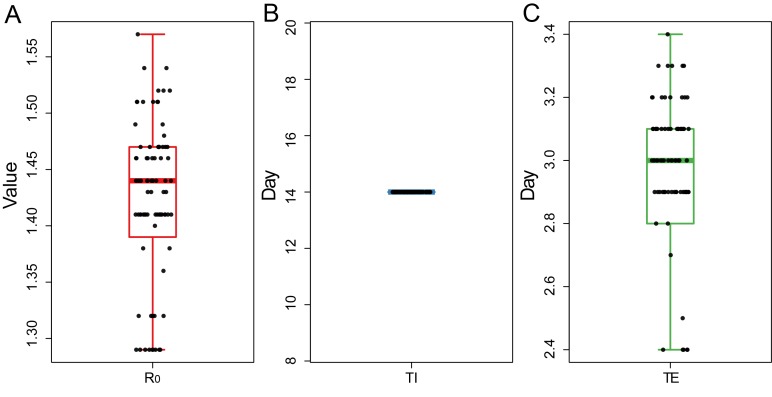
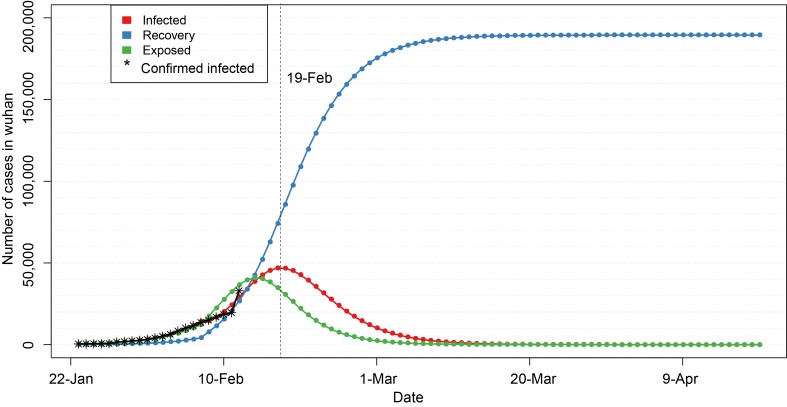
The optimal parameters were estimated as R = 1.44 (interquartile range: 1.40-1.47), TI = 14 (interquartile range = 14-14) and TE = 3.0 (interquartile range = 2.8-3.1). Based on these parameters, the number of infected individuals in Wuhan city may reach the peak around February 19 at about 47 000 people. Once entering March, the epidemic would gradually decline, and end around the late March. It is worth noting that the above prediction is based on the assumption that the number of susceptible population N = 200 000 will not increase. If the epidemic situation is not properly controlled, the peak of infected number can be further increased and the peak time will be a little postponed. It was expected that the epidemic would subside in early March, and disappear gradually towards the late March.

CONCLUSIONS

The epidemic situation of 2019-nCoV in Wuhan was effectively controlled after the closure of the city, and the disease transmission index also decreased significantly. It is expected that the peak of epidemic situation would be reached in late February and end in March.

摘要

背景

2019 年新型冠状病毒(2019-nCoV)在武汉爆发,引起了严重的公共卫生关注。截至 2020 年 2 月 15 日,武汉市累计确诊感染病例已达 37914 例,死亡 1123 例,分别占中国确诊病例总数的 56.9%和死亡病例总数的 73.7%。人们急切地想知道疫情何时能得到完全控制,人们的工作和生活何时能恢复正常。

方法

本研究采用 SEIR 模型方法,利用武汉市封城后截至 2020 年 2 月 12 日的数据,对 2019-nCoV 在武汉的疫情动态和趋势进行分析。

结果

估计的最优参数为 R=1.44(四分位间距:1.40-1.47),TI=14(四分位间距=14-14)和 TE=3.0(四分位间距=2.8-3.1)。基于这些参数,武汉市感染人数可能在 2 月 19 日左右达到峰值,约为 47000 人。一旦进入 3 月,疫情将逐渐下降,3 月底结束。值得注意的是,上述预测是基于假设易感人群数量 N=200000 不会增加的情况下得出的。如果疫情得不到有效控制,感染人数的峰值可能会进一步增加,峰值时间也会稍有推迟。预计疫情将在 3 月初得到控制,3 月底逐渐消失。

结论

武汉市封城后,2019-nCoV 疫情得到有效控制,疾病传播指数也显著下降。预计疫情高峰期将在 2 月底出现,3 月底结束。
https://cdn.ncbi.nlm.nih.gov/pmc/blobs/d926/7125416/aecf59039972/jogh-10-011002-F4.jpg
https://cdn.ncbi.nlm.nih.gov/pmc/blobs/d926/7125416/c6fb160c4458/jogh-10-011002-F1.jpg
https://cdn.ncbi.nlm.nih.gov/pmc/blobs/d926/7125416/139a35dad802/jogh-10-011002-F2.jpg
https://cdn.ncbi.nlm.nih.gov/pmc/blobs/d926/7125416/dc79f2054206/jogh-10-011002-F3.jpg
https://cdn.ncbi.nlm.nih.gov/pmc/blobs/d926/7125416/aecf59039972/jogh-10-011002-F4.jpg
https://cdn.ncbi.nlm.nih.gov/pmc/blobs/d926/7125416/c6fb160c4458/jogh-10-011002-F1.jpg
https://cdn.ncbi.nlm.nih.gov/pmc/blobs/d926/7125416/139a35dad802/jogh-10-011002-F2.jpg
https://cdn.ncbi.nlm.nih.gov/pmc/blobs/d926/7125416/dc79f2054206/jogh-10-011002-F3.jpg
https://cdn.ncbi.nlm.nih.gov/pmc/blobs/d926/7125416/aecf59039972/jogh-10-011002-F4.jpg

相似文献

1
When will the battle against novel coronavirus end in Wuhan: A SEIR modeling analysis.武汉抗击新冠病毒之战何时结束:SEIR 模型分析
J Glob Health. 2020 Jun;10(1):011002. doi: 10.7189/jogh.10.011002.
2
Covid-19 Outbreak Progression in Italian Regions: Approaching the Peak by the End of March in Northern Italy and First Week of April in Southern Italy.意大利各地区的新冠疫情进展:北部地区将于 3 月底达到高峰,南部地区将于 4 月初达到高峰。
Int J Environ Res Public Health. 2020 Apr 27;17(9):3025. doi: 10.3390/ijerph17093025.
3
Transmission patterns of COVID-19 in the mainland of China and the efficacy of different control strategies: a data- and model-driven study.中国大陆 COVID-19 的传播模式及不同防控策略的效果:基于数据和模型的研究。
Infect Dis Poverty. 2020 Jul 6;9(1):83. doi: 10.1186/s40249-020-00709-z.
4
[Fitting and forecasting the trend of COVID-19 by SEIR(+CAQ) dynamic model].基于SEIR(+CAQ)动态模型拟合与预测新型冠状病毒肺炎疫情趋势
Zhonghua Liu Xing Bing Xue Za Zhi. 2020 Apr 10;41(4):470-475. doi: 10.3760/cma.j.cn112338-20200216-00106.
5
The effect of control strategies to reduce social mixing on outcomes of the COVID-19 epidemic in Wuhan, China: a modelling study.控制策略对减少社交接触以控制中国武汉 COVID-19 疫情的效果:建模研究。
Lancet Public Health. 2020 May;5(5):e261-e270. doi: 10.1016/S2468-2667(20)30073-6. Epub 2020 Mar 25.
6
The effectiveness of quarantine of Wuhan city against the Corona Virus Disease 2019 (COVID-19): A well-mixed SEIR model analysis.武汉市对 2019 年冠状病毒病(COVID-19)的隔离措施的有效性:一个混合 SEIR 模型分析。
J Med Virol. 2020 Jul;92(7):841-848. doi: 10.1002/jmv.25827. Epub 2020 Apr 25.
7
Early epidemiological assessment of the transmission potential and virulence of coronavirus disease 2019 (COVID-19) in Wuhan City, China, January-February, 2020.2020 年 1 月至 2 月中国武汉市 2019 年冠状病毒病(COVID-19)传播潜力和毒力的早期流行病学评估。
BMC Med. 2020 Jul 15;18(1):217. doi: 10.1186/s12916-020-01691-x.
8
The SARS, MERS and novel coronavirus (COVID-19) epidemics, the newest and biggest global health threats: what lessons have we learned?严重急性呼吸综合征(SARS)、中东呼吸综合征(MERS)和新型冠状病毒(COVID-19)疫情,最新和最大的全球健康威胁:我们从中吸取了哪些教训?
Int J Epidemiol. 2020 Jun 1;49(3):717-726. doi: 10.1093/ije/dyaa033.
9
Potential Maternal and Infant Outcomes from (Wuhan) Coronavirus 2019-nCoV Infecting Pregnant Women: Lessons from SARS, MERS, and Other Human Coronavirus Infections.新型冠状病毒(2019-nCoV)感染孕妇的母婴潜在结局:来自 SARS、MERS 和其他人类冠状病毒感染的教训。
Viruses. 2020 Feb 10;12(2):194. doi: 10.3390/v12020194.
10
The First 75 Days of Novel Coronavirus (SARS-CoV-2) Outbreak: Recent Advances, Prevention, and Treatment.新型冠状病毒(SARS-CoV-2)爆发的前 75 天:最新进展、预防和治疗。
Int J Environ Res Public Health. 2020 Mar 30;17(7):2323. doi: 10.3390/ijerph17072323.

引用本文的文献

1
A multi-scale agent-based model of infectious disease transmission to assess the impact of vaccination and non-pharmaceutical interventions: The COVID-19 case.一种基于多尺度主体的传染病传播模型,用于评估疫苗接种和非药物干预措施的影响:以新冠疫情为例。
J Saf Sci Resil. 2021 Dec;2(4):199-207. doi: 10.1016/j.jnlssr.2021.08.005. Epub 2021 Sep 4.
2
SARS-CoV-2 transmission dynamics in Mozambique and Zimbabwe during the first 3 years of the pandemic.疫情头三年莫桑比克和津巴布韦的新冠病毒传播动态
R Soc Open Sci. 2025 Jan 22;12(1):241275. doi: 10.1098/rsos.241275. eCollection 2025 Jan.
3
Solving the stochastic dynamics of population growth.

本文引用的文献

1
Novel coronavirus 2019-nCoV (COVID-19): early estimation of epidemiological parameters and epidemic size estimates.新型冠状病毒 2019-nCoV (COVID-19):流行病学参数和疫情规模的早期估计。
Philos Trans R Soc Lond B Biol Sci. 2021 Jul 19;376(1829):20200265. doi: 10.1098/rstb.2020.0265. Epub 2021 May 31.
2
Clinical Characteristics of Coronavirus Disease 2019 in China.《中国 2019 年冠状病毒病临床特征》
N Engl J Med. 2020 Apr 30;382(18):1708-1720. doi: 10.1056/NEJMoa2002032. Epub 2020 Feb 28.
3
Preliminary prediction of the basic reproduction number of the Wuhan novel coronavirus 2019-nCoV.
解决种群增长的随机动力学问题。
Ecol Evol. 2023 Jul 30;13(8):e10295. doi: 10.1002/ece3.10295. eCollection 2023 Aug.
4
Epidemiologic Parameters for COVID-19: A Systematic Review and Meta-Analysis.新型冠状病毒肺炎的流行病学参数:一项系统综述与荟萃分析
Med J Islam Repub Iran. 2022 Dec 19;36:155. doi: 10.47176/mjiri.36.155. eCollection 2022.
5
Modeling the COVID-19 epidemic in Croatia: a comparison of three analytic approaches.建模克罗地亚的 COVID-19 疫情:三种分析方法的比较。
Croat Med J. 2022 Jun 22;63(3):295-298. doi: 10.3325/cmj.2022.63.295.
6
Application of genetic algorithm combined with improved SEIR model in predicting the epidemic trend of COVID-19, China.遗传算法与改进的 SEIR 模型在中国预测 COVID-19 疫情趋势中的应用。
Sci Rep. 2022 May 26;12(1):8910. doi: 10.1038/s41598-022-12958-z.
7
Predicting COVID-19 Cases From Atmospheric Parameters Using Machine Learning Approach.使用机器学习方法从大气参数预测新冠肺炎病例
Geohealth. 2022 Apr 1;6(4):e2021GH000509. doi: 10.1029/2021GH000509. eCollection 2022 Apr.
8
Prediction and Analysis of Tourist Management Strategy Based on the SEIR Model during the COVID-19 Period.基于 SEIR 模型的 COVID-19 期间旅游管理策略预测与分析。
Int J Environ Res Public Health. 2021 Oct 8;18(19):10548. doi: 10.3390/ijerph181910548.
9
Effectiveness of the movement control measures during the third wave of COVID-19 in Malaysia.马来西亚在 COVID-19 第三波疫情期间采取的运动控制措施的效果。
Epidemiol Health. 2021;43:e2021073. doi: 10.4178/epih.e2021073. Epub 2021 Sep 23.
10
An application of the ensemble Kalman filter in epidemiological modelling.集合卡尔曼滤波器在流行病学建模中的应用。
PLoS One. 2021 Aug 19;16(8):e0256227. doi: 10.1371/journal.pone.0256227. eCollection 2021.
2019 年新型冠状病毒(武汉)基本繁殖数的初步预测。
J Evid Based Med. 2020 Feb;13(1):3-7. doi: 10.1111/jebm.12376. Epub 2020 Feb 12.
4
Incubation period of 2019 novel coronavirus (2019-nCoV) infections among travellers from Wuhan, China, 20-28 January 2020.2020 年 1 月 20 日至 28 日,中国武汉旅行者感染 2019 年新型冠状病毒(2019-nCoV)的潜伏期。
Euro Surveill. 2020 Feb;25(5). doi: 10.2807/1560-7917.ES.2020.25.5.2000062.
5
Nowcasting and forecasting the potential domestic and international spread of the 2019-nCoV outbreak originating in Wuhan, China: a modelling study.实时预测和预报源自中国武汉的 2019-nCoV 疫情在国内和国际的潜在传播:一项建模研究。
Lancet. 2020 Feb 29;395(10225):689-697. doi: 10.1016/S0140-6736(20)30260-9. Epub 2020 Jan 31.
6
Early Transmission Dynamics in Wuhan, China, of Novel Coronavirus-Infected Pneumonia.新型冠状病毒感染肺炎在中国武汉的早期传播动力学。
N Engl J Med. 2020 Mar 26;382(13):1199-1207. doi: 10.1056/NEJMoa2001316. Epub 2020 Jan 29.
7
Hospital outbreak of Middle East respiratory syndrome coronavirus.医院中东呼吸综合征冠状病毒暴发。
N Engl J Med. 2013 Aug 1;369(5):407-16. doi: 10.1056/NEJMoa1306742. Epub 2013 Jun 19.
8
How generation intervals shape the relationship between growth rates and reproductive numbers.世代间隔如何塑造增长率与繁殖数之间的关系。
Proc Biol Sci. 2007 Feb 22;274(1609):599-604. doi: 10.1098/rspb.2006.3754.
9
Epidemiological determinants of spread of causal agent of severe acute respiratory syndrome in Hong Kong.香港严重急性呼吸系统综合症病原体传播的流行病学决定因素。
Lancet. 2003 May 24;361(9371):1761-6. doi: 10.1016/S0140-6736(03)13410-1.