School of Psychology, University of Nottingham, Nottingham, UK.
Presently at Laureate Institute for Brain Research, 6655 S Yale Avenue, Tulsa, OK, 74133, USA.
BMC Public Health. 2020 Jul 16;20(1):1114. doi: 10.1186/s12889-020-09094-6.
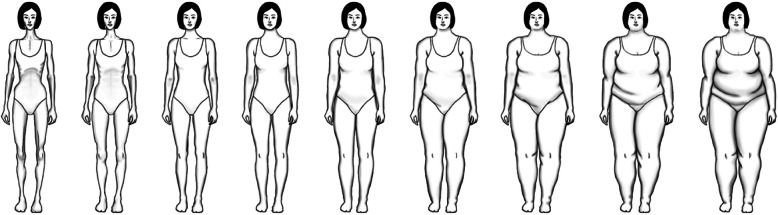
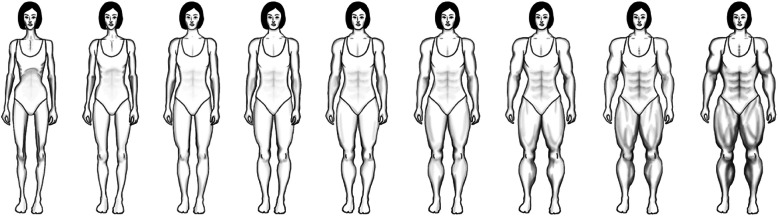
Body dissatisfaction influences women's mental and physical health. To date, most research has focused on body dissatisfaction in relation to the 'thin-ideal'. Thus, the association between body dissatisfaction, eating disorder symptomatology and muscularity-ideal in women is less clear. Lack of understanding is underpinned by the lack of reliable and valid muscularity-related assessments for women. To address this need, we developed, tested and re-tested two new body dissatisfaction scales: The Female Body Scale (FBS; adiposity dimension) and Female Fit Body Scale (FFITBS; muscularity dimension).
One hundred and fifty-two women in the United Kingdom rated which body figure best represented their current and ideal body, completed the Eating Disorder Examination Questionnaire (EDE-Q 6.0), and their body composition was measured. During re-test, the EDE-Q 6.0 and Drive for Muscularity Scale (DMS) were completed.
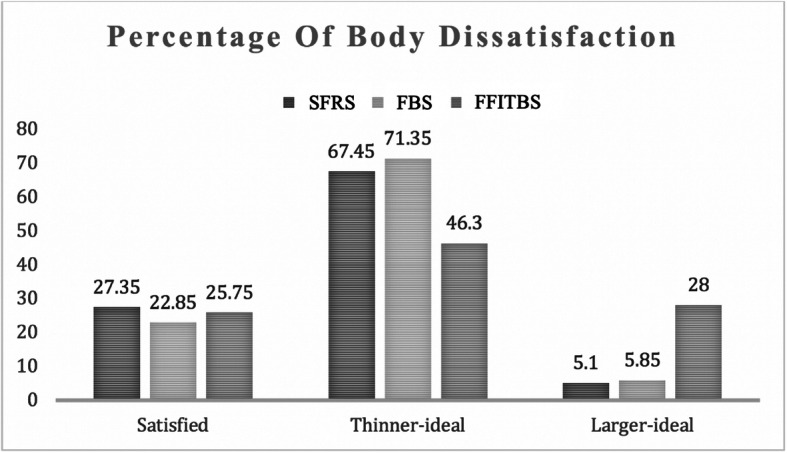
Both the FBS and the FFITBS were found to be valid and reliable, and distinct types of body dissatisfaction were identified. Higher EDE-Q scores corresponded with greater body dissatisfaction scores on both the FBS and FFITBS. Thin-ideal (FBS) and larger/muscularity-ideal (FFITBS) body dissatisfaction predicted higher scores on the DMS. The muscularity scale (FFITBS) uniquely revealed that 28% of participants indicated body dissatisfaction toward the larger-muscularity-ideal.
Results reveal distinct dimensions of body dissatisfaction. These new, validated scales may be utilized to quickly identify eating disorder risk in women as a preventative assessment for clinicians and inform female-focused body-image and eating disorder research.
身体不满会影响女性的身心健康。迄今为止,大多数研究都集中在与“瘦理想”相关的身体不满上。因此,身体不满、饮食障碍症状和女性对肌肉理想的关系尚不清楚。缺乏理解的原因是缺乏可靠和有效的与肌肉相关的女性评估。为了解决这一需求,我们开发、测试和重新测试了两种新的身体不满量表:女性身体量表(FBS;肥胖维度)和女性健康身体量表(FFITBS;肌肉维度)。
英国的 152 名女性对最能代表她们当前和理想体型的身体图像进行了评分,完成了饮食障碍检查问卷(EDE-Q 6.0),并测量了她们的身体成分。在重新测试期间,完成了 EDE-Q 6.0 和肌肉驱动量表(DMS)。
发现 FBS 和 FFITBS 都是有效和可靠的,并且确定了不同类型的身体不满。EDE-Q 评分越高,FBS 和 FFITBS 的身体不满评分也越高。瘦理想(FBS)和更大/肌肉理想(FFITBS)的身体不满预测了 DMS 的更高分数。肌肉量表(FFITBS)独特地表明,28%的参与者对更大的肌肉理想表示不满。
结果揭示了不同维度的身体不满。这些新的、经过验证的量表可用于快速识别女性的饮食障碍风险,作为临床医生的预防性评估,并为以女性为重点的身体形象和饮食障碍研究提供信息。