Department of Biomedical Engineering, Hanyang University, 222 Wangsimni-ro, Seongdong-gu, Seoul, 04763, Republic of Korea.
Department of Structure & Function of Neural Network, Korea Brain Research Institute, Daegu, Republic of Korea.
Sci Rep. 2020 Jul 16;10(1):11730. doi: 10.1038/s41598-020-68660-5.
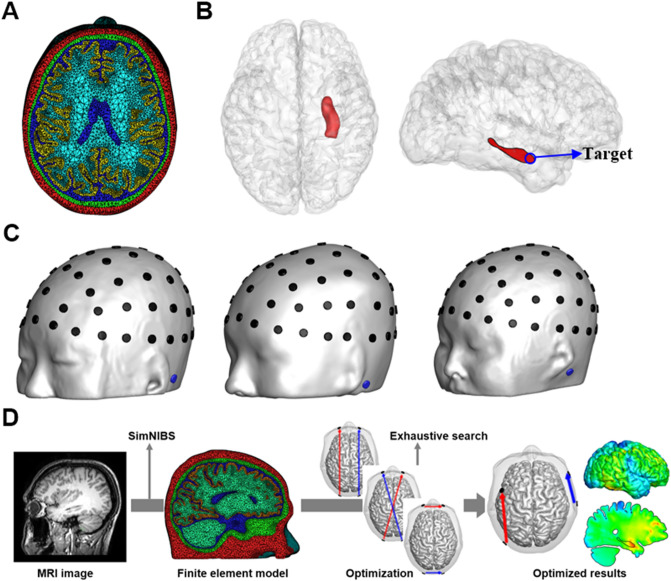
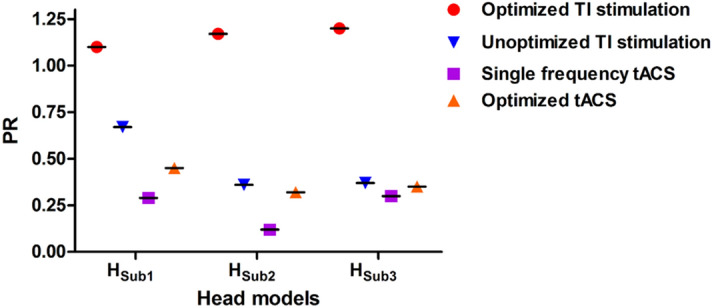
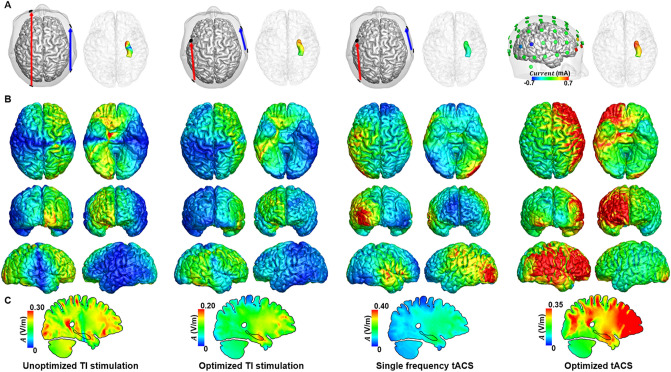
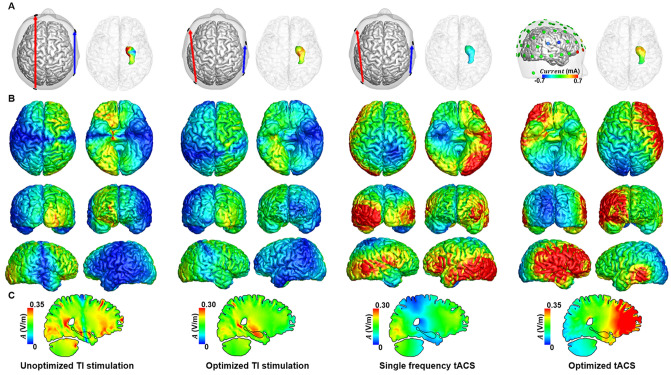
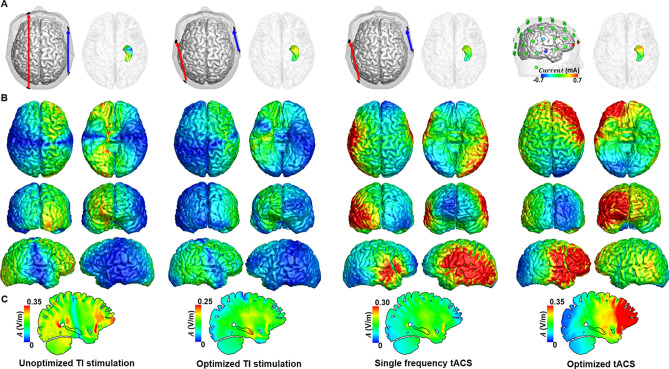
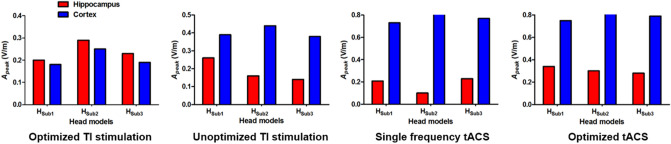
Temporal interference (TI) stimulation was recently proposed that allows for the stimulation of deep brain structures with neocortical regions being minimally stimulated. For human brain modulation, TI current patterns are known to be considerably affected by the complex structures of the human head, and thus, it is hard to deliver TI current to a specific deep brain region. In this study, we optimized scalp electrode configurations and injection currents that can deliver maximum TI stimulation currents to a specific deep brain region, the head of the right hippocampus in this study, considering the real anatomical head structures of each individual. Three realistic finite element (FE) head models were employed for the optimization of TI stimulation. To generate TI current patterns, two pairs of scalp electrodes were selected, which carry two sinusoidally alternating currents with a small frequency difference. For every possible combination of electrode pairs, optimal injection currents delivering the maximal TI currents to the head of the right hippocampus were determined. The distribution of the optimized TI currents was then compared with that of the unoptimized TI currents and the conventional single frequency alternating current stimulation. Optimization of TI stimulation parameters allows for the delivery of the desired amount of TI current to the target region while effectively reducing the TI currents delivered to cortical regions compared to the other stimulation approaches. Inconsistency of the optimal stimulation conditions suggest that customized stimulation, considering the individual anatomical differences, is necessary for more effective transcranial TI stimulation. Customized transcranial TI stimulation based on the numerical field analysis is expected to enhance the overall effectiveness of noninvasive stimulation of the human deep brain structures.
时间干扰(TI)刺激最近被提出,可以用最小程度刺激皮质区域的方式来刺激深部脑结构。对于人脑的调制,已知 TI 电流模式会受到人头复杂结构的显著影响,因此很难将 TI 电流输送到特定的深部脑区。在这项研究中,我们考虑到每个人的真实解剖头部结构,优化了头皮电极配置和注入电流,以将最大 TI 刺激电流输送到特定的深部脑区,即本研究中的右侧海马头。三个现实的有限元(FE)头部模型被用于 TI 刺激的优化。为了产生 TI 电流模式,选择了两对头皮电极,它们携带两个具有小频率差的正弦交流电。对于每对电极组合的所有可能组合,确定了输送到右侧海马头的最大 TI 电流的最佳注入电流。然后将优化后的 TI 电流的分布与未经优化的 TI 电流和传统的单频交流电刺激的分布进行比较。TI 刺激参数的优化允许在目标区域输送所需量的 TI 电流,同时与其他刺激方法相比,有效地减少输送到皮质区域的 TI 电流。优化刺激条件的不一致性表明,考虑到个体解剖差异,需要定制刺激,才能使经颅 TI 刺激更有效。基于数值场分析的定制经颅 TI 刺激有望提高对人类深部脑结构的非侵入性刺激的整体效果。