School of Physical Education and Sport Training, Shanghai University of Sport, Shanghai 200438, China.
School of Physical Education and Sport Training, Shanghai University of Sport, Shanghai 200438, China; Shanghai Research Centre for Physical Fitness and Health of Children and Adolescents, Shanghai University of Sport, Shanghai 200438, China.
J Sport Health Sci. 2021 May;10(3):349-359. doi: 10.1016/j.jshs.2020.07.002. Epub 2020 Jul 15.
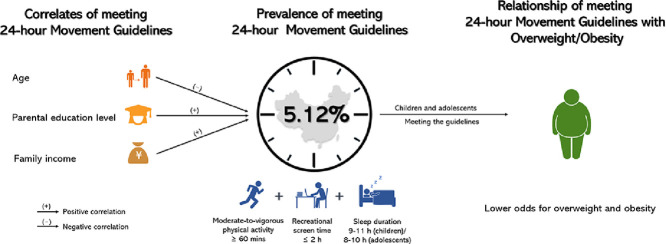
Meeting 24-h movement guidelines by children and adolescents has been associated with improved indicators of health, although it has been under-studied in China. Hence, this study aimed to investigate the prevalence of meeting the 24-h movement guidelines, its correlates, and its relationships with body mass index in children and adolescents in China.
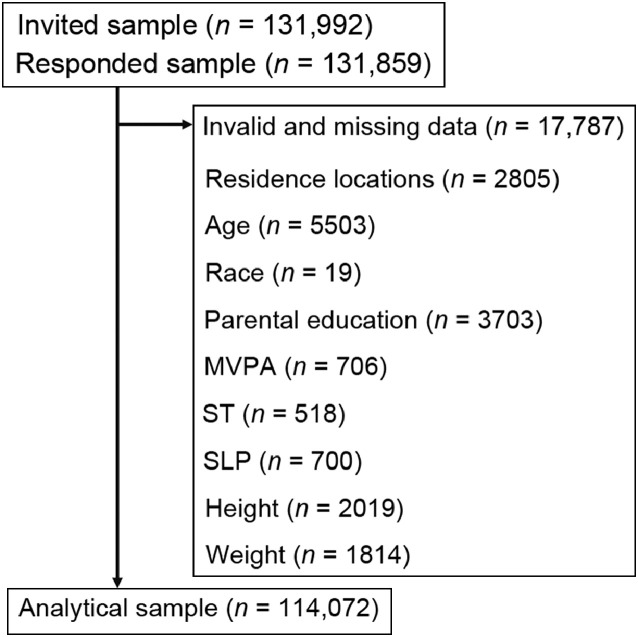
Cross-sectional data from the 2017 Youth Study in China of 114,072 children and adolescents (mean age = 13.75 years, 49.18% boys) were used. Meeting 24-h movement guidelines (≥60 min of daily moderate-to-vigorous physical activity, ≤2 h of daily leisure screen time, 9-11 h and 8-10 h nightly sleep duration for 6-13-year-olds and 14-17-year-olds, respectively) and height and weight of all participants were assessed. The prevalence of meeting the 24-h movement guidelines and World Health Organization weight status categories were determined. Generalized linear models were used to determine the correlates of meeting the 24-h movement guidelines and the relationships of meeting the 24-h movement guidelines with overweight (OW) and obesity (OB).
Only 5.12% of Chinese children and adolescents met the 24-h movement guidelines, and 22.44% were classified as OW/OB. Older children and adolescents were less likely to meet the 24-h movement guidelines. Parental education level and family income were positively related to meeting the 24-h movement guidelines. Children and adolescents meeting the 24-h movement guidelines showed lower odds ratios for OW/OB. Compared with participants meeting the 24-h movement guidelines, boys in 4th-6th grades met none of the recommendations (OR = 1.22, 95%CI: 1.06-1.40), met the screen time recommendation only (OR = 1.13, 95%CI: 1.01-1.28), met the nightly sleep duration recommendation only (OR = 1.14, 95%CI: 1.03-1.28), and had significantly higher odds ratios for OW/OB. Similar trends were observed for girls in 4th-6th grades: meeting none of the guidelines (OR = 1.35, 95%CI: 1.14-1.59), meeting sleep duration guidelines only (OR = 1.23, 95%CI: 1.08-1.39), and meeting moderate-to-vigorous physical activity + nightly sleep duration guidelines (OR = 1.24, 95%CI: 1.01-1.54). For girls in 7th-9th grades, the following trend was observed: meeting none of the guidelines (OR = 1.30, 95%CI: 1.01-1.67).
Very few Chinese children and adolescents met the 24-h movement guidelines. Age (negatively correlated), parental education level, and family income (both positively correlated) were correlates of meeting the 24-h movement guidelines. Children and adolescents meeting the 24-h movement guidelines were more likely to have lower risks for OW/OB, especially in the youngest age group (Grades 4-6); and girls in the middle age group (Grades 7-9) were also more likely to have lower risks for OW/OB. Further research studies should explore additional correlates and determinants for meeting the 24-h movement guidelines. Also, future studies should use longitudinal or interventional designs to determine the relationships between meeting the 24-h movement guidelines and OW/OB and other health indicators, while taking sex and age differences into account.
儿童和青少年达到 24 小时运动指南标准与健康指标的改善有关,但在中国,这方面的研究还很少。因此,本研究旨在调查中国儿童和青少年达到 24 小时运动指南标准的流行率、其相关因素,以及与身体质量指数(BMI)的关系。
本研究使用了 2017 年中国青少年研究的横断面数据,共纳入 114072 名儿童和青少年(平均年龄 13.75 岁,49.18%为男性)。评估了他们的日常中等到剧烈运动时间(≥60 分钟)、日常休闲屏幕时间(≤2 小时)、6-13 岁和 14-17 岁儿童和青少年的夜间睡眠时间(9-11 小时和 8-10 小时)。评估了所有参与者的身高和体重。确定了达到 24 小时运动指南的流行率和世界卫生组织体重状况分类。采用广义线性模型确定达到 24 小时运动指南的相关因素,以及达到 24 小时运动指南与超重(OW)和肥胖(OB)的关系。
只有 5.12%的中国儿童和青少年达到了 24 小时运动指南标准,22.44%的儿童和青少年被归类为 OW/OB。年龄较大的儿童和青少年不太可能达到 24 小时运动指南标准。父母的教育水平和家庭收入与达到 24 小时运动指南标准呈正相关。达到 24 小时运动指南标准的儿童和青少年超重/肥胖的可能性较低。与达到 24 小时运动指南标准的参与者相比,四年级至六年级的男生没有达到任何建议(OR=1.22,95%CI:1.06-1.40),只达到了屏幕时间建议(OR=1.13,95%CI:1.01-1.28),只达到了夜间睡眠时间建议(OR=1.14,95%CI:1.03-1.28),超重/肥胖的可能性显著较高。四年级至六年级的女生也有类似的趋势:没有达到任何指南(OR=1.35,95%CI:1.14-1.59),只达到了睡眠时长建议(OR=1.23,95%CI:1.08-1.39),只达到了中等到剧烈运动和夜间睡眠时间建议(OR=1.24,95%CI:1.01-1.54)。对于七年级至九年级的女生,观察到以下趋势:没有达到任何指南(OR=1.30,95%CI:1.01-1.67)。
很少有中国儿童和青少年达到 24 小时运动指南标准。年龄(负相关)、父母的教育水平和家庭收入(均呈正相关)是达到 24 小时运动指南标准的相关因素。达到 24 小时运动指南标准的儿童和青少年超重/肥胖的风险较低,尤其是年龄较小的儿童(四年级至六年级);年龄较大的女生(七年级至九年级)也有较低的超重/肥胖风险。需要进一步的研究来探索达到 24 小时运动指南标准的其他相关因素和决定因素。此外,未来的研究应该使用纵向或干预性设计,同时考虑到性别和年龄差异,确定达到 24 小时运动指南标准与超重/肥胖和其他健康指标之间的关系。