From the Department of Clinical Science (D.B., J.L., L.F., N.L.), Neurosciences, and Department of Radiation Sciences (S.J.M., K.R.), Diagnostic Radiology and Umeå Center for Functional Brain Imaging, Umeå University; Department of Psychiatry and Neurochemistry (H.Z., K.B.), Institute of Neuroscience and Physiology, the Sahlgrenska Academy at the University of Gothenburg; Clinical Neurochemistry Laboratory (H.Z., K.B.), Sahlgrenska University Hospital, Mölndal, Sweden; Department of Neurodegenerative Disease (H.Z.), UCL Queen Square Institute of Neurology; and UK Dementia Research Institute at UCL (H.Z.), London, UK.
Neurology. 2020 Aug 18;95(7):e827-e838. doi: 10.1212/WNL.0000000000010084. Epub 2020 Jul 17.
To determine whether neurofilament light chain protein in CSF (cNfL), a sensitive biomarker of neuroaxonal damage, reflects disease severity or can predict survival in Parkinson disease (PD).
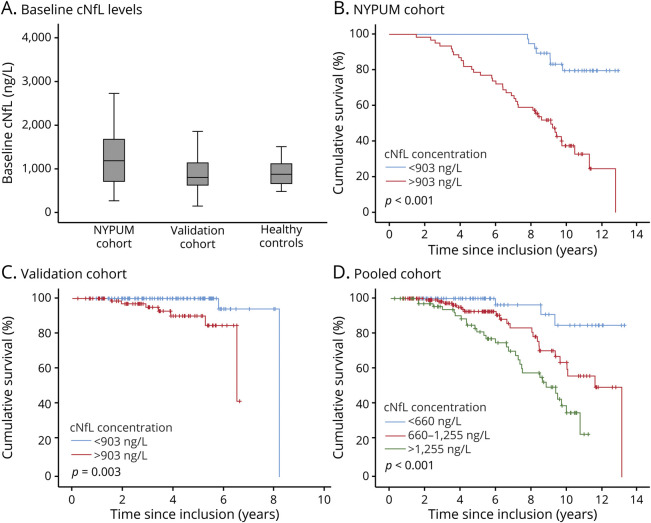
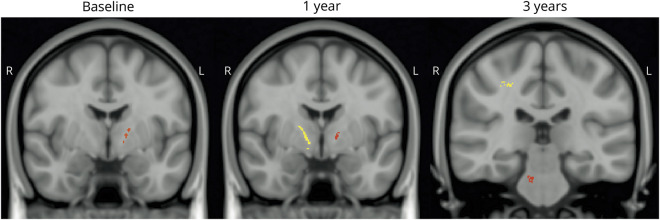
We investigated whether disease severity, phenotype, or survival in patients with new-onset PD correlates with cNfL concentrations around the time of diagnosis in the population-based New Parkinsonism in Umeå (NYPUM) study cohort (n = 99). A second, larger new-onset PD cohort (n = 194) was used for independent validation. Association of brain pathology with the cNfL concentration was examined with striatal dopamine transporter imaging and repeated diffusion tensor imaging at baseline and 1 and 3 years.
Higher cNfL in the early phase of PD was associated with greater severity of all cardinal motor symptoms except tremor in both cohorts and with shorter survival and impaired olfaction. cNfL concentrations above the median of 903 ng/L conferred an overall 5.8 times increased hazard of death during follow-up. After adjustment for age and sex, higher cNfL correlated with striatal dopamine transporter uptake deficits and lower fractional anisotropy in diffusion tensor imaging of several axonal tracts.
cNfL shows usefulness as a biomarker of disease severity and to predict survival in PD. The present results indicate that the cNfL concentration reflects the intensity of the neurodegenerative process, which could be important in future clinical trials.
This study provides Class II evidence that in patients with PD, cNfL concentrations are associated with more severe disease and shorter survival.
确定脑脊液中的神经丝轻链蛋白(cNfL)是否反映疾病严重程度或可预测帕金森病(PD)患者的生存情况,cNfL 是神经轴突损伤的一种敏感生物标志物。
我们研究了新发 PD 患者的疾病严重程度、表型或生存情况是否与基于人群的于默奥新帕金森症(NYPUM)研究队列中诊断时周围 cNfL 浓度相关(n=99)。第二项更大的新发 PD 队列(n=194)用于独立验证。用纹状体多巴胺转运蛋白成像和基线及 1 年和 3 年时的重复弥散张量成像来检查脑病理与 cNfL 浓度的相关性。
在两个队列中,PD 早期阶段的 cNfL 越高,除了震颤之外,所有主要运动症状的严重程度越大,且生存时间越短,嗅觉越受损。cNfL 浓度超过中位数 903ng/L,随访期间死亡的整体风险增加 5.8 倍。调整年龄和性别后,较高的 cNfL 与纹状体多巴胺转运蛋白摄取缺陷以及几个轴突束弥散张量成像中的分数各向异性降低相关。
cNfL 可作为 PD 疾病严重程度的生物标志物并预测生存。目前的结果表明,cNfL 浓度反映了神经退行性过程的强度,这在未来的临床试验中可能很重要。
本研究提供了 II 级证据,表明在 PD 患者中,cNfL 浓度与更严重的疾病和更短的生存时间相关。